answer.
Ask question
Login Signup
Ask question
All categories
  • English
  • Mathematics
  • Social Studies
  • Business
  • History
  • Health
  • Geography
  • Biology
  • Physics
  • Chemistry
  • Computers and Technology
  • Arts
  • World Languages
  • Spanish
  • French
  • German
  • Advanced Placement (AP)
  • SAT
  • Medicine
  • Law
  • Engineering
Simora [160]
2 years ago
3

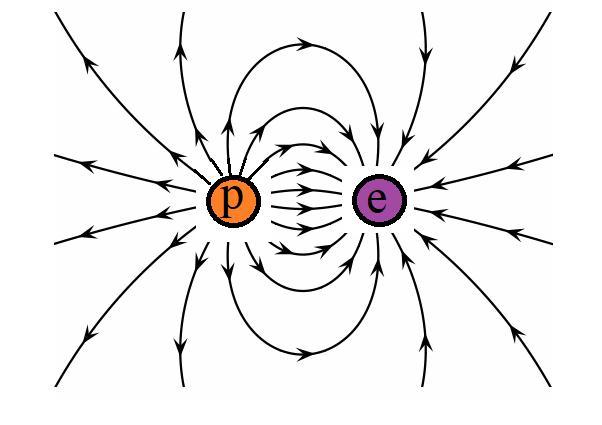
Draw the electric field lines between a proton and an electron. According to Coulomb's law, how would the electrical force betwe

en these particles change if the product of their electrical charge increased?

Chemistry
1 answer:
erica [24]2 years ago
4 0

Explanation:

An electron has a negative charge and a proton is a positively charged particle. Electric field lines are used to express the direction of the electric field. For a positive charge, it is outwards while for a negative charge it is inwards. The attached figure shows the electric field lines between a proton and an electron. The field lines emerge from proton and terminate at electron.

The electrical force between charges is given by :

F=k\dfrac{q_1q_2}{r^2}

r is the distance between charges

The force is directly proportional to the product of charges. It means that if the product of electrical charge increased, it means that the electrical force will increase proportionally.

You might be interested in
Choose the answer in which the three atoms and/or ions are listed in order of increasing EXPECTED size (smallest particle listed
svp [43]

Answer:

Ar < Cl - < S2-

Explanation:

All the species written above are isoelectronic. This means that they all possess the same number of electrons. All the species above possess 18 electrons, the noble gas electron configuration.

However, for isoelectronic species, the greater the atomic number of the specie, the smaller it is. This is because, greater atomic number implies that their are more protons in the nucleus exerting a greater attractive force on the electrons thereby making the specie smaller in size due to high electrostatic attraction.

8 0
2 years ago
The piece of iron that miguel measured had a mass of 51.1 g and a volume of 6.63 cm 3 . what did miguel calculate to be the dens
likoan [24]
Given:
Mass, m = 51.1 g
Volume, V = 6.63 cm³

By definition, 
Density = Mass/Volume
              = (51.1 g)/(6.63 cm³)
              = 7.7074 g/cm³

In SI units,
Density = (7.7074 g/cm³)*(10⁻³ kg/g)*(10² cm/m)³
              = 7707.4 kg/m³

Answer: 7.707 g/cm³ or 7707.4 kg/m³

4 0
2 years ago
The successive ionization energies of a certain element are I1= 577.9 kJ/mol, I2 = 1820 kJ/mol, I3= 2750 kJ/mol, I4 = 11,600 kJ/
Maksim231197 [3]

Answer:

Aluminium

Explanation:

Ionization energy is the amount of energy needed to remove an electron from a gaseous atom to form a gaseous ion.

The difference between the third and fourth ionization energies is great. This indicates a group III element which is in the third period.

This element is Aluminium (Al)

6 0
2 years ago
By mistake, you added salt instead of sugar to the<br> oil. How can you remove the salt?
Jet001 [13]

Answer:

by adding water into the mix

Explanation:

this will dissolve the salt

5 0
2 years ago
Read 2 more answers
The nitrogen content of organic compounds can be determined by the Dumas method. The compound in question is first reacted by pa
MAVERICK [17]

Answer:

Mass percent of nitrogen in the compound is 13,3%

Explanation:

Dumas method is an analytical method to determine nitrogen content in samples, thus:

CₐHₓNₙ + (2a+x/2) CuO  → aCO₂ +  ˣ/₂ H₂O +  ⁿ/₂ N₂ + (2a+x/2) Cu

As the CO₂ is removed with KOH, in the mixture you have H₂O and N₂

At 25°C. the vapor pressure of water is 23,8 torr, that means that the pressure due to N₂ is:

726torr - 23,8torr = 702,2 torr.

Using gas law:

n = PV/RT

Where:

P is pressure (702,2torr≡ 0,924 atm)

V is volume (0,0318L)

R is gas constant (0,082atmL/molK)

And T is temperature (25°C≡298,15K)

Replacing, number of moles of N₂, n, are:

n = 1,20x10⁻³moles of N₂. In grams:

1,20x10⁻³moles of N₂×\frac{28g}{1mol} =<em> 0,0336 g of N₂</em>.

Thus, mass percent of nitrogen in the compound is:

\frac{0,0336g N}{0,253gSample}×100= <em>13,3%</em>

<em></em>

I hope it helps!
7 0
2 years ago
Other questions:
  • In [cu(nh3)4]co3, how many 3d electrons does copper have?
    5·1 answer
  • An atom of beryllium (m = 8.00 u) splits into two atoms of helium (m = 4.00 u) with the release of 92.2 kev of energy. if the or
    10·2 answers
  • How does 0.5 m sucrose (molecular mass 342) solution compare to 0.5 m glucose (molecular mass 180) solution?
    8·2 answers
  • Which equation shows the proper setup to find the volume of a 0.250 M CaCl2 solution that contains 39.5 g of CaCl2?
    11·2 answers
  • Which of the following is a valid conversion factor?
    15·2 answers
  • What is the reaction energy Q of this reaction? Use c2=931.5MeV/u. Express your answer in millions of electron volts to three si
    7·1 answer
  • This is the chemical formula for methyl acetate: CH32CO2. Calculate the mass percent of hydrogen in methyl acetate. Round your a
    9·1 answer
  • a carbon-12 atom has a mass defect of 0.9564 amu. what is its nuclear binding energy? round to 3 significant figures.
    9·2 answers
  • Identify and calculate the number of representative particles in 2.15 moles of gold.<br>​
    13·1 answer
  • Two substances in a mixture differ in density and particle size. These properties can be used to
    7·1 answer
Add answer
Login
Not registered? Fast signup
Signup
Login Signup
Ask question!