answer.
Ask question
Login Signup
Ask question
All categories
  • English
  • Mathematics
  • Social Studies
  • Business
  • History
  • Health
  • Geography
  • Biology
  • Physics
  • Chemistry
  • Computers and Technology
  • Arts
  • World Languages
  • Spanish
  • French
  • German
  • Advanced Placement (AP)
  • SAT
  • Medicine
  • Law
  • Engineering
Brilliant_brown [7]
2 years ago
13

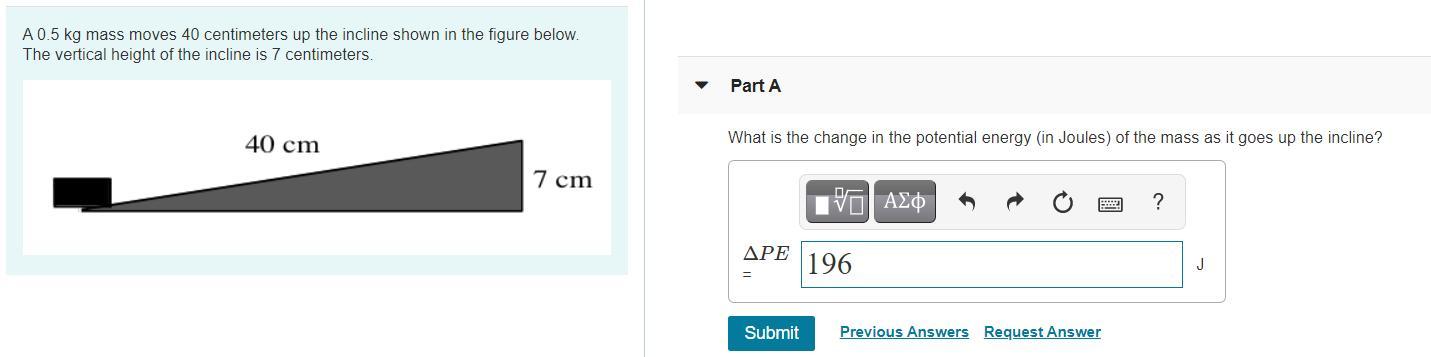
A 0.5 kg mass moves 40 centimeters up the incline shown in the figure below. The vertical height of the incline is 7 centimeters

. What is the change in the potential energy (in Joules) of the mass as it goes up the incline?

Physics
1 answer:
Tanya [424]2 years ago
5 0

Answer:

The change in potential energy of the mass as it goes up the incline is 0.343 joules.

Explanation:

We must remember in this case that change in the potential energy is entirely represented by the change in the gravitational potential energy. From Work-Energy Theorem and definition of work we get that:

U_{g}= m\cdot g\cdot \Delta y

Where:

U_{g} - Gravitational potential energy, measured in Joules.

m - Mass, measured in kilograms.

g - Gravitational acceleration, measured in meters per square second.

\Delta y - Change in vertical height, measured in meters.

This work is the energy needed to counteract effects of gravity at given vertical displacement.

If we know that m = 0.5\,kg, g = 9.807\,\frac{m}{s^{2}} and \Delta y = 0.07\,m, the change in the potential energy of the mass as it goes up the incline is:

U_{g} = (0.5\,kg)\cdot \left(9.807\,\frac{m}{s^{2}} \right)\cdot (0.07\,m)

U_{g} = 0.343\,J

The change in potential energy of the mass as it goes up the incline is 0.343 joules.
You might be interested in
One of the main factors driving improvements in the cost and complexity of integrated circuits (ICs) is improvements in photolit
nika2105 [10]

Answer:

0.000003782 m

0.000001891 m

0.000001197125 m

Explanation:

\lambda = Wavelength = 248 nm

D = Diameter of beam = 1 cm

f = Focal length = 0.625 cm

The angle is given by

\theta=\dfrac{1.22\lambda}{D}

The width is given by

d=2\theta f\\\Rightarrow d=2\dfrac{1.22\lambda f}{D}\\\Rightarrow d=2\dfrac{1.22\times 248\times 10^{-9}\times 6.25\times 10^{-2}}{1\times 10^{-2}}\\\Rightarrow d=0.000003782\ m

The required width is 0.000003782 m

Minimum resolvable line separation is given by

\dfrac{0.000003782}{2}=0.000001891\ m

The minimum resolvable line separation between adjacent lines is 0.000001891 m

when \lambda=157\ nm

d=2\dfrac{1.22\times 157\times 10^{-9}\times 6.25\times 10^{-2}}{1\times 10^{-2}}\\\Rightarrow d=0.00000239425\ m

The new minimum resolvable line separation between adjacent lines is

\dfrac{0.00000239425}{2}=0.000001197125\ m

6 0
2 years ago
7. A local sign company needs to install a new billboard. The signpost is 30 m tall, and the ladder truck is parked 24 m away fr
wolverine [178]
<h2>Solution :</h2>

Here ,

• Height of sign post = 30 m

• Distance between signpost and truck = 24 m

Let the

• Top of signpost = A

• Bottom of signpost = B

• The end of truck facing sign post be = C

Now as we can clearly imagine that the ladder will act as an hypotenuse to the Triangle ABC .

Where

• AB = Height of signpost = 30 m

• BC = distance between both = 24 m

• AC = Minimum length of ladder

→ AC² = AB² + BC² ( As we can see AB is perpendicular to BC )

→ AC² = (30)² + (24)²

→ AC² = 900 + 576

→ AC² = 1476

→ AC = 38.41875

or AC apx = 38.42

So minimum height of ladder = 38.42

6 0
2 years ago
The howler monkey is the loudest land animal and, under some circumstances, can be heard up to a distance of 8.9 km. Assume the
exis [7]

Answer:

113.7

Explanation:

maximum distance (s) = 8.9 km

reference intensity (I0) = 1 x 10^{-12} W/m^{2}

power of a juvenile howler monkey (p) = 63 x 10^{-6} W

distance (r) = 210 m

intensity (I) = power/area

where we assume the area of a sphere due to the uniformity of the output in all directions

area = 4πr^{2} =  4π x 210^{2} = 554,176.9 m^{2}

intensity (I) = \frac{63 x 10^{-6} }{554,176.9} = 113.7 x 10^{-12}

therefore the desired ratio I/I0 = \frac{113.7 x 10^{-12}}{1 x 10^{-12}} = 113.7

7 0
2 years ago
In an adiabatic process oxygen gas in a container is compressed along a path that can be described by the following pressure p,
viktelen [127]

Answer:

Explanation:

In case of gas , work done

W = ∫ p dV , p is pressure and dV is small change in volume

the limit of integration is from Vi to Vf .

= ∫ p dV

=  ∫ p₀V^{-\frac{6}{5}  dV

= p₀ V^{-\frac{6}{5} +1} / ( \frac{-6}{5} +1 )

=  - 5p₀ V^{-\frac{1}{5}

Taking limit from Vi  to Vf

W = - 5 p₀ ( V_f^\frac{-1}{5} - V_i^{\frac{-1}{5}  ) ltr- atm.

7 0
2 years ago
Two forces F1 and F2 act on a 5.00 kg object. Taking F1=20.0N and F2=15.00N, find the acceleration of the object for the configu
Anit [1.1K]
A) mass m with F1 acting in the positive x direction and F2 acting perpendicular in the positive y direction<span>

m = 5.00 kg
F1=20.0N  ... x direction
F2=15.00N</span><span>  ... y direction

Net force ^2 = F1^2 + F2^2 = (20N)^2 + (15n)^2 =  625N^2 =>

Net force = √625 = 25N

F = m*a => a = F/m = 25.0 N /5.00 kg = 5 m/s^2

Answer: 5.00 m/s^2

b) mass m with F1 acting in the positive x direction and F2 acting on the object at 60 degrees above the horizontal. </span>

<span>m = 5.00 kg
F1=20.0N  ... x direction
F2=15.00N</span><span>  ... 60 degress above x direction

Components of F2

F2,x = F2*cos(60) = 15N / 2 = 7.5N

F2, y = F2*sin(60) = 15N* 0.866 = 12.99 N ≈ 13 N


Total force in x = F1 + F2,x = 20.0 N + 7.5 N = 27.5 N

Total force in y = F2,y = 13.0 N

Net force^2 = (27.5N)^2 + (13.0N)^2 = 925.25 N^2 = Net force = √(925.25N^2) =

= 30.42N

a = F /m = 30.42 N / 5.00 kg = 6.08 m/s^2

Answer: 6.08 m/s^2


</span>
8 0
2 years ago
Read 2 more answers
Other questions:
  • A boat takes off from the dock at 2.5 m/s and speeds up at 4.2 m/s2 for 6.0 s. How far has the boat traveled? Round your answer
    10·2 answers
  • You are waiting to turn left into a small parking lot. a car approaching from the opposite direction has a turn signal on. you s
    14·1 answer
  • What is the rate of heat transfer by radiation, with an unclothed person standing in a dark room whose ambient temperature is 22
    15·1 answer
  • A sleep time of 15.9 hours per day for a newborn baby is at the 10th percentile of the distribution of sleep times for all newbo
    13·1 answer
  • A 91.5 kg football player running east at 2.73 m/s tackles a 63.5 kg player running east at 3.09 m/s. what is their velocity aft
    15·1 answer
  • A meteoroid, heading straight for Earth, has a speed of 14.8 km/s relative to the center of Earth as it crosses our moon's orbit
    5·1 answer
  • An astronaut holds a rock 100m above the surface of Planet XX. The rock is then thrown upward with a speed of 15m/s, as shown in
    11·1 answer
  • A molecule of ethanol has two carbon atoms, six hydrogen atoms, and one oxygen atom. A ball-and-stick model of a molecule of eth
    5·1 answer
  • The Problems: 1. Xavier starts at a position of 0 m and moves with an average speed of 0.50 m/s for 3.0 seconds. He normally mov
    7·1 answer
  • A balloon tied up with a wooden piece is moving upward with velocity of 15m/s. At a height of 300m above the ground, the wooden
    10·1 answer
Add answer
Login
Not registered? Fast signup
Signup
Login Signup
Ask question!
