answer.
Ask question
Login Signup
Ask question
All categories
  • English
  • Mathematics
  • Social Studies
  • Business
  • History
  • Health
  • Geography
  • Biology
  • Physics
  • Chemistry
  • Computers and Technology
  • Arts
  • World Languages
  • Spanish
  • French
  • German
  • Advanced Placement (AP)
  • SAT
  • Medicine
  • Law
  • Engineering
Alik [6]
2 years ago
4

List the salts in order from weakest to strongest lattice energy. Just input numbers, so if you think the order is 1234 enter 12

34 (so calcium oxide the weakest then sodium chloride etc) 1. calcium oxide 2. sodium chloride 3. calcium chloride 4. aluminum chloride
Chemistry
1 answer:
Dovator [93]2 years ago
4 0

Answer:

1324

Explanation:

Lattice energy is defined as the energy required to released when ions are combined to make a compound. Lattice energy depends on the charge on the ions, and the size of the ion, small is the size strong is the lattice energy.

The salts in order from weakest to strongest lattice energy are calcium oxide, calcium chloride, sodium chloride, and aluminum chloride.

Aluminum chloride has strongest lattice energy because aluminum share its three valence electrons with three chlorides and form a very stable ion that results in a small size of the Aluminum chloride.

Calcium oxide has the smallest lattice energy because the charge on the ions is 2 cations (Calcium) and 2 anions (oxide) while calcium chloride have 2 cations and one anion.

Hence, the correct answer is "1324".

You might be interested in
The reaction N2 + 3 H2 → 2 NH3 is used to produce ammonia. When 450. g of hydrogen was reacted with nitrogen, 1575 g of ammonia
tiny-mole [99]

Answer:

The percent yield of this reaction is 70%

Explanation:

The reaction is: N₂ + 3H₂ → 2NH₃

We only have the mass of H₂, so we assume that N₂ is in excess

We convert the mass to moles, to work with the reaction:

450 g . 1mol / 2 g = 225 moles

Ratio is 2:3. 3 moles of H₂ can produce 2 moles of ammonia

Therefore 225 moles of H₂ will produce (225 .2)/ 3 = 150 moles

This is the 100% yield reaction → We convert the moles of NH₃ to mass

150 mol . 17g /1mol = 2550 g

Percent yield = (Produced yield/Theoretical yield) .100

Percent yield = (1575g/2550g) . 100 = 70%

7 0
2 years ago
Calculate the empirical formula for each of the following substances. (Express answer as a chemical formula) 1) 2.90 g of Ag and
exis [7]

Answer:

1) Ag3N

2)Na2S

3)NaHSO4

4) KNO3

Explanation:

We divide each mass by the element's relative atomic mass

1) 2.90/108-Ag, 0.125/14-N

0.027-Ag, 0.0089-N

Divide by the lowest ratio

0.027/0.0089-Ag, 0.0089/0.0089 N

3-Ag, 1-N

Empirical formula- Ag3N

2)2.22/23-Na, 1.55/32-S

0.097-Na, 0.048-S

Divide by the lowest ratio

0.097/0.048-Na, 0.048/0.048-S

2-Na, 1-S

Empirical formula- Na2S

3) 2.11/23-Na, 0.0900/1-H, 2.94/32-S,5.86/16-O

0.09-Na, 0.09-H, 0.09-S,0.366-O

Divide by the lowest ratio

0.09/0.09-Na, 0.09/0.09-H, 0.09/0.09-S, 0.366/0.09-O

1-Na, 1-H, 1-S, 4-O

Empirical formula- NaHSO4

4)1.84/39, 0.657/14-N, 2.25/16-O

0.047-K, 0.047-N, 0.14-O

Divide through by the lowest ratio

0.047/0.047-K, 0.047/0.047-N, 0.14/0.047-O

1-K, 1-N, O-3

Empirical formula- KNO3

4 0
2 years ago
Find the age t of a sample, if the total mass of carbon in the sample is mc, the activity of the sample is a, the current ratio
Paha777 [63]
N₀ is the number of C-14 atoms per kg of carbon in the original sample at time = Os when its carbon was of the same kind as that present in the atmosphere today. After time ts, due to radioactive decay, the number of C-14 atoms per kg of carbon is the same sample which has decreased to N. λ is the radioactive decay constant.
Therefore N = N₀e-λt which is the radioactive decay equation,
N₀/N = eλt In (N₀.N= λt. This is the equation 1
The mass of carbon which is present in the sample os mc kg. So the sample has a radioactivity of A/mc decay is/kg. r is the mass of C-14 in original sample at t= 0 per total mass of carbon in a sample which is equal to [(total number of C-14 atoms in the sample at t m=m 0) × ma]/ total mass of carbon in the sample.
Now that the total number of C-14 atoms in the sample at t= 0/ total mass of carbon in sample = N₀ then r = N₀×ma
So N₀ = r/ma. this equation 2.
 The activity of the radioactive substance is directly proportional to the number of atoms present at the time.
Activity = A number of decays/ sec = dN/dt = λ(number of atoms of C-14 present at time t) = 
λ₁(N×mc). By rearranging we get N = A/(λmc) this is equation 3.
By plugging in equation 2 and 3 and solve t to get
t = 1/λ In (rλmc/m₀A).

6 0
2 years ago
Zinc metal is added to hydrochloric acid to generate hydrogen gas and is collected over a liquid whose vapor pressure is the sam
mafiozo [28]

Question:

Zinc metal is added to hydrochloric acid to generate hydrogen gas and is collected over a liquid whose vapor pressure is the same as pure water at 20.0 degrees C (18 torr). The volume of the mixture is 1.7 L and its total pressure is 0.987 atm. Determine the number of moles of hydrogen gas present in the sample.

A. 0.272 mol

B. 0.04 mol

C. 0.997 mol

D. 0.139 mol

E. 0.0681 mol

Answer:

The correct option is;

E. 0.0681 mol

Explanation:

The equation for the reaction is

Zn + HCl = H₂ + ZnCl₂

Vapor pressure of the liquid = 18 torr = 2399.803 Pa

Total pressure of gas mixture H₂ + liquid vapor = 0.987 atm  

= 100007.775 Pa

Therefore, by Avogadro's law, pressure of the hydrogen gas is given by the following equation

Pressure of H₂ = 100007.775 Pa - 2399.803 Pa = 97607.972 Pa

Volume of H₂ = 1.7 L = 0.0017 m³

Temperature = 20 °C = 293.15 K

Therefore,

n = \frac{PV}{RT} =  \frac{100007.775 \times 0.0017 }{8.3145 \times 293.15} = 0.068078 \ moles

Therefore, the number of moles of hydrogen gas present in the sample is n ≈ 0.0681 moles.

7 0
2 years ago
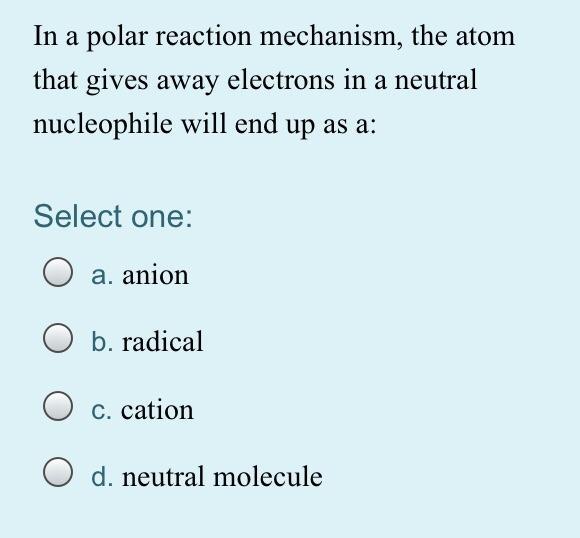
In a polar reaction mechanism, the atom that gives away electrons in a neutral nucleophile will end up as a(n):
Ray Of Light [21]

The question is incomplete, the complete question is shown in the image attached.

Answer:

Cation

Explanation:

In a polar reaction mechanism, a specie must give out electrons and another specie must accept those electrons.

The specie that gives out electrons becomes electron deficient and positively charged so we refer to such a specie as a cation.

Hence, the specie that looses electrons becomes a cation.

5 0
2 years ago
Other questions:
  • If a large marshmallow has a volume of 2.75 in3 and density of 0.242 g/cm3, how much would it weigh in grams? 1 in3=16.39 cm3.
    9·1 answer
  • How many moles of ions are in 285 ml of 0.0150 m mgcl2?
    10·2 answers
  • For each reaction, identify the precipitate, or lack thereof. 2nacl(aq)+ba(oh)2(aq)⟶bacl2+2naoh naoh bacl2 no precipitate agclo3
    14·2 answers
  • According to reference table adv-10, which reaction will take place spontaneously?
    8·1 answer
  • Identify which of the following two reactions you would expect to occur more rapidly: (1) addition of HBr to 2-methyl-2-pentene
    13·1 answer
  • 495 cm3 of oxygen gas and 877 cm3 of nitrogen gas, both at 25.0 C and 114.7 kpa, are injected into an evacuated 536 cm3 flask. F
    13·2 answers
  • Robyn has been working on developing a new task to test the reaction time of athletes. As she begins to test athletes using her
    8·1 answer
  • Energy may not be created or destroyed, but it may be converted into different types. Categorize the examples below as either Po
    7·1 answer
  • The concept of resonance describes molecular structures Question 17 options: that have several different geometric arrangements.
    5·1 answer
  • Use the words protons neutrons and I suppose in the same sentence ​
    5·1 answer
Add answer
Login
Not registered? Fast signup
Signup
Login Signup
Ask question!