answer.
Ask question
Login Signup
Ask question
All categories
  • English
  • Mathematics
  • Social Studies
  • Business
  • History
  • Health
  • Geography
  • Biology
  • Physics
  • Chemistry
  • Computers and Technology
  • Arts
  • World Languages
  • Spanish
  • French
  • German
  • Advanced Placement (AP)
  • SAT
  • Medicine
  • Law
  • Engineering
In-s [12.5K]
2 years ago
10

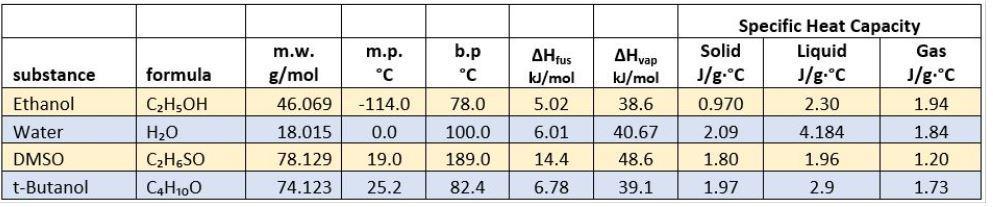
Calculate the number of kilojoules of energy required to convert 50.0 grams of solid DMSO initially at a temperature of 19.0°C t

o gas at 250.0°C.

Chemistry
1 answer:
GuDViN [60]2 years ago
4 0

Answer:

20.79 kilojoules

Explanation:

Using Q = m×c×∆T

Where;

Q = Quantity of heat (J)

c = specific heat capacity of solid DMSO (1.80 J/g°C)

m = mass of DMSO

∆T = change in temperature

According to the provided information, m= 50g, initial temperature = 19.0°C, final temperature= 250.0°C

Q = m×c×∆T

Q = 50 × 1.80 × (250°C - 19°C)

Q = 90 × 231

Q = 20790 Joules

To convert Joules to kilojoules, we divide by 1000 i.e.

20790/1000

= 20.79 kilojoules

Hence, 20.79 kilojoules of energy is required to convert 50.0 grams of solid DMSO to gas.

You might be interested in
When heating a flammable or volatile solvent for a recrystallization, which of these statements are correct? More than one answe
otez555 [7]

Explanation:

A volatile substance is defined as the substance which can easily evaporate into the atmosphere due to weak intermolecular forces present within its molecules.

Whereas a flammable substance is defined as a substance which is able to catch fire easily when it comes in contact with flame.

Hence, when we heat a flammable or volatile solvent for a recrystallization then it should be kept in mind that should heat the solvent in a stoppered flask to keep vapor away from any open flames so that it won't catch fire.

And, you should ensure that no one else is using an open flame near your experiment.

Thus, we can conclude that following statements are correct:

  • You should heat the solvent in a stoppered flask to keep vapor away from any open flames.
  • You should ensure that no one else is using an open flame near your experiment.
3 0
2 years ago
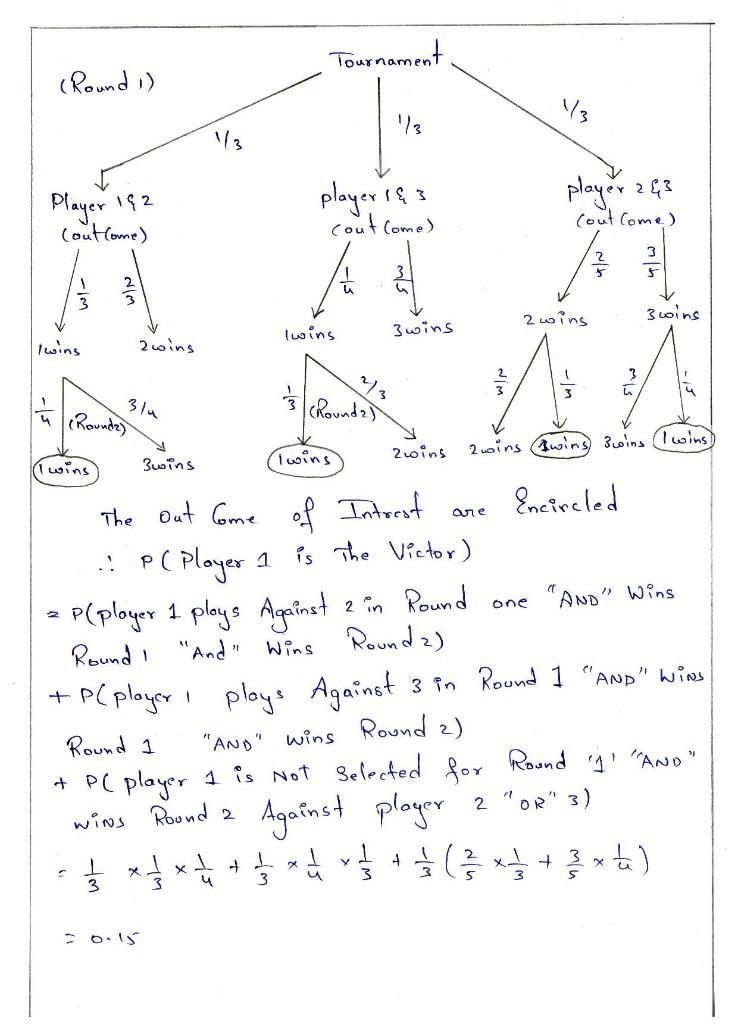
Players 1, 2, 3 are playing a tournament. Two of these three players are randomly chosen to play a game in round one, with the w
Anastasy [175]

The answer & explanation for this question is given in the attachment below.

6 0
2 years ago
When balanced, which equation would have the coefficient 3 in front of any of the reactants? Zn + HCl ZnCl2 + H2 H2SO4 + B(OH)3
Gwar [14]

The correct answer is B. H2SO4 + B(OH)3  B2(SO4)3 + H2O

Hope this helps!

6 0
2 years ago
Read 2 more answers
If 455-ml of 6.0 M HNO3 is used to make 2.5 L dilution, what is the molarity of the dilution
Anna11 [10]
Hi there

Formula
M1V1=M2V2
(455*6)/2500
Answer
1.092 M
5 0
2 years ago
The standard free energy ( Δ G ∘ ′ ) (ΔG∘′) of the creatine kinase reaction is − 12.6 kJ ⋅ mol − 1 . −12.6 kJ⋅mol−1. The Δ G ΔG
Dmitrij [34]

Answer:

The concentration of [ADP] = 21.896*10^-6 μM

Explanation:

Given Data:

creatine + ATP -----------> ADP + creatine phosphate    

ΔG∘   = -12.6 KJ/mole  = -12600 J/mole

ΔG = -0.1 KJ/mole  =  -100 J/mole

[Creatine phosphate]  = 25 mM = 25*10^-3 M

[Creatine] = 17 mM    = 17*10^-3 M

[ATP]   =5mM = 5*10^-3M

Calculating the concentration of [ADP] using the formula;

ΔG = ΔG∘ + RTlnQc

Substituting, we have

-12600   = -100 + 8.314*298lnQc

-12600+100 = 8.314*298lnQc

-12500   = 2477.57lnQc

lnQc = -12500/2477.57

lnQc = -5.045

Qc = e^ -5.045

Qc   = 6.44*10^-3

But,

Qc    = [Creatine phosphate]*[ADP]/[creatine]*[ATP]

6.44*10^-3   = 25*10^-3*[ADP]/ (17*10^-3* 5*10^-3)

6.44*10^-3 = 25*10^-3[ADP]/8.5*10^-5

6.44*10^-3 * 8.5*10^-5 = 25*10^-3[ADP]

5.474*10^-7 = 25*10^-3[ADP]

[ADP] = 5.474*10^-7 /25*10^-3

          = 2.1896 *10^-5 M

          = 21.896*10^-6 μM

Therefore, the concentration of [ADP] = 21.896*10^-6 μM
3 0
2 years ago
Other questions:
  • What is the minimum total energy released when an electron and its antiparticle (positron) annihilate each other?
    8·2 answers
  • Ammonia can also be synthesized by this reaction: 3h2(g)+n2(g) → 2nh3(g) what maximum amount of ammonia in grams can be synthesi
    7·2 answers
  • Jim collects a sample of beach sand during a class trip. After a close inspection of the sample he classifies it as a __________
    5·2 answers
  • A compound contains 81.1 boron with the remainder being hydrogen what is the empirical formula of the compound
    9·1 answer
  • Which of the following reactions will not occur as written? Which of the following reactions will not occur as written? Sn (s) +
    8·2 answers
  • Which of the following statements are true concerning ionic bonding? Select one: a. Ionic bonding occurs between a metal, which
    7·1 answer
  • Balance the following redox reaction occurring in an acidic solution. The coefficient of Cr2O72−(aq) is given. Enter the coeffic
    13·1 answer
  • Suppose 1.65 moles of C₆H₆ react with excess oxygen to produce carbon dioxide and water.
    6·2 answers
  • What is the pressure of a 3.00 L gas vessel that has 18.0 grams of helium at 25°C? (R= 0.0821 L atm/ mol K)
    7·1 answer
  • b) Write a few paragraphs describing the chemical reaction and explaining the energy change in the reaction. Your document shoul
    8·2 answers
Add answer
Login
Not registered? Fast signup
Signup
Login Signup
Ask question!