answer.
Ask question
Login Signup
Ask question
All categories
  • English
  • Mathematics
  • Social Studies
  • Business
  • History
  • Health
  • Geography
  • Biology
  • Physics
  • Chemistry
  • Computers and Technology
  • Arts
  • World Languages
  • Spanish
  • French
  • German
  • Advanced Placement (AP)
  • SAT
  • Medicine
  • Law
  • Engineering
Shtirlitz [24]
2 years ago
12

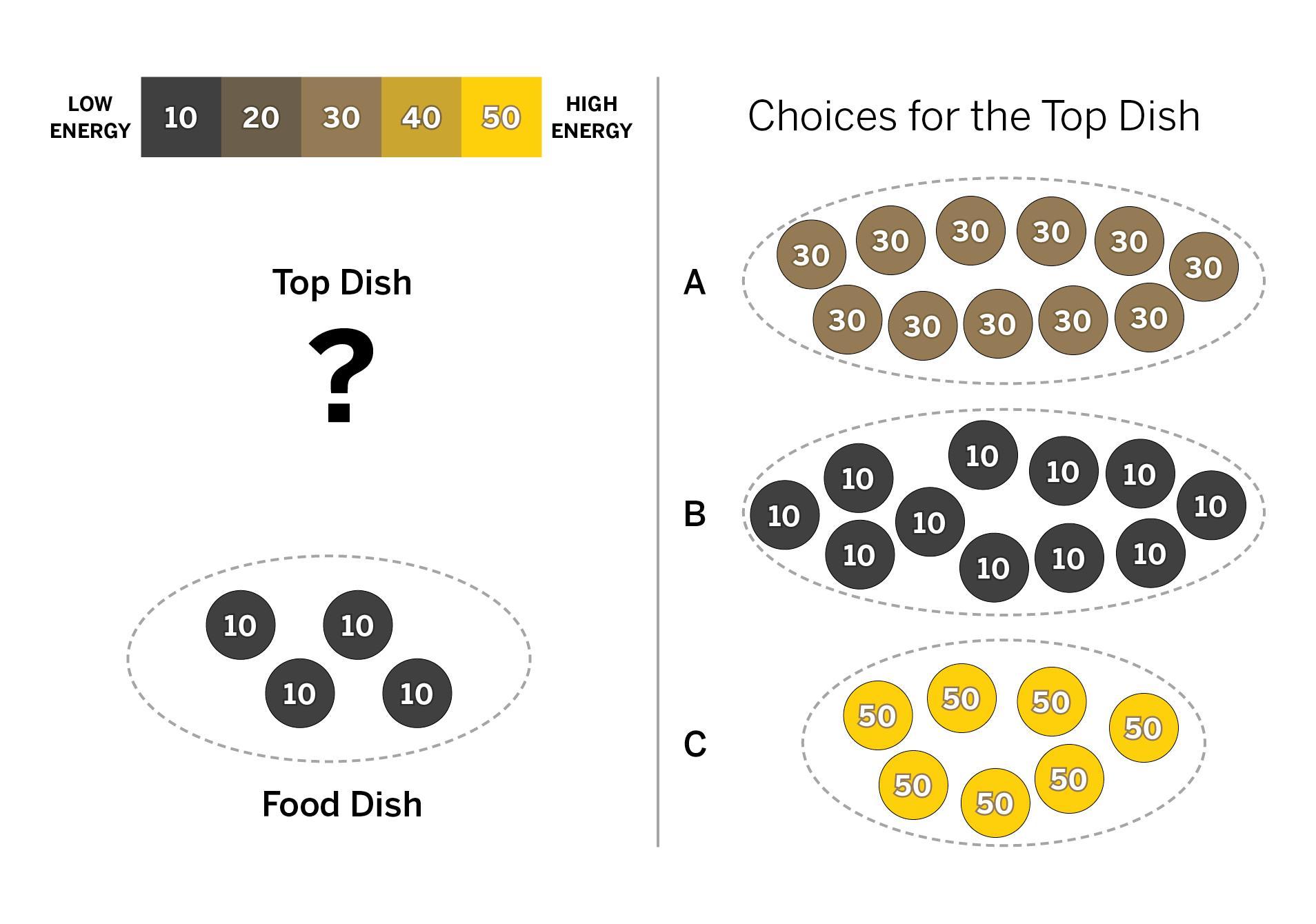
PLSSS HELP ME WITH THIS!!!!! Which one of these dishes would make the food dish the warmest when placed on top of it? As part of

your answer, explain how the energy and temperature of both the top dish and the food dish will change when the food dish warms up, and why.

Chemistry
1 answer:
Serggg [28]2 years ago
3 0

Answer:

Since the food dish  10  and it's at ur low energy soruce I would go with 20  

Explanation: add 10 more of enegry it will bring it to 30 which that would make that warm enough  and it's in between 10-50 and we dont want to much enegry into the dish

You might be interested in
If an aqueous solution of urea n2h4co is 26% by mass and has density of 1.07 g/ml, calculate the molality of urea in the soln
Ksju [112]
Answer is: molality of urea is 5.84 m.

If we use 100 mL of solution:
d(solution) = 1.07 g/mL.
m(solution) = 1.07 g/mL · 100 mL.
m(solution) = 107 g.
ω(N₂H₄CO) = 26% ÷ 100% = 0.26.
m(N₂H₄CO) = m(solution) · ω(N₂H₄CO).
m(N₂H₄CO) = 107 g · 0.26.
m(N₂H₄CO) = 27.82 g.
1) calculate amount of urea:
n(N₂H₄CO) = m(N₂H₄CO) ÷ M(N₂H₄CO).
n(N₂H₄CO) = 27.82 g ÷ 60.06 g/mol.
n(N₂H₄CO) = 0.463 mol; amount of substance.
2) calculate mass of water:
m(H₂O) = 107 g - 27.82 g.
m(H₂O) = 79.18 g ÷ 1000 g/kg.
m(H₂O) = 0.07918 kg.
3) calculate molality:
b = n(N₂H₄CO) ÷ m(H₂O).
b = 0.463 mol ÷ 0.07918 kg.
b = 5.84 mol/kg.
5 0
2 years ago
Read 2 more answers
How much water(in grams) at its boiling point can be vaporized by adding 1.50 kJ of heat? The molar heat of vaporization for wat
LekaFEV [45]

Answer:

0.66g of water

Explanation:

Molar heat of vaporization of any substance is defined as the heat necessary to vaporize 1 mole of the substance.

If heat of vaporization of water is 40.79kJ/mol and you add 1.50kJ, the moles you vaporize are:

1.50kJ × (1mol / 40.79kJ) = 0.0368 moles of water.

As molar mass of water is 18.01g/mol, mass of water that can be vaporized are:

0.0368 moles × (18.01g / mol) = <em>0.66g of water</em>

6 0
2 years ago
What is the reaction energy Q of this reaction? Use c2=931.5MeV/u. Express your answer in millions of electron volts to three si
emmasim [6.3K]

Answer:

Energy= 2.7758 × 10^-11 J ;

71.112×10^-6 kJ.

Mass defect in Kilogram= 3.0885×10^-28 kg.

That is; 3.1×10^-28 kg(to two significant figure).

Explanation:

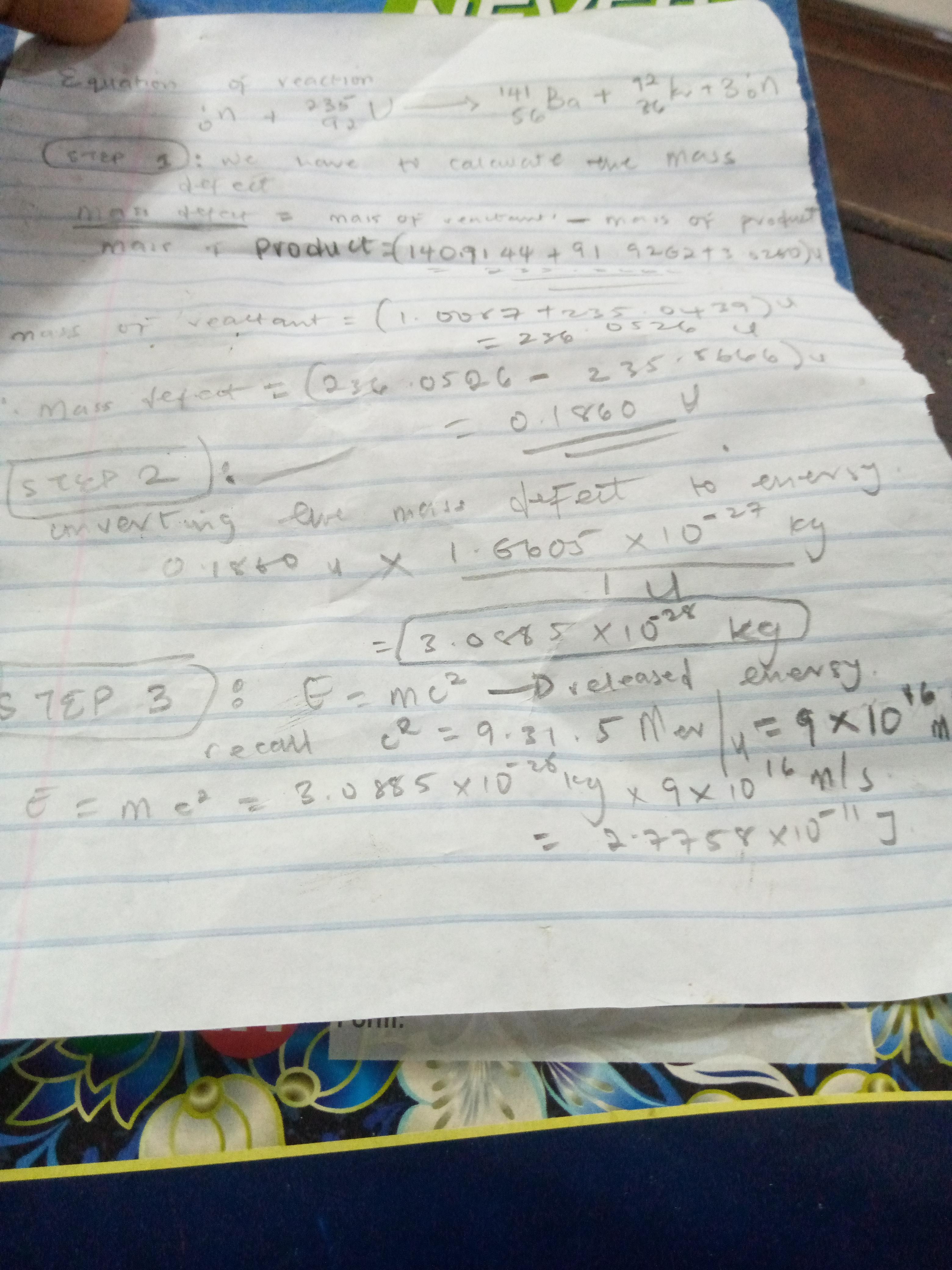
(Note: Check equation of reaction in the attached file/picture).

STEP ONE: we have to calculate the Mass defect.

Mass defect= Mass of reactants -- Mass of products.

Mass of the products: (140.9144+91.9262+3.060) u.

= 235.8666 u.

Mass of reactants: (1.0087+235.0439) u= 236.0526 u.

Therefore, the Mass defect= (236.0526 -- 235.8666) u

= 0.1860 u.

STEP TWO: Converting the Mass defect to energy;

0.18860 × 1.6605 × 10^27 kg

= 3.0885× 10^-28 kg

STEP THREE: Calculating energy released . Recall(from the question) c^2= 931.5 Mev/u. This is also equals to 9×10^16 m/s.

E=Mc^2.

Where E= energy released, c= speed of light, M= Mass.

Slotting in the values;

E= 3.0885×10^-28 kg × 9×10^16 m/s.

E=2.7758 × 10^-11 J.

Know that;( 1g of uranium × 1 mol of uranium ÷ 235.0439 g of uranium) × (6.002×10^23 atom of uranium/ 1 mol of uranium) × 2.7758× 10^-11.

=7.1112×10^-10 J

= 71.112×10^6 kJ.
3 0
2 years ago
A gas cylinder filled with nitrogen at standard temperature and pressure has a mass of 37.289 g. The same container filled with
andrew-mc [135]

Answer:

Molar mass = 3.9236 g/mol ≅ 4 g/mol

This corresponds to Helium gas.

Explanation:

Let the moles of nitrogen gas = x moles

Moles of carbon dioxide = x moles ( As both are filled at same temperature and pressure conditions )

Given:

Mass_{Container}+Mass_{Nitrogen\ gas}=37.289\ g

Molar mass of nitrogen gas, N_2 = 28.014 g/mol

The formula for the calculation of moles is shown below:

moles = \frac{Mass\ taken}{Molar\ mass}

Thus,

x\ moles= \frac{Mass}{28.014\ g/mol}

Mass of nitrogen gas = 28.014x g

So,

Let, Mass_{Container}=y

y+28.014x=37.289

Similarly,

Mass_{Container}+Mass_{Carbon\ dioxide\ gas}=37.440\ g

Molar mass of nitrogen gas, CO_2 = 44.01 g/mol

The formula for the calculation of moles is shown below:

moles = \frac{Mass\ taken}{Molar\ mass}

Thus,

x\ moles= \frac{Mass{44.01\ g/mol}

Mass of nitrogen gas = 44.01x g

So,

y+44.01x=37.440

Solving the two equations, we get :

Mass_{Container}=y=37.025\ g

x = 0.00943 moles

Thus, Given:

Mass_{Container}+Mass_{Unknown\ gas}=37.062\ g

37.025\ g+Mass_{Unknown\ gas}=37.062\ g

Mass of the gas = 0.037 moles

Moles = 0.00943 moles

The formula for the calculation of moles is shown below:

moles = \frac{Mass\ taken}{Molar\ mass}

Thus,

0.00943\ moles= \frac{0.037\ g}Molar mass}

Molar mass = 3.9236 g/mol ≅ 4 g/mol

This corresponds to Helium gas.

7 0
2 years ago
Suppose that the microwave radiation has a wavelength of 12.4 cm . How many photons are required to heat 255 mL of coffee from 2
vivado [14]

Answer:

Explanation:

wavelength λ = 12.4 x 10⁻² m .

energy of one photon = h c / λ

= 6.6 x 10⁻³⁴ x 3 x 10⁸ /  12.4 x 10⁻²

= 1.6 x 10⁻²⁴ J .

Let density of coffee be equal to density of water .

mass of coffee = 255 x 1 = 255 g

heat required to heat up coffee = mass x specific heat x rise in temp

= 255 x 4.18 x ( 62-25 )

= 39438.3 J  .

No of photons required = heat energy required / energy of one photon

= 39438.3 / 1.6 x 10⁻²⁴

= 24649 x 10²⁴

= 24.65 x 10²⁷ .

5 0
2 years ago
Other questions:
  • Determine how many grams of silver would be produced, if 12.83 x 10^23 atoms of copper react with an excess of silver nitrate. G
    10·1 answer
  • A 63 kg object needs to be lifted 7 meters in a matter of 5 seconds. Approximately how much horsepower is required to achieve th
    14·2 answers
  • When elemental sodium is added to water, the sodium atoms ionize spontaneously. uncharged na becomes na+. this means that the na
    5·1 answer
  • A certain gas is present in a 12.0 L cylinder at 4.0 atm pressure. If the pressure is increased to 8.0 atm the volume of the gas
    13·2 answers
  • In May 2016, William Trubridge broke the world record in free diving (diving underwater without the use of supplemental oxygen)
    13·1 answer
  • A graduated cylinder holds 100 mL of water. A lead weight is dropped into the cylinder bringing the new volume up to 450 mL. If
    5·1 answer
  • What is the pressure of a 3.00 L gas vessel that has 18.0 grams of helium at 25°C? (R= 0.0821 L atm/ mol K)
    7·1 answer
  • A blacksmith making a tool heats 525 grams of steel to 1230°C. After hammering the steel, she places it into a bucket of water t
    5·1 answer
  • Why is it important to have regular supervision of the weight and measurements in the market
    10·1 answer
  • How many moles of copper are in 6,000,000 atoms of copper?
    9·1 answer
Add answer
Login
Not registered? Fast signup
Signup
Login Signup
Ask question!