answer.
Ask question
Login Signup
Ask question
All categories
  • English
  • Mathematics
  • Social Studies
  • Business
  • History
  • Health
  • Geography
  • Biology
  • Physics
  • Chemistry
  • Computers and Technology
  • Arts
  • World Languages
  • Spanish
  • French
  • German
  • Advanced Placement (AP)
  • SAT
  • Medicine
  • Law
  • Engineering
Tom [10]
2 years ago
15

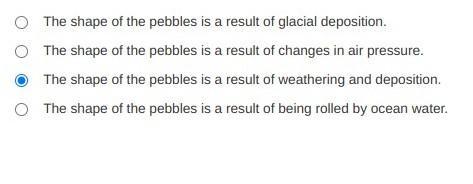
A sixth grade teacher takes students on a field trip to the beach. One student finds several pebbles that have a rounded shape a

nd are smooth to the touch. What process most likely shaped these pebbles?​

Chemistry
2 answers:
ahrayia [7]2 years ago
8 0

Answer:

the one you have selected is correct

Explanation:

kolbaska11 [484]2 years ago
7 0

Answer:

The shape of the pebbles is a result of weathering and deposition.

Explanation:

You might be interested in
How many grams of calcium chloride are needed to produce 1.50 g of potassium chloride? cacl2(aq) + k2co3(aq) → 2 kcl(aq) + caco3
Virty [35]
CaCl2(aq) + K2CO3(aq) → 2 KCl(aq) + CaCO3(aq)

1.12 g
2.23 g
0.896 g
4.47 g
1.12 g

Hope it helps :)
8 0
2 years ago
Read 2 more answers
What is the percent yield of this reaction if 22.o g of Mgl2 is produced by the reaction of 25.0 g of Mg with 25.0 g of l2?
expeople1 [14]

% yield = 80.719

<h3>Further explanation</h3>

Given

22.0 g of Mgl₂

25.0 g of Mg

25.0 g of l₂

Required

The percent yield

Solution

Reaction

Mg + I₂⇒ MgI₂

mol Mg = 25 g : 24.305 g/mol = 1.029

mol I₂ = 25 g : 253.809 g/mol = 0.098

Limiting reactant = I₂

Excess reactant = Mg

mol MgI₂ based on I₂, so mol MgI₂ = 0.098

Mass MgI₂ (theoretical):

= mol x MW

= 0.098 x 278.114

= 27.255 g

% yield = (actual/theoretical) x 100%

% yield = (22 / 27.255) x 100%

% yield = 80.719

8 0
1 year ago
Suppose you are studying the K sp of K C l O 3 , which has a molar mass of 122.5 g/mol, at multiple temperatures. You dissolve 4
Ghella [55]

Answer:

The K sp Value is  K_{sp}=7.40

Explanation:

From the question we are told that

   The of KClO_3 is = 122.5 g/ mol

    The mass of KClO_3 dissolved is m_s = 4.0g

    The volume of solution is  V_s = 12mL = 12*10^{-3}L

The number of moles of KClO_3 is mathematically evaluated as

           No \ of  \ moles  \ = \frac{mass }{Molar \ mass}

Substituting values

                                  = \frac{4}{122.5}

                                  =0.0327\ moles

Generally concentration is mathematically represented as

         concentration = \frac{No \ of \ moles}{volume }

For KClO_3        

               Z= \frac{0.0327}{12*10^{-3}}

                              =2.72 \ mol/L

The dissociation reaction of KClO_3  is

         KClO_3 \ ----> K^{+}_{(aq)} + ClO_3^-_{(aq)}

The solubility product constant is mathematically represented as

                   K_{sp} = \frac{concentration of ionic product }{concentration of ionic reactant }

Since there is no ionic reactant we have

                  K_{sp} = [k^+] [ClO_3^-]

                          = Z^2

                          = 2.72^2

                          K_{sp}=7.40


5 0
2 years ago
Read 2 more answers
An empty beaker is weighed and found to weigh 23.1 g. Some potassium chloride is then added to the beaker and weighed again. The
GuDViN [60]

Answer:Mass of Potassium chloride =1.762g

Explanation:

Mass of empty beaker = 23.100 g

Mass of beaker with Potassium chloride = 24.862g

Mass of Potassium chloride = Final weight - initial weight = Mass of beaker with Potassium chloride  - Mass of empty beaker = 24.862-23.100 = 1.762g

8 0
2 years ago
Suppose there is a gaseous mixture of nitrogen and oxygen. If the total pressure of the mixture is 470 mmHg , and the partial pr
ch4aika [34]

Answer:

190 mmHg

Explanation:

According to Dalton's law, in a mixture of ideal gases, each gas behaves independently of the other. Also, the total pressure is equal to the sum of the individual partial pressures.

The total pressure of the mixture is 470 mmHg , and the partial pressure of nitrogen is 280 mmHg. Then,

P = pO₂ + pN₂

pO₂ = P - pN₂

pO₂ = 470 mmHg - 280 mmHg

pO₂ = 190 mmHg
5 0
2 years ago
Other questions:
  • Why does it help to keep the distillation head warm?
    15·1 answer
  • If 35.50 cm3 of a NaOH solution are required for the complete neutralization of a 25.00cm3 sample of 0.200mol dm-3 H2SO4, what i
    5·1 answer
  • How to calculate electronegativity with 3 elements?
    11·1 answer
  • Write a balanced half-reaction describing the oxidation of gaseous dihydrogen to aqueous hydrogen cations.
    12·2 answers
  • 1. Calculate the molar enthalpy of solidification (ΔHsolidification) when 10.00kJ of energy are lost as 30.00g of water are froz
    14·1 answer
  • Iron-59 is used in medicine to diagnose blood circulation disorders. The half life of iron-59 is 44.5 days. How much of a 2.000
    5·1 answer
  • A piston containing 0.120moles of methane gas, CH4, has a volume of 2.12liters. If methane is added until the volume is increase
    6·1 answer
  • Which of the following best describes electrolytes
    10·1 answer
  • In a laboratory, Carlos places one plate with grape jelly and another plate with cooked brown rice inside an ant farm. The next
    12·2 answers
  • Calculate the number of kilojoules of energy required to convert 50.0 grams of solid DMSO initially at a temperature of 19.0°C t
    10·1 answer
Add answer
Login
Not registered? Fast signup
Signup
Login Signup
Ask question!
