answer.
Ask question
Login Signup
Ask question
All categories
  • English
  • Mathematics
  • Social Studies
  • Business
  • History
  • Health
  • Geography
  • Biology
  • Physics
  • Chemistry
  • Computers and Technology
  • Arts
  • World Languages
  • Spanish
  • French
  • German
  • Advanced Placement (AP)
  • SAT
  • Medicine
  • Law
  • Engineering
maw [93]
2 years ago
5

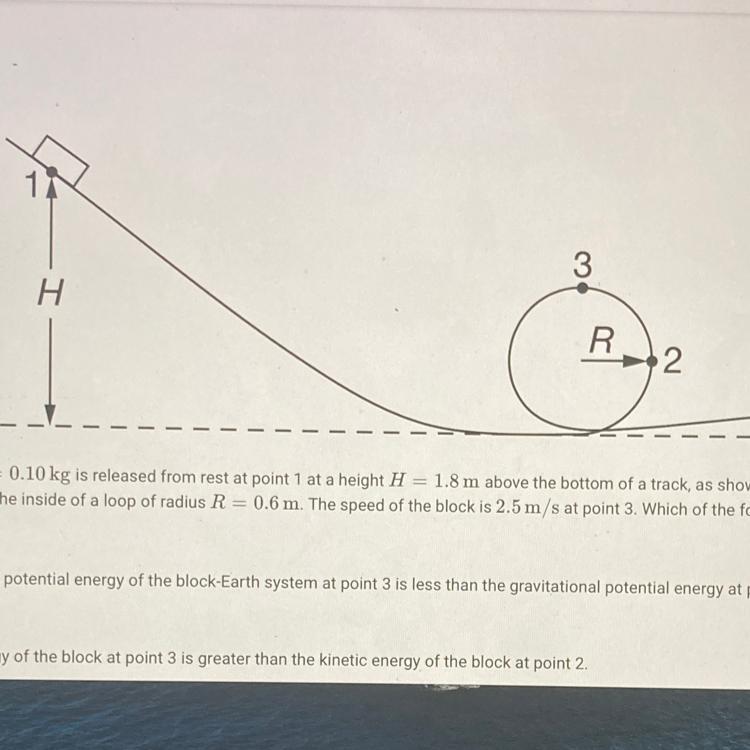
A small block of mass M = 0.10 kg is released from rest at point 1 at a height H = 1.8 m above the bottom of a track, as shown i

n the diagram. It slides
down the track and around the inside of a loop of radius R = 0.6 m. The speed of the block is 2.5 m/s at point 3. Which of the following claims about the
situation is correct?
A) The gravitational potential energy of the block-Earth system at point 3 is less than the gravitational potential energy at point 2.
B) The kinetic energy of the block at point 3 is greater than the kinetic energy of the block at point 2.
The mechanical energy of the block-Earth system at point 3 is less than the mechanical energy of the block-Earth system at point 1.
D
The mechanical energy of the block-Earth system at point 2 is equal to the gravitational potential energy of the block-Earth system at point 1.

Physics
1 answer:
Ede4ka [16]2 years ago
7 0

Answer:

D

Explanation:

A) is not correct, because the gravitation potential energy will depend on the height the block is located at. It will be calculated with the formula:

U=mgh.

If we take the ground as a zero height reference, then on point 2 the potential energy will be:

U_{2} = 0.10kg(9.81 m/s^{2})(0.6m)

U_{2}=0.59 J

While on point 3, the potential energy will be greater.

U_{3}=0.10kg(9.81 m/s^{2})(1.2m)

U_{3}=1.18 J

B) is not the right answer because the kinetic energy will vary with the height the block is located at in the fact that the energy is conserved (this is if we don't take friction into account or air resistance) so in this case:

U_{2}+K_{2}= U_{3}+K_{3}

We already know the potential energy at point 2. We can calculate the kinetic energy at point 3 like this:

K_{3} =\frac{1}{2}mv_{3}^{2}

K_{3} =\frac{1}{2}(0.10kg)(2.5 m/s)^{2}

K_{3} =0.31 J

So the kinetic energy at point 2 is given by the equation:

K_{2}  =U_{3}-U_{2}+K_{3}

so:

K_{2} = (1.18J)-(0.59J)+0.31J

K_{2} =0.9J

As you may see the kinetic energy at point 2 is greater than the kinetic energy at point 3.

C) Is not correct because according to the first law of thermodinamics, energy is not lost, only transformed. So, since we are not taking into account friction or any other kind of loss, then we can say that the amount of mechanical energy at point 1 is exactly the same as the mechanical energy at point 3.

D) Because of what we talked about on part C, this will be the true situation, because the mechanical energy of the block will be the same no matter theh point you measure it at.

You might be interested in
Determine the sign (+ or −) of the torque about the elbow caused by the biceps, τbiceps, the sign of the weight of the forearm,
Alex Ar [27]
Ans: 
1.  τbiceps = +(Positive)
2.  τforearm = -(Negative)
3.  τball = -(Negative)

Explanation:

The figure is attached down below.

1. T<span>orque about the elbow caused by the biceps, τbiceps:
Since Torque = r x F (where r and F are the vectors)
</span>Where r is the vector from elbow to the biceps.
<span>
We can see in the figure that F(biceps) is in upward direction, and by applying the right hand rule from r to F, we get the counterclockwise direction. The torque in counterclockwise direction is positive(+). Therefore, the sign would be +.

2. </span>Torque about the the weight of the forearm, τforearm:
Since Torque = r x F (where r and F are the vectors)
Where r is the vector from elbow to the forearm.

Also weight is the special kind of Force caused by the gravity.

We can see in the figure that W(forearm) is in downward direction, and by applying the right hand rule from r to F, we get the clockwise direction. The torque in clockwise direction is negative(-). Therefore, the sign would be -.
3. Torque about the the weight of the ball, τball:
Since Torque = r x F (where r and F are the vectors)
Where r is the vector from elbow to the ball.

Also weight is the special kind of Force caused by the gravity.

We can see in the figure that W(ball) is in downward direction, and by applying the right hand rule from r to F, we get the clockwise direction. The torque in clockwise direction is negative(-). Therefore, the sign would be -.

8 0
2 years ago
A ball weighing 1 lb is attached to a string 2 feet long and is whirled in a vertical circle at a constant speed of 10 ft/sec.
fredd [130]

Explanation:

It is given that,

Mass of the ball, m = 1 lb

Length of the string, l = r = 2 ft

Speed of motion, v = 10 ft/s

(a) The net tension in the string when the ball is at the top of the circle is given by :

F=\dfrac{mv^2}{r}-mg

F=m(\dfrac{v^2}{r}-g)

F=1\ lb\times (\dfrac{(10\ ft/s)^2}{2}-1\ lb\times 32\ ft/s^2)

F = 18 N

(b) The net tension in the string when the ball is at the bottom of the circle is given by :

F=\dfrac{mv^2}{r}+mg

F=m(\dfrac{v^2}{r}+g)

F=1\ lb\times (\dfrac{(10\ ft/s)^2}{2}+1\ lb\times 32\ ft/s^2)

F = 82 N

(c) Let h is the height where the ball at certain time from the top. So,

T=mg(\dfrac{r-h}{r})+\dfrac{mv^2}{r}

T=\dfrac{m}{r}(g(r-h)+v^2)

Since, v^2=u^2-2gh

T=\dfrac{m}{r}(u^2-3gh+gr)

Hence, this is the required solution.

6 0
2 years ago
How much power does it take to lift a 24 kg gift box 6m above the floor in 4 s?
Mrac [35]

Answer:

<h2>5.6kW</h2>

Explanation:

Step one:

given

mass m= 24kg

distance moved= 6m

time taken= 4seconds

Step two:

Required

power

but work done is the force applied at a distance, and the power is the work done time the time taken

Work done= F*D

F=mg

W= mg*D

W=24*9.81*6

W=1412.6J

Power P= work * time

P=1412.6*4

p=5650.5W

P=5.6kW

3 0
2 years ago
Hope you can answer this: A Student Visits A Farm And Makes These Notes In Her Journal.
Strike441 [17]

Answer:

Common Sense

Explanation:

The chick has probably seen other chicks get caught by the Hawk and knows not to go near, or saw a giant bird flying straight towards it and used common sense to identify it as danger and run away. Although if this is for a test or a grade or something, please do not use the answer, it is most likely incorrect. This is honestly my best answer.

8 0
2 years ago
A physics professor that doesn’t get easily embarrassed stands at the center of a frictionless turntable with arms outstretched
mr Goodwill [35]
Apply conservation of angular momentum:
L = Iw = const.
L = angular momentum, I = moment of inertia, w = angular velocity, L must stay constant.

L must stay the same before and after the professor brings the dumbbells closer to himself.

His initial angular velocity is 2π radians divided by 2.0 seconds, or π rad/s. His initial moment of inertia is 3.0kg•m^2

His final moment of inertia is 2.2kg•m^2.

Calculate the initial angular velocity:
L = 3.0π

Final angular velocity:
L = 2.2w

Set the initial and final angular momentum equal to each other and solve for the final angular velocity w:

3.0π = 2.2w
w = 1.4π rad/s

The rotational energy is given by:
KE = 0.5Iw^2

Initial rotational energy:
KE = 0.5(3.0)(π)^2 = 14.8J

Final rotational energy:
KE = 0.5(2.2)(1.4)^2 = 21.3J

There is an increase in rotational energy. Where did this energy come from? It came from changing the moment of inertia. The professor had to exert a radially inward force to pull in the dumbbells, doing work that increases his rotational energy.
3 0
2 years ago
Read 2 more answers
Other questions:
  • Write the meaning of an object has 2 meter length
    15·1 answer
  • 40-turn circular coil (radius = 4.0 cm, total resistance = 0.20 ) is placed in a uniform magnetic field directed perpendicular
    5·1 answer
  • Consider a very small hole in the bottom of a tank 17.0 cm in diameter filled with water to a heightof 90.0 cm. Find the speed a
    7·1 answer
  • In a physics laboratory experiment, a coil with 200 turns enclosing an area of 12cm2 is rotated in 0.040 s from a position where
    7·1 answer
  • A child's toy is suspended from the ceiling by means of a string. The Earth pulls downward on the toy with its weight force of 8
    5·1 answer
  • An ore sample weighs 17.50 N in air. When the sample is suspended by a light cord and totally immersed in water, the tension in
    13·1 answer
  • Water evaporating from a pond does so as if it were diffusing across an air film 0.15 cm thick. The diffusion coefficient of wat
    7·1 answer
  • An electron is moving in the vicinity of a long, straight wire that lies along the z-axis. The wire has a constant current of 8.
    10·1 answer
  • A uniform Rectangular Parallelepiped of mass m and edges a, b, and c is rotating with the constant angular velocity ω around an
    6·1 answer
  • A squeeze bottle squeezes when pressed. It regains its shape when pressed .It regains its shape when the pressure from your hand
    5·1 answer
Add answer
Login
Not registered? Fast signup
Signup
Login Signup
Ask question!
