answer.
Ask question
Login Signup
Ask question
All categories
  • English
  • Mathematics
  • Social Studies
  • Business
  • History
  • Health
  • Geography
  • Biology
  • Physics
  • Chemistry
  • Computers and Technology
  • Arts
  • World Languages
  • Spanish
  • French
  • German
  • Advanced Placement (AP)
  • SAT
  • Medicine
  • Law
  • Engineering
Oksi-84 [34.3K]
2 years ago
10

A sample of 211 g of iron (III) bromide is reacted with

Chemistry
1 answer:
Alisiya [41]2 years ago
6 0

FeBr₃ ⇒ limiting reactant

mol NaBr = 1.428

<h3>Further explanation</h3>

Reaction

2FeBr₃ + 3Na₂S → Fe₂S₃ + 6NaBr

Limiting reactant⇒ smaller ratio (mol divide by coefficient reaction)

  • FeBr₃

211 g of Iron (III) bromide(MW=295,56 g/mol), so mol FeBr₃ :

\tt n=\dfrac{mass}{MW}\\\\n=\dfrac{211}{295,56}\\\\n=0.714

  • Na₂S

186 g of Sodium sulfide(MW=78,0452 g/mol), so mol Na₂S :

\tt n=\dfrac{186}{78.0452}=2.38

Coefficient ratio from the equation FeBr₃ :  Na₂S = 2 : 3, so mol ratio :

\tt FeBr_3\div Na_2S=\dfrac{0.714}{2}\div \dfrac{2.38}{3}=0.357\div 0.793

So  FeBr₃ as a limiting reactant(smaller ratio)

mol NaBr based on limiting reactant (FeBr₃) :

\tt \dfrac{6}{3}\times 0.714=1.428

You might be interested in
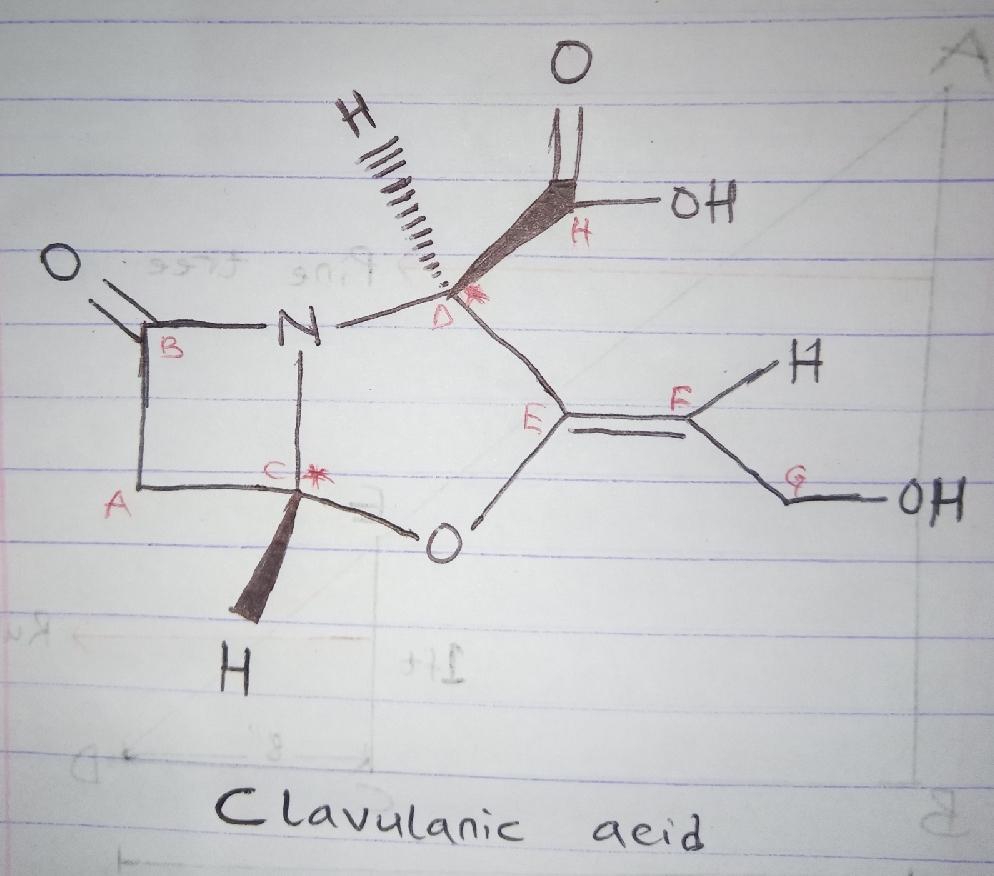
How many chiral centers does clavulanic acid have?
VikaD [51]

Answer:

Clavulanic acid has two (2) chiral centers.

Explanation:

A chiral center is a center (usually carbon) with four different substituents.

The structure of clavulanic acid is shown in the attachment below.

Consider the labeled diagram in the attachment,

Carbon A is not a chiral carbon because it has two hydrogen atoms attached to it

Carbon B is not a chiral carbon because it has only three substituents

Carbon C is a chiral carbon because it has four different substituents

Carbon D is a chiral carbon because it has four different substituents

Carbon E is not a chiral carbon because it has only three atoms directly attached to it

Carbon F is not a chiral carbon because it has only three atoms directly attached to it

Carbon G is not a chiral carbon because it has two hydrogen atoms attached to it

Carbon H is not a chiral carbon because it has only three substituents

Then, only carbons C and D are chiral carbons.

Hence, clavulanic acid have two (2) chiral centers.

7 0
2 years ago
Solar energy travels to the Earth in many forms, such as ultraviolet radiation, infrared radiation, and visible rays. These vari
galben [10]
Radiation. Hope this Helps


4 0
2 years ago
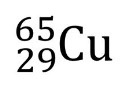
Give the nuclide symbol for an atom that has<br> mass number 64 and 35 neutrons.
azamat
The mass number represents the summation of the number of protons and the number of neutrons in the nucleus of an atom.
We are given that the mass number is 64 and that the number of neutrons is 35. Therefore:
number of protons = 64 - 35 = 29 protons

In ground state, number of protons in an atom is equal to the number of electrons. Therefore,
number of electrons = 29 electron

Using the periodic table, we will find that the element that has 29 electrons in ground state is copper.
The nuclide symbol of copper is shown in the attached image.

5 0
2 years ago
0.9775 grams of an unknown compound is dissolved in 50.0 ml of water. Initially the water temperature is 22.3 degrees Celsius. A
elena-14-01-66 [18.8K]

Answer:

The enthlapy of solution is -55.23 kJ/mol.

Explanation:

Mass of water = m

Density of water = 1 g/mL

Volume of water = 50.0 mL

m = Density of water × Volume of water = 1 g/mL × 50.0 mL=50.0 g

Change in temperature of the water ,ΔT= 27.0°C - 22.3°C = 4.7°C

Heat capacity of water,c =4.186 J/g°C

Heat gained by the water when an unknown compound is dissolved be Q

Q= mcΔT

Q=50.0 g\times 4.186 J/g^oC\times 4.7^oC=983.71 J

heat released when 0.9775 grams of an unknown compound is dissolved in water will be same as that heat gained by water.

Q'=-Q

Q'= -983.71 J =-0.98371 kJ

Moles of unknown compound = \frac{0.9975 g}{56 g/mol}=0.01781 mol

The enthlapy of solution :

\frac{Q'}{moles}

=\frac{-0.98371 kJ}{0.01781 mol}=-55.23 kJ/mol

The enthlapy of solution is -55.23 kJ/mol.

8 0
2 years ago
Give a possible explanation for the relative amounts of the isometric methyl nitrobenzoates formed in the nitration reaction. Co
vovikov84 [41]

Answer:

The electrophilic aromatic substitution reaction nitration is used to nitrate methyl benzoate and acetanilide with a nitronium ion. Crystallization was used to purify the product. The melting point was used to determine its purity and the regiochemistry of the products.

Explanation:

Methyl m-Nitrobenzoate is formed in this

reaction rather that ortho/para isomers

because of the ester group of your starting

product of methylbenzoate. The functional

group of ester is a electron withdrawing group

causing nitrobenzene (N02) to become in the

meta position. Thus N02 is a deactivating

group causing itself to be a meta director.

Basically you must look at the substituents

that are attached to your starting benzene ring

in order to figure out whether your reaction

with be ortho/para directors or meta

directors. If the substituents are electron

withdrawing groups then you will be left with

meta as your product but if your substituents

are electron donating groups then your

product will be ortho/para.

4 0
2 years ago
Other questions:
  • Which factors affect the flow of electric charge? Check all that apply.
    9·2 answers
  • The first thing alcohol impairs is your _________.
    14·2 answers
  • A reagent bottle on the shelf labeled 0.5m nacl was used in place of the 0.5 m cacl2. assuming c2o4^2- to be in excess, what wou
    11·1 answer
  • Balance the following reaction. A coefficient of "1" is understood. Choose option "blank" for the correct answer if the coeffici
    8·2 answers
  • Ethyl achohol has a heat of vaporization of 850. J/g. What mass of ethyl alcohol can be boiled using 15000 j of energy
    14·2 answers
  • What mass of sodium chloride (NaCl) forms when 7.5 g of sodium carbonate (Na2CO3) reacts with a dilute solution of hydrochloric
    11·2 answers
  • How many L of carbon dioxide at 1.00 atm and 298.15 K are released from a car's engine upon consumption of a 60.0 L LIQUID tank
    10·1 answer
  • A race car is driven by a professional driver at 99 . What is this speed in and ? 1 mile = 1.61 kilometers 1 hour = 60 minutes E
    10·1 answer
  • A student buys a rope at the store. The label on the packaging says that the rope is 2.15 meters in length. The student measures
    14·1 answer
  • How many grams of copper (II) nitrate would be produced from 0.80 g of copper metal reacting with excess nitric acid?
    10·1 answer
Add answer
Login
Not registered? Fast signup
Signup
Login Signup
Ask question!