answer.
Ask question
Login Signup
Ask question
All categories
  • English
  • Mathematics
  • Social Studies
  • Business
  • History
  • Health
  • Geography
  • Biology
  • Physics
  • Chemistry
  • Computers and Technology
  • Arts
  • World Languages
  • Spanish
  • French
  • German
  • Advanced Placement (AP)
  • SAT
  • Medicine
  • Law
  • Engineering
erma4kov [3.2K]
2 years ago
5

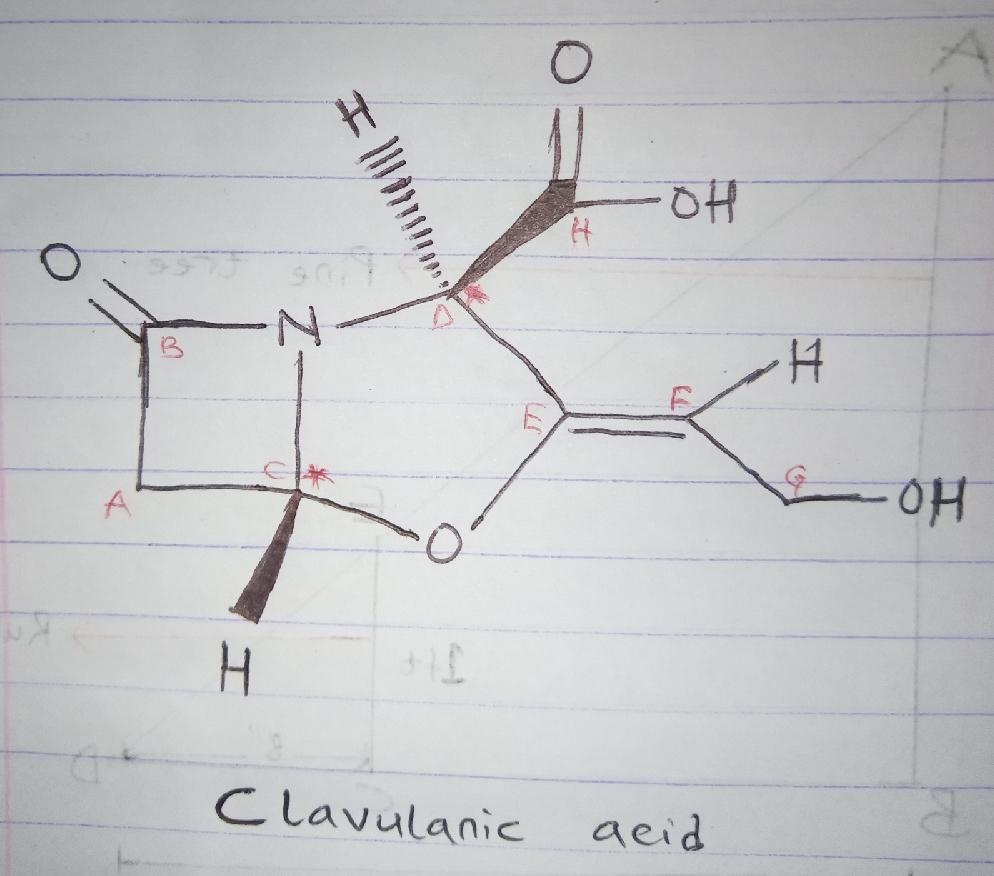
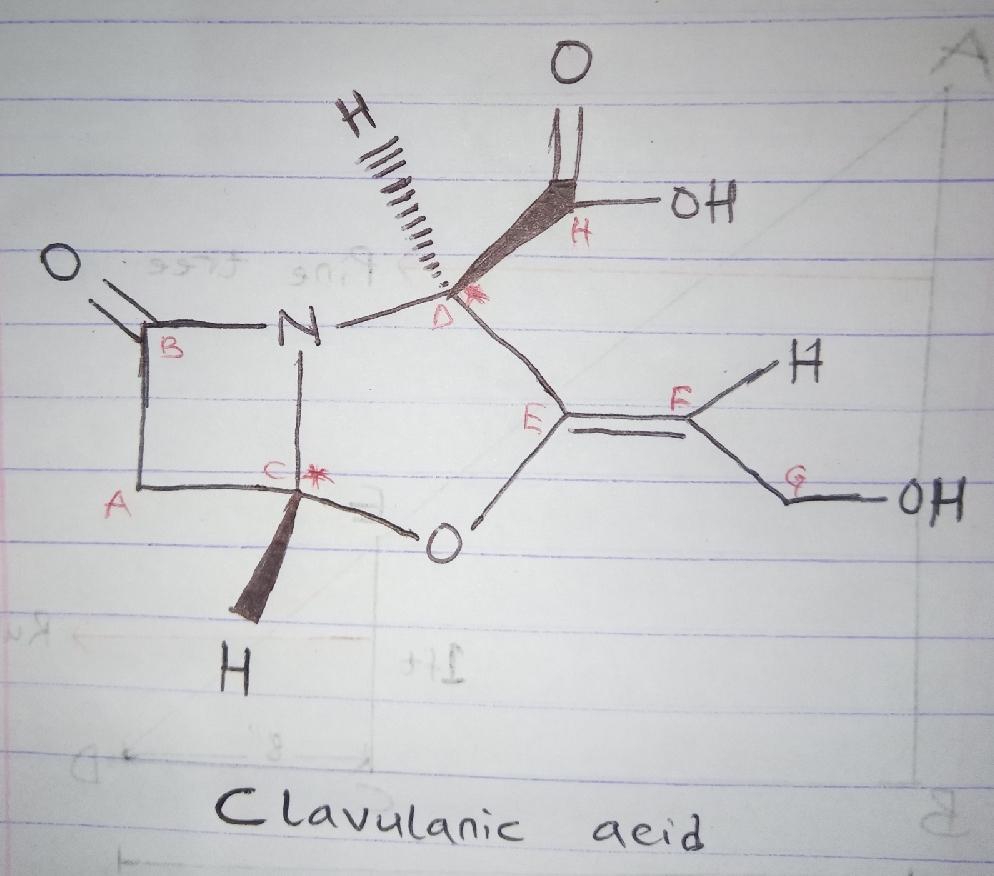
How many chiral centers does clavulanic acid have?

Chemistry
1 answer:
VikaD [51]2 years ago
7 0

Answer:

Clavulanic acid has two (2) chiral centers.

Explanation:

A chiral center is a center (usually carbon) with four different substituents.

The structure of clavulanic acid is shown in the attachment below.

Consider the labeled diagram in the attachment,

Carbon A is not a chiral carbon because it has two hydrogen atoms attached to it

Carbon B is not a chiral carbon because it has only three substituents

Carbon C is a chiral carbon because it has four different substituents

Carbon D is a chiral carbon because it has four different substituents

Carbon E is not a chiral carbon because it has only three atoms directly attached to it

Carbon F is not a chiral carbon because it has only three atoms directly attached to it

Carbon G is not a chiral carbon because it has two hydrogen atoms attached to it

Carbon H is not a chiral carbon because it has only three substituents

Then, only carbons C and D are chiral carbons.

Hence, clavulanic acid have two (2) chiral centers.

You might be interested in
Why does 5060 have three significant figures?
Morgarella [4.7K]
<h2>5060 have three significant figures : Explanation given below </h2>

Explanation:

Significant figures

The significant figures (also known as the significant digits and decimal places) of a number are digits that possess certain  meaning .

It  includes all digits except: zeros

Rules to find significant figures

1.All non-zero digits are considered significant. For example, 23  has two significant figures.

2.Zeros in between two non-zero digits are significant: like in 202.1201  has seven significant figures.

3.Zeros to the left of the significant figures are not significant. For example, .000021 has two significant figures, zeros have no value .

4.Zeros to the right of the significant figures are significant.

That is the reason in number 5060 , it has 3 significant figures .

3 0
2 years ago
Use the conversion factor 1amu=6.66054 x 10^-24 to answer the following questions.. . a) 1.674 x 10^-24 g of neutrons is how man
Wewaii [24]
A.) The conversion factor is 1 amu = 1.66054 ^{-24}g

To know how many amu in 1.674x10^{-24}g grams of neutrons:
1.674x10^{-24}g ( \frac{x (amu) }{ 1.66054x10^{-24} g)}

=1.00811 amu

b.) The mass in grams of one lithium ion which has an atomic weight of 6.94 amu.

6.94 amu (\frac{6.66054 ^{-24} g}{1 amu}) = 4.62241x10 ^{23} g

c.) How many amu in 6.492x10^-23g potassium?

6.492x10^{-23}g ( \frac{x (amu) }{ 1.66054x10^{-24}g }) = 39.0957 amu


6 0
2 years ago
Read 2 more answers
Write the equations that represent the first and second ionization steps for hydroselenic acid (H2Se) in water. (Use H3O+ instea
Otrada [13]

Answer:

The equations are

1) H_{2}Se+H_{2}O--> H_{3}O^{+}+HSe^{-}

2) HSe^{-} +H_{2}O--> H_{3}O^{+}+Se^{-2}

Explanation:

There are two ionization steps in the dissociation of hydroselenic acid.

In first dissociation the H₂Se loses one proton and forms hydrogen selenide ion as shown below:

H_{2}Se+H_{2}O--> H_{3}O^{+}+HSe^{-}

The next step is again removal of a proton from the base formed above.

HSe^{-} +H_{2}O--> H_{3}O^{+}+Se^{-2}

4 0
2 years ago
Buffer consists of undissociated acid (ha) and the ion made by dissociating the acid (a-). How does this system buffer a solutio
docker41 [41]

In buffer solution there is an equilibrium between the acid  HA and its conjugate base A⁻: HA(aq) ⇌ H⁺(aq) + A⁻(aq).

When acid (H⁺ ions) is added to the buffer solution, the equilibrium is shifted to the left, because conjugate base (A⁻) reacts with hydrogen cations from added acid, according to Le Chatelier's principle: H⁺(aq) + A⁻(aq) ⇄ HA(aq). So, the conjugate base (A⁻) consumes some hydrogen cations and pH is not decreasing (less H⁺ ions, higher pH of solution).

A buffer can be defined as a substance that prevents the pH of a solution from changing by either releasing or absorbing H⁺ in a solution.

Buffer is a solution that can resist pH change upon the addition of an acidic or basic components and it is able to neutralize small amounts of added acid or base, pH of the solution is relatively stable


3 0
2 years ago
It takes energy to ionize any atom. It takes progressively more and more energy for each successive electron that is removed and
IrinaVladis [17]

Answer:

Removal of Third Electron

Explanation:

a major jump is required to remove the third electron. In general, successive ionization energies always increase because each subsequent electron is being pulled away from an increasingly more positive ion.

Ionization energy increases from bottom to top within a group, and increases from left to right within a period.

5 0
2 years ago
Other questions:
  • A sample of hydrogen gas was collected over water at 21ºc and 685 mmhg. the volume of the container was 7.80 l. calculate the m
    10·1 answer
  • Which of the pairs of molecular structures shown below depict enantiomers (enantiomeric forms) of the same molecule?
    11·1 answer
  • A 75.00 g sample of a substance is analyzed and found to consist of 32.73 g phosphorus and 42.27 g oxygen. calculate the percent
    5·1 answer
  • When Xavier places his hands near a light bulb, he notices that certain areas around the light bulb are warmer than others. Whic
    13·2 answers
  • The equilibrium constant, Kc, for the reaction H2 (g) + I2 (g) ⇄ 2HI (g) at 425°C is 54.8. A reaction vessel contains 0.0890 M H
    14·1 answer
  • Which of the following statements, if true, would support the claim that the NO3− ion, represented above, has three resonance st
    10·1 answer
  • How much energy must be removed from a 125 g sample of benzene (molar mass= 78.11 g/mol) at 425.0 K to liquify the sample and lo
    9·1 answer
  • A solution is prepared by adding 100 mL of 1.0 M HC2H3O2 (aq) to 100 mL of 1.0 M NaC2H3O2 (aq). The solution is stirred and its
    8·1 answer
  • Imagine you needed to identify if an object has undergone a physical change or a chemical change. What information would you nee
    10·1 answer
  • What is the mass of 2.25 mol of the element Iron (Fe)?
    13·2 answers
Add answer
Login
Not registered? Fast signup
Signup
Login Signup
Ask question!