answer.
Ask question
Login Signup
Ask question
All categories
  • English
  • Mathematics
  • Social Studies
  • Business
  • History
  • Health
  • Geography
  • Biology
  • Physics
  • Chemistry
  • Computers and Technology
  • Arts
  • World Languages
  • Spanish
  • French
  • German
  • Advanced Placement (AP)
  • SAT
  • Medicine
  • Law
  • Engineering
Natasha_Volkova [10]
2 years ago
11

Jolene wants to experiment with sugar cubes. Which of the following causes a sugar cube to only change physically, not chemicall

y
Chemistry
1 answer:
Ugo [173]2 years ago
5 0
If you cut the cube and keep all the pieces you are causing only physical change
You might be interested in
calculate the water potential of a solution of 0.15m sucrose. the solution is at standard temperature.
Mrac [35]

Answer:

The water potential of a solution of 0.15 M sucrose solution is -3.406 bar.

Explanation:

Water potential = Pressure potential + solute potential

P_w=P_p+P_s

P_w=P_p+(-iCRT)

We have :

C = 0.15 M, T = 273.15 K

i = 1

The water potential of a solution of 0.15 m sucrose= P_w

P_p=0 bar (At standard temperature)

P_s=-iCRT=-\times 1\times 8.314\times 10^{-2}bar L/mol K\times 273.15 K=-3.406 bar

P_w=0 bar+(-3.406 ) bar

The water potential of a solution of 0.15 M sucrose solution is -3.406 bar.

7 0
2 years ago
Which of the following solutions is a buffer?A) A solution made by mixing 100 mL of 0.100 M HClO and 50 mL of 0.100 M HCl.B) A s
kumpel [21]

Answer:

D

Explanation:

solution made by mixing 100 mL of 0.100 M HClO and 50 mL of 0.100 M NaOH Can resist pH change when there is little addition of either acid or base, hence it is a buffer solution

7 0
2 years ago
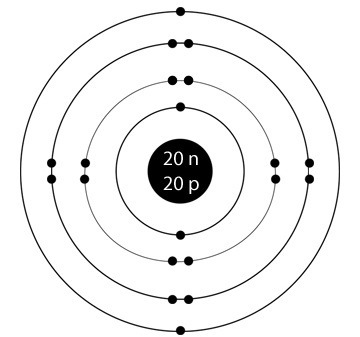
Illustrate a model of a calcium atom including the number and position of protons neutrons and electrons in the atom
andrey2020 [161]

The model would look something like the image below.

There would be a <em>central nucleus</em> containing <em>20 protons</em> and <em>20 neutrons</em>.

Surrounding the nucleus would be four concentric rings (energy levels) containing <em>20 electron</em>s.

Going out from the nucleus, the number of electrons in each ring would

be <em>2, 8, 8, 2</em>.

8 0
2 years ago
Olive oil has a density of 0.92g/ml. How much would 1.0 Liter of olive oil weigh in grams?
Julli [10]

Answer:

9.2x10²g

Explanation:

Data obtained from the question include the following:

Density = 0.92g/ml

Volume = 1L = 1 x 1000 = 1000mL

Mass =..?

Density is simply defined as the mass of the substance per unit volume of the substance. Mathematically it can be represented as:

Density = Mass /volume.

Mass = Density x volume

Mass = 0.92 x 1000

Mass = 9.2x10²g.

Therefore, 1L of olive will weigh 9.2x10²g.

5 0
2 years ago
A high school class is discussing whether a particular discovery in chemistry has had a positive impact on society. Which questi
AURORKA [14]
The most important question for the students to answer is what the discovery did to society. Did it change society in any way or better something?
3 0
2 years ago
Other questions:
  • Write the empirical formula of at least four binary ionic compounds that could be formed from the following ions:
    11·2 answers
  • Give the atomic symbol for an element that does not exist as a molecule or extended structure. that is, an element that exists o
    14·2 answers
  • Calculate the frequency of the n = 6 line in the Lyman series of hydrogen.
    15·2 answers
  • In the compound potassium nitrate (KNO3), the atoms within the nitrate ion are held together with bonding, and the potassium ion
    8·1 answer
  • A radioisotope is placed near a radiation detector, which registers 64 counts per second. Eight hours later, the detector regist
    11·2 answers
  • The name "penicillin" is used for several closely-related antibiotics. A 1.2177 g sample of one of these compounds is burned, pr
    12·1 answer
  • The first ionization energy of chlorine is 1.25x10³ kJ/mol. What is the wavelength of light in units of meters (absorbed) which
    6·1 answer
  • Describe the valence electrons in nitrogen and how it could bond to other atoms.
    14·1 answer
  • A student in a chemistry laboratory has access to two acid solutions. The first one is 20% acid and the second solution is 45% a
    12·1 answer
  • Consider the energy diagram below.
    12·2 answers
Add answer
Login
Not registered? Fast signup
Signup
Login Signup
Ask question!