answer.
Ask question
Login Signup
Ask question
All categories
  • English
  • Mathematics
  • Social Studies
  • Business
  • History
  • Health
  • Geography
  • Biology
  • Physics
  • Chemistry
  • Computers and Technology
  • Arts
  • World Languages
  • Spanish
  • French
  • German
  • Advanced Placement (AP)
  • SAT
  • Medicine
  • Law
  • Engineering
Xelga [282]
2 years ago
12

The name "penicillin" is used for several closely-related antibiotics. A 1.2177 g sample of one of these compounds is burned, pr

oducing 0.4503 g of SO2, 2.1654 g of CO2, 0.6965 g of H2O, and 0.2109 g of NO. Determine the empirical formula of this compound.
Chemistry
1 answer:
masya89 [10]2 years ago
4 0

<u>Answer:</u> The empirical formula for the given organic compound is C_7H_{11}O_2SN

<u>Explanation:</u>

The chemical equation for the combustion of hydrocarbon having carbon, hydrogen and oxygen follows:

S_vN_wC_xH_yO_z+O_2\rightarrow CO_2+H_2O+SO_2+NO

where, 'v', 'w' 'x', 'y' and 'z' are the subscripts of sulfur, nitrogen, carbon, hydrogen and oxygen respectively.

We are given:

Mass of CO_2=0.2829g

Mass of H_2O=0.1159g

Mass of SO_2=0.4503g

Mass of NO = 0.2109 g

We know that:

Molar mass of carbon dioxide = 44 g/mol

Molar mass of water = 18 g/mol

Molar mass of sulfur dioxide = 64 g/mol

Molar mass of nitrogen monoxide = 30 g/mol

  • <u>For calculating the mass of carbon:</u>

In 44 g of carbon dioxide, 12 g of carbon is contained.

So, in 2.1654 g of carbon dioxide, \frac{12}{44}\times 2.1654=0.590g of carbon will be contained.

  • <u>For calculating the mass of hydrogen:</u>

In 18 g of water, 2 g of hydrogen is contained.

So, in 0.6965 g of water, \frac{2}{18}\times 0.6965=0.077g of hydrogen will be contained.

  • <u>For calculating the mass of sulfur:</u>

In 64 g of sulfur dioxide, 32 g of sulfur is contained.

So, in 0.4503 g of sulfur dioxide, \frac{32}{64}\times 0.4503=0.225g of sulfur will be contained.

  • <u>For calculating the mass of nitrogen:</u>

In 30 g of nitrogen monoxide, 14 g of nitrogen is contained.

So, in 0.2109 g of nitrogen monoxide, \frac{14}{30}\times 0.2109=0.098g of nitrogen will be contained.

  • Mass of oxygen in the compound = (1.2177) - (0.590 + 0.077 + 0.225 + 0.098) = 0.2277 g

To formulate the empirical formula, we need to follow some steps:

  • <u>Step 1:</u> Converting the given masses into moles.

Moles of Carbon =\frac{\text{Given mass of Carbon}}{\text{Molar mass of Carbon}}=\frac{0.590g}{12g/mole}=0.049moles

Moles of Hydrogen = \frac{\text{Given mass of Hydrogen}}{\text{Molar mass of Hydrogen}}=\frac{0.077g}{1g/mole}=0.077moles

Moles of Oxygen = \frac{\text{Given mass of oxygen}}{\text{Molar mass of oxygen}}=\frac{0.2277g}{16g/mole}=0.0142moles

Moles of Sulfur = \frac{\text{Given mass of Sulfur}}{\text{Molar mass of sulfur}}=\frac{0.225g}{32g/mole}=0.007moles

Moles of Nitrogen = \frac{\text{Given mass of nitrogen}}{\text{Molar mass of nitrogen}}=\frac{0.098g}{14g/mole}=0.007moles

  • <u>Step 2:</u> Calculating the mole ratio of the given elements.

For the mole ratio, we divide each value of the moles by the smallest number of moles calculated which is 0.007 moles.

For Carbon = \frac{0.049}{0.007}=7

For Hydrogen  = \frac{0.077}{0.007}=11

For Oxygen  = \frac{0.0142}{0.007}=2.03\approx 2

For Sulfur  = \frac{0.007}{0.007}=1

For Nitrogen  = \frac{0.007}{0.007}=1

  • <u>Step 3:</u> Taking the mole ratio as their subscripts.

The ratio of C : H : O : S : N = 7 : 11 : 2 : 1 : 1

Hence, the empirical formula for the given compound is C_7H_{11}O_2S_1N_1=C_7H_{11}O_2SN

You might be interested in
Phosphine, ph3(g), combusts in oxygen gas to form water vapor and solid tetraphosphorus decaoxide. express your answer as a bala
djverab [1.8K]

Tetraphosphorus Decaoxide has a molecular formula of P4O10, all else are known. Therefore the balanced chemical equation would be:

4PH3 + 8O2 --> 6H2O + P4O10


Taking into account the phases:

4PH3(g) + 8O2(g) --> 6H2O(g) + P4O10(s)

6 0
2 years ago
Convert 5.0x10^24 molecules to liters.
makvit [3.9K]
Number of moles = 5 x 10^24 / 6.02 x 10^23 = 8.305 moles. Volume= moles x 22.4 = 186.032 liters. Hope this helps!
5 0
2 years ago
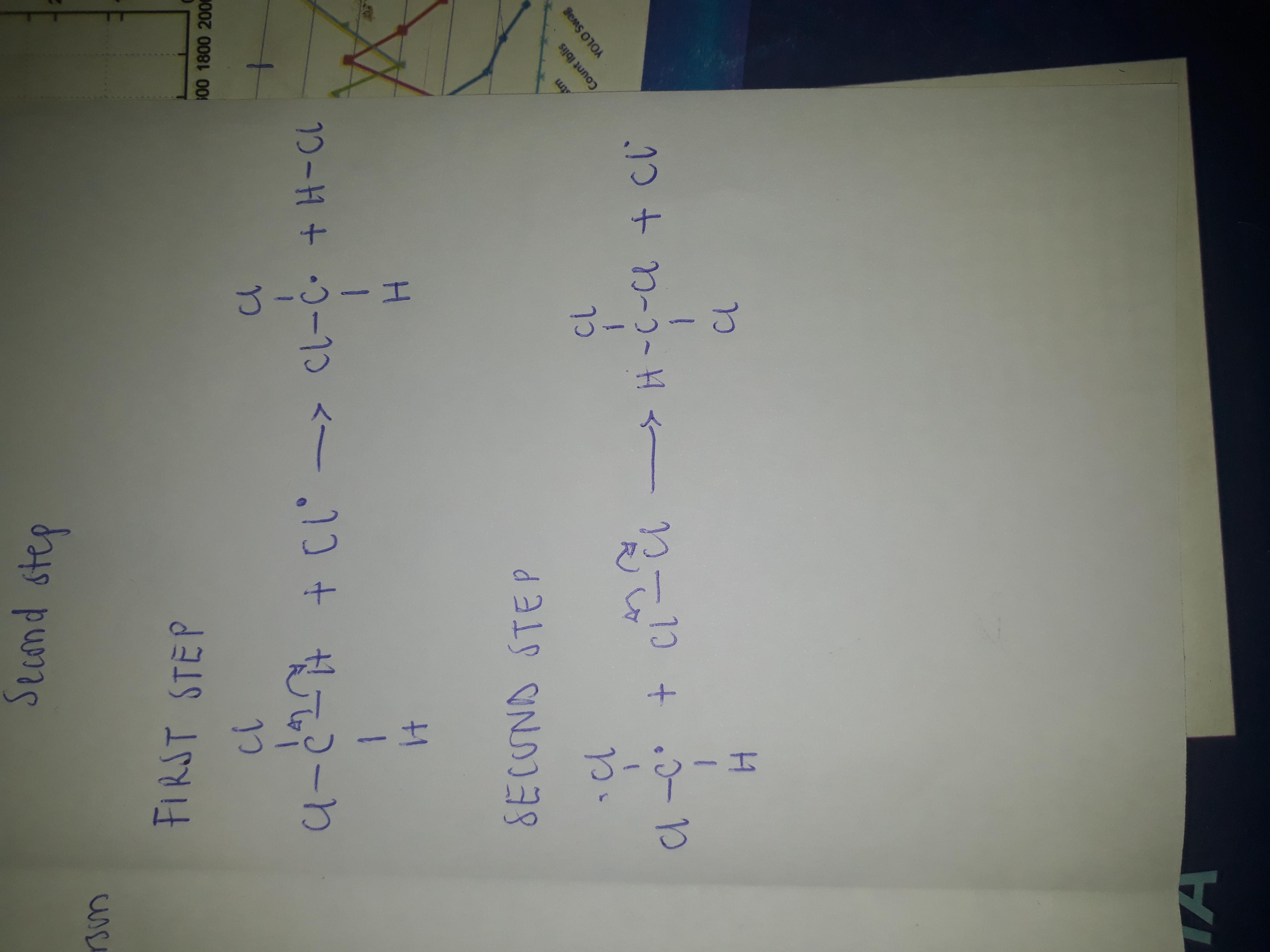
Which of the following represents a propagation step in the monochlorination of methylene chloride (CH2Cl2)?a. CHCl3 + Cl. Right
svetlana [45]

Answer:

B = CHCl2 + Cl2 --> CHCl3 + Cl

Explanation:

Free radical halogenation is a chlorination reaction on Alkane hydrocarbons. This involves the splitting of molecules into radicals/ unstable molecules in the presence of sunlight/ U.V light which ensures bonding of the molecules.

Free radical chlorination is divided into 3 steps which are:

The initiation step

The propagation step

The termination step

So in reference to the question, propagation step involves two steps.

The first step is where the molecule in this case the methylene chloride(CH2Cl2) loses a hydrogen atom and then bond with a chlorine atom radical to give a nethylwnw chloride radical and HCl.

The second step involves the reaction of this methylene chloride got in the first step with chlorine molecule to form trichloride methane and a chlorine radical.

You would find in the attachment the 2 step mechanism.

3 0
2 years ago
How many grams of sulfur must be burned to give 100.0 g of So2
andriy [413]

Answer:

50 g of S are needed

Explanation:

To star this, we begin from the reaction:

S(s) + O₂ (g) →  SO₂ (g)

If we burn 1 mol of sulfur with 1 mol of oxygen, we can produce 1 mol of sulfur dioxide. In conclussion, ratio is 1:1.

According to stoichiometry, we can determine the moles of sulfur dioxide produced.

100 g. 1mol / 64.06g = 1.56 moles

This 1.56 moles were orginated by the same amount of S, according to stoichiometry.

Let's convert the moles to mass

1.56 mol . 32.06g / mol = 50 g

4 0
2 years ago
Which choice(s) correctly rank(s) the bonds in terms of increasing polarity?
Marina CMI [18]

Answer:

(II) only correctly rank the bonds in terms of increasing polarity.

Explanation:

Bond polarity is proportional to difference in electronegativity between bonded atoms.

Atoms    Electronegativity          Bond        Electronegativity difference

Cl                          3.0                       Cl-F                      1.0

Br                          2.8                       Br-Cl                     0.2

F                            4.0                       Cl-Cl                      0

H                            2.1                       H-C                       0.4

C                            2.5                       H-N                       0.9

N                             3.0                      H-O                       1.4

O                             3.5                      Br-F                       1.2

I                               2.7                      I-F                         1.3

Si                             1.9                      Cl-F                       1.0  

P                              2.2                      Si-Cl                      1.1

                                                          Si-P                        0.3

                                                          Si-C                        0.6

                                                           Si-F                        2.1

So, clearly, order of increasing polarity : O-H > N-H > C-H

So, (II) only correctly rank the bonds in terms of increasing polarity

4 0
2 years ago
Other questions:
  • In a blast furnace, elemental iron is produced from a mixture of coke (c), iron ore (fe3o4), and other reactants. an important r
    15·1 answer
  • Rank the size of a change in temperature of one degree Fahrenheit, one degree Celsius, and one kelvin. In other words, if a ther
    6·1 answer
  • How much energy must be supplied to break a single aluminum-27 nucleus into separated protons and neutrons if an aluminum-27 ato
    10·1 answer
  • Most NADH molecules generated during cellular respiration are produced during __________. View Available Hint(s) Most NADH molec
    10·1 answer
  • What will occur if solution A containing 400 mosmol/L nonpenetrating solute is separated by a biological membrane from solution
    14·1 answer
  • Rubbing alcohol contains 615g of isopropanol (C3H7OH) per liter (aqueous solution). Calculate the molality of this solution. Giv
    12·1 answer
  • 1. Calculate the molarity of a sugar solution if 4 liters of the solution contains 8 moles of sugar
    15·1 answer
  • Reaction A has a high activation energy, whereas reacton B has a low activation energy. Which of the statements about reaction A
    12·1 answer
  • What is the difference between matter and non matter ?
    7·2 answers
  • Question 5
    5·1 answer
Add answer
Login
Not registered? Fast signup
Signup
Login Signup
Ask question!