answer.
Ask question
Login Signup
Ask question
All categories
  • English
  • Mathematics
  • Social Studies
  • Business
  • History
  • Health
  • Geography
  • Biology
  • Physics
  • Chemistry
  • Computers and Technology
  • Arts
  • World Languages
  • Spanish
  • French
  • German
  • Advanced Placement (AP)
  • SAT
  • Medicine
  • Law
  • Engineering
taurus [48]
1 year ago
8

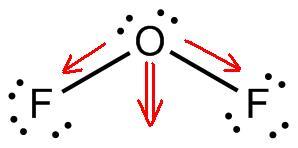
The compound F2O has two lone pairs on the central oxygen atom. What's the structure of an F2O molecule? Is this compound polar

or non-polar? Question 1 options: A) Bent or angular, polar B) Trigonal planar, polar C) Bent or angular, non-polar D) Trigonal planar, non-polar
Chemistry
1 answer:
GuDViN [60]1 year ago
3 0

Answer:  A) Bent or angular, polar

Explanation:

The central atom oxygen has two lone pairs and two bond pairs in OF_2. The number of electron pairs are 4,  that means the hybridization will be sp^3 and the electronic geometry of the molecule will be tetrahedral. But as there are two lone pair of atoms around the central oxygen atom, repulsion between lone and bond pair of electrons is more and hence the molecular geometry will be bent shape.

The compound OF_2 is polar as the net dipole moment of oxygen - fluoride bonds do not cancel each other out.

You might be interested in
Butane (c4h10) undergoes combustion in excess oxygen to generate gaseous carbon dioxide and water. given δh°f[c4h10(g)] = –124.7
vagabundo [1.1K]

The value of Δ H butane (g) = -124.7 kJ/mol

The value of Δ H CO2 (g) = -393.5 kJ/mol

The value of Δ H H2O (g) = -241.8 kJ/mol

Mass of butane, m = 8.30 gm

Molar mass of butane is 58 gm/mol

Consider the reaction,

C₄H₁₀ + 6.5 O₂ = 4CO₂ + 5H₂O

Calculating the value of Δ H° rxn:

ΔH°rxn = ∑nH° f (products) - ∑nH° f (reactants)

Substituting the values we get,

Δ H° rxn = 4 (-393.5) + 5 (-241.8) - (-124.7)

= -1574 -1209 + 124.7

= -2783 - 124.7

= -2658.3 kJ/mol

Now, calculate the number of moles of butane in 8.30 gm.

Number of moles = mass/molar mass

= 8.30 / 58

= 0.143 moles

Thus, the total energy released in the reaction is,

Q = number of moles × ΔH° rxn

= 0.143 × (2658.3)

= 380.14 kJ

Hence, the total heat released in the reaction is 380.14 kJ.
6 0
2 years ago
Explain why you cannot just take away a proton to make a halogen negative.​
Ilia_Sergeevich [38]

The force that holds protons and neutrons together is too strong to overcome.

<h3>Explanation</h3>

Consider the location of the particles in an atom.

  • Electrons are found outside the nucleus.
  • Protons and neutrons are found within the nucleus.

Protons carry positive charges and repel each other. The nucleus will break apart without the strong force that holds the protons and neutrons together. This force is much stronger than the attraction between the nucleus and the electrons. X-rays are energetic enough for removing electrons from an atom. However, you'll need a collider to remove protons from a stable nucleus. You could well have ionized the atom with all that energy.

Also, changing the number of protons per nucleus will convert the halogen atom to an atom of a different element. Rather than making the halogen negative, removing a proton will convert the halogen atom to the negative ion of a different element.

6 0
2 years ago
When you apply heat energy to a substance, where does the energy go? Think about the law of conservation of energy.
MAVERICK [17]

The energy is transformed into kinetic energy which makes the substance to move. The law of conservation of energy which is the first law of thermodynamics states that in a closed system energy can neither be created nor destroyed but can change from one form to another

7 0
2 years ago
n the diagram shown, when an object ‘X’ is brought near the ring shaped magnet, the magnet moves away from it. Four friends are
kati45 [8]

Answer:

Akash

Explanation:

it could be a magnet with the same poles facing eachoher

6 0
2 years ago
Sodium acetate spontaneously crystallizes out of a supersaturated solution upon standing or upon the addition of a seed crystal.
AlekseyPX

Answer:

Option (c) is correct.

Explanation:

According to 2nd law of thermodynamics, every spontaneous process is associated with increase in entropy (\Delta S>0).

As sodium acetate crystallizes out spontaneously therefore it is associated with \Delta S>0.

During crystallization, bond formation takes place which results evolution of heat. In other words, crystallization phenomenon is exothermic (\Delta H).

So, the given crystallization process renders the following thermodynamic quantities- \Delta S>0 J/K and \Delta H J

Option (c) is correct.

6 0
2 years ago
Other questions:
  • [16]. A 3.0 L container holds a sample of hydrogen gas at 150 kPa. If the pressure increases to 2 atm and the temperature remain
    14·1 answer
  • What will be the pressure in atmospheres in a 750.0 mL vessel containing 5.00 g of argon gas at 15°C?
    15·1 answer
  • Which gas tank will empty first? acetylene (C2H2) oxygen (O2)
    13·2 answers
  • Which expression represents the equilibrium constant expression for sulphurous acid (H2SO3)?
    8·1 answer
  • In the compound potassium nitrate (KNO3), the atoms within the nitrate ion are held together with bonding, and the potassium ion
    8·1 answer
  • You have a balloon filled with hydrogen gas which keeps it at a constant pressure, regardless of its volume. The initial volume
    7·1 answer
  • A cylinder container can hold 2.45 L of water. It’s radius is 4.00 cm. What is the volume of it in cubic centimeters?
    7·1 answer
  • A sample of an unknown gas weighs 0.419 grams and produced 5.00L of gas at 1.00atm (unknown gas only) and 298.15K, what is the m
    9·1 answer
  • There are many important laws and theories in science. Which of the following is a law of science?
    11·2 answers
  • The diagram below represents a beaker of water being heated by a flame. The arrows represent heat
    14·1 answer
Add answer
Login
Not registered? Fast signup
Signup
Login Signup
Ask question!
