answer.
Ask question
Login Signup
Ask question
All categories
  • English
  • Mathematics
  • Social Studies
  • Business
  • History
  • Health
  • Geography
  • Biology
  • Physics
  • Chemistry
  • Computers and Technology
  • Arts
  • World Languages
  • Spanish
  • French
  • German
  • Advanced Placement (AP)
  • SAT
  • Medicine
  • Law
  • Engineering
Mekhanik [1.2K]
2 years ago
4

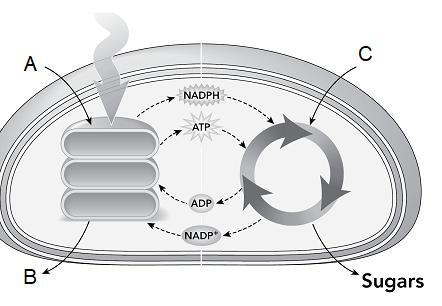
Vernon is using the diagram shown below to develop a model of photosynthesis. The letters A, B, and C each represent a reactant

or product of the process.
In the light-dependent reactions, light strikes the oval thylakoids. Compound A enters the thylakoid, and compound B leaves it. In the light-independent reactions, compound C enters a cycle in the stroma, and sugars leave the cycle. ATP and NADPH cycle between the two sets of reactions.

Vernon wonders whether NADPH and ATP should be classified as reactants or as products of photosynthesis. How should these compounds be classified?

A. as reactants, because they are used up by photosynthesis
B. as products, because they are generated by photosynthesis
C. as either reactants or products, depending on the rate that photosynthesis occurs
D. as neither reactant nor product, because they are recycled instead of made or used up

Chemistry
2 answers:
ser-zykov [4K]2 years ago
6 0

Answer:

Explanation:

The right answer is D

vagabundo [1.1K]2 years ago
3 0

Answer:

The anwser to this problem is C :)

Explanation:

You might be interested in
A solution is made by dissolving 9.74 g of sodium sulfate in water to a final volume of 165 mL of solution. What is the weight/w
MatroZZZ [7]

Answer: The weight/weight % or percent by mass of the solute is 5.41 %.

Explanation:

Mass of the sodium sulfate,w = 9.74 g

Volume of the water = 165 mL

Density of the water = 1 g/mL

Density=1 g/mL=\frac{\text{Mass of water}}{\text{Volume of water}}

Mass of the water =1 g/mL\times 165 mL=165 g

Mass of the solution, W:

Mass of solute + Mass of solvent =9.47 g + 165 g=174.47 g

w/w\%=\frac{w\times 100}{W}=\frac{9.45 g\times 100}{174.47 g}=5.41 \%

The weight/weight % or percent by mass of the solute is 5.41 %.


8 0
2 years ago
Why is radioactive dating important when approximating the age of earth?
Furkat [3]

Answer:

So, we rely on radiometric dating to calculate their ages. Radiometric dating, or radioactive dating as it is sometimes called, is a method used to date rocks and other objects based on the known decay rate of radioactive isotopes.

Explanation:

radiometric dating is a very accurate way to date the Earth.We know it is accurate because radiometric dating is based on the radioactive decay of unstable isotopes. When an unstable Uranium (U) isotope decays, it turns into an isotope of the element Lead (Pb).

6 0
2 years ago
Read 2 more answers
A gas occupies 22.4 l at stp and 14.5 l at 100c and 2.00 atm pressure. how many moles of gas did the system gain or lose?
azamat
<span>At standard temperature and pressure 22.4 l of an ideal gas would contain 1 mole. in order to find the change in moles we must look at the ideal gas law PV=nRT where P=Pressure V=volume n=Moles R= Gas constant T= Temperature. To simplify this equation we will be using the gas constant at .08206 L-atm/mol-K. We must first convert 100c to k which is 373.15. Then we can plug the values into our equation which gives us (2atm)(14.5 l)=(n)(.08206 L-atm/mol-K)(373.15). After some basic algebra we get the moles to equal roughly .95 which is .05 moles less than our original system.</span>
6 0
2 years ago
495 cm3 of oxygen gas and 877 cm3 of nitrogen gas, both at 25.0 C and 114.7 kpa, are injected into an evacuated 536 cm3 flask. F
I am Lyosha [343]

Answer:

<u><em>Total pressure of the flask is 2.8999 atm.</em></u>

Explanation:

Given data:

Volume of oxygen (O2) gas= 495 cm3

                                              = 0.495 L (1 cm³ = 1 mL = 0.001 L)                                            

Volume of nitrogen (N2) gas =  877 cm3

                                               = 0.877 L (1 cm³ = 1 mL = 0.001 L)

volume of falsk = 536 cm3

                         = 0.536 L (1 cm³ = 1 mL = 0.001 L)

Temperature =  25 °C

T = (25°C + 273.15) K

    = 298.15 K

Pressure = 114.7 kPa

               = 114.700 Pa

Pressure (torr) = 114,700 / 101325

                        = 1.132 atm

Formula:

PV=nRT  <em>(ideal gas equation)</em>

P = pressure

V = volume

R (gas constnt)=  0.0821 L.atm/K.mol

T = temperature

n = number of moles for both gases

Solution:

Firstly we will find the number of moles for oxygen and nitrogen gas.

<u>For Oxygen:</u>

n = PV / RT

n = 1.132 atm × 0.495 L / 0.0821 L.atm/K.mol × 298.15 K

  = 0.560 / 24.47

  = 0.0229 moles

<u>For Nitrogen:</u>

n = PV / RT

n = 1.132 atm × 0.877 / 0.0821 L.atm/K.mol × 298.15 K

n = 0.992 / 24.47

  = 0.0406

Total moles = moles for oxygen gas + moles for nitrogen gas

  = 0.0229 moles + 0.0406 moles

n  = 0.0635 moles

Now put the values in formula

PV=nRT

P = nRT / V

P = 0.0635 × 0.0821 L.atm/K.mol × 298.15 K  /  0.536 L

P = 1.554 / 0.536

<u><em>P = 2.8999 atm</em></u>

Total pressure in the flask is  2.8999 atm, while assuming the temperature constant.

7 0
2 years ago
Read 2 more answers
A 2.50-l flask contains a mixture of methane (ch4) and propane (c3h8) at a pressure of 1.45 atm and 20°c. when this gas mixture
Cerrena [4.2K]

Answer:- Mole fraction of methane in the original gas mixture is 0.854.

Solution:- From given volume, pressure and temperature, we could calculate the total moles of the gaseous mixture of methane and propane using ideal gas law as:

PV = nRT

n=\frac{PV}{RT}

V = 2.50 L

P = 1.45 atm

T = 20 + 273 = 293 K

Let's plug in the values in the equation:

n=(\frac{1.45*2.50}{0.0821*293})

n = 0.151

Let's say the solution has X moles of methane. Then moles of propane would be = (0.151 - X)

The combustion equations of methane and propane are:

CH_4+2O_2\rightarrow CO_2+2H_2O

C_3H_8+5O_2\rightarrow 3CO_2+4H_2O

From methane balanced equation, there is 1:1 mol ratio between methane and carbon dioxide. So, X moles of methane would produce X moles of carbon dioxide.

From balanced equation of propane, there is 1:3 mol ratio between propane and carbon dioxide. So, (0.151 - X) moles of propane would give 3(0.151 - X) moles of carbon dioxide.

So, total moles of carbon dioxide that we would get from methane and propane combustion are:

X + 3(0.151 - X)

From given data, 8.60 g of carbon dioxide are formed by the combustion of gas mixture.

moles of Carbon dioxide = 8.60g(\frac{1mol}{44g})

moles of carbon dioxide = 0.195 mol

Hence, 0.195 = X + 3(0.151 - X)

Let's solve this for X as:

0.195 = X + 0.453 - 3X

0.195 = 0.453 - 2X

2X = 0.453 - 0.195

2X = 0.258

X=\frac{0.258}{2}

X = 0.129

So, there are 0.129 moles of methane in the mixture.

moles of propane = 0.151 - 0.129 = 0.022

mole fraction of methane = \frac{moles of Methane}{total moles}

mole fraction of methane = \frac{0.129}{0.151}

mole fraction of methane = 0.854

Hence, the mole fraction of methane gas in the original gas mixture is 0.854.
6 0
2 years ago
Other questions:
  • In which of these situations would light slow down?
    14·2 answers
  • If a large marshmallow has a volume of 2.75 in3 and density of 0.242 g/cm3, how much would it weigh in grams? 1 in3=16.39 cm3.
    9·1 answer
  • Ms. Block's students are studying chemical reactions. A classic reaction occurs when a metal is added to hydrochloric acid. Migu
    11·2 answers
  • Mercury and bromine willreact with each other to produce mercury (II) bromide:Hg(l)+Br2(l)--&gt;HgBr2(s)Consider an experimentwh
    5·2 answers
  • Boris is interested in conducting his first "real" scientific research. However, he is a bit overwhelmed with all of the possibl
    11·1 answer
  • g A 0.25 mol sample of HBr is added to a 1.00 L buffer solution consisting of 0.68 M HCN and 0.35 M NaCN. Identify all species t
    10·1 answer
  • Dibutyl phthalate is a plasticizer added to make brittle polymers softer and more flexible. Dibutyl phthalate can be prepared by
    11·1 answer
  • 5. Rubbing alcohol is a commonly used disinfectant and has a cooling effect when applied to the skin. The active ingredient in r
    12·1 answer
  • As the pressure of a system changes, boiling points can change in what direction?
    5·2 answers
  • NaOH+HCL=NaCL+H2O
    12·1 answer
Add answer
Login
Not registered? Fast signup
Signup
Login Signup
Ask question!
