answer.
Ask question
Login Signup
Ask question
All categories
  • English
  • Mathematics
  • Social Studies
  • Business
  • History
  • Health
  • Geography
  • Biology
  • Physics
  • Chemistry
  • Computers and Technology
  • Arts
  • World Languages
  • Spanish
  • French
  • German
  • Advanced Placement (AP)
  • SAT
  • Medicine
  • Law
  • Engineering
soldier1979 [14.2K]
2 years ago
4

An electrical device is insulated on all sides except one face. That face is bonded to a 4mm thick aluminum plate which is coole

d by air. The electrical device dissipates 10^4 W m2 The resistance of the joint between the device and aluminum plate is 0.5E-4 m2K W The conductivity of the aluminum is 238 W mK The temperature of the air is 278 K and the convection coefficient from the aluminum plate to the air is 100 W m2K What is the operating temperature of the device
Engineering
1 answer:
kifflom [539]2 years ago
8 0

Answer:

t₁ = 378.668 K

Explanation:

From the given information:

The heat dissipated (q) from the electrical device = 10^4 W/m^2

The contact resistance between device and aluminium;

(R_{const} ) = 0.5× 10⁻⁴ m² K/W

Conductivity of aluminum (k)  = 238 \ W/mK

The thickness of aluminum plate (L) = 0.004 m

Convection coefficient (h) = 100 \ W/m^2 K

Surrounding temperature (t_2) = 278 \ k

According to Fourier's law of heat conduction.

q = \dfrac { t_1- t_2 }{R_{const} + \dfrac{L}{k} + \dfrac{1}{h} }

10^4 = \dfrac{t_1 - 278}{0.5 \times 10^{-4} + \dfrac{0.004}{238} + \dfrac{1}{100} }

10^4 *( 0.5 \times 10^{-4} + \dfrac{0.004}{238} + \dfrac{1}{100})  = t_1 - 278

100.668 =  t_1 -278

t₁ = 378.668 K


You might be interested in
Water at 200C flows through a pipe of 10 mm diameter pipe at 1 m/s. Is the flow Turbulent ? a. Yes b. No
Degger [83]

Answer:

Yes, the flow is turbulent.

Explanation:

Reynolds number gives the nature of flow. If he Reynolds number is less than 2000 then the flow is laminar else turbulent.

Given:

Diameter of pipe is 10mm.

Velocity of the pipe is 1m/s.

Temperature of water is 200°C.

The kinematic viscosity at temperature 200°C is 1.557\times10^{-7}m2/s.

Calculation:

Step1

Expression for Reynolds number is given as follows:

Re=\frac{vd}{\nu}

Here, v is velocity, \nu is kinematic viscosity, d is diameter and Re is Reynolds number.

Substitute the values in the above equation as follows:

Re=\frac{vd}{\nu}

Re=\frac{1\times(10mm)(\frac{1m}{1000mm})}{1.557\times10^{-7}}

Re=64226.07579

Thus, the Reynolds number is 64226.07579. This is greater than 2000.

Hence, the given flow is turbulent flow.

5 0
2 years ago
Consider an infinitely thin flat plate of chord c at an angle of attack α in a supersonic flow. The pressure on the upper and lo
amm1812

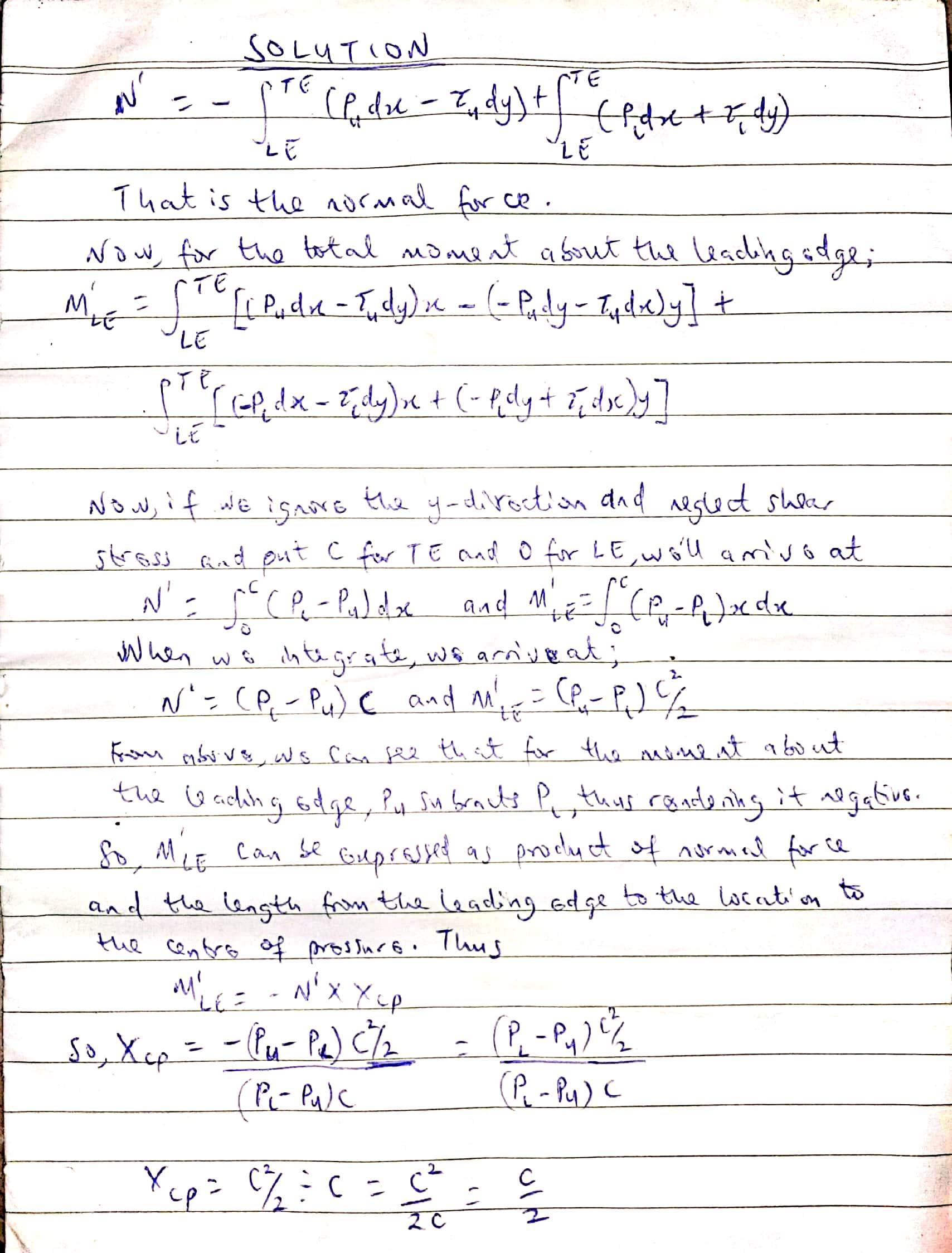
Answer:

X_cp = c/2

Explanation:

We are given;

Chord = c

Angle of attack = α

p u (s) = c 1

​p1(s)=c2,

and c2 > c1

First of all, we need to find the resultant normal force on the plate and the total moment about leading edge.

I've attached the solution

4 0
2 years ago
Derive an equation for the work of a mechanically reversible, isothermal compression of 1 mol of a gas from an initial pressure
Lyrx [107]

Answer:

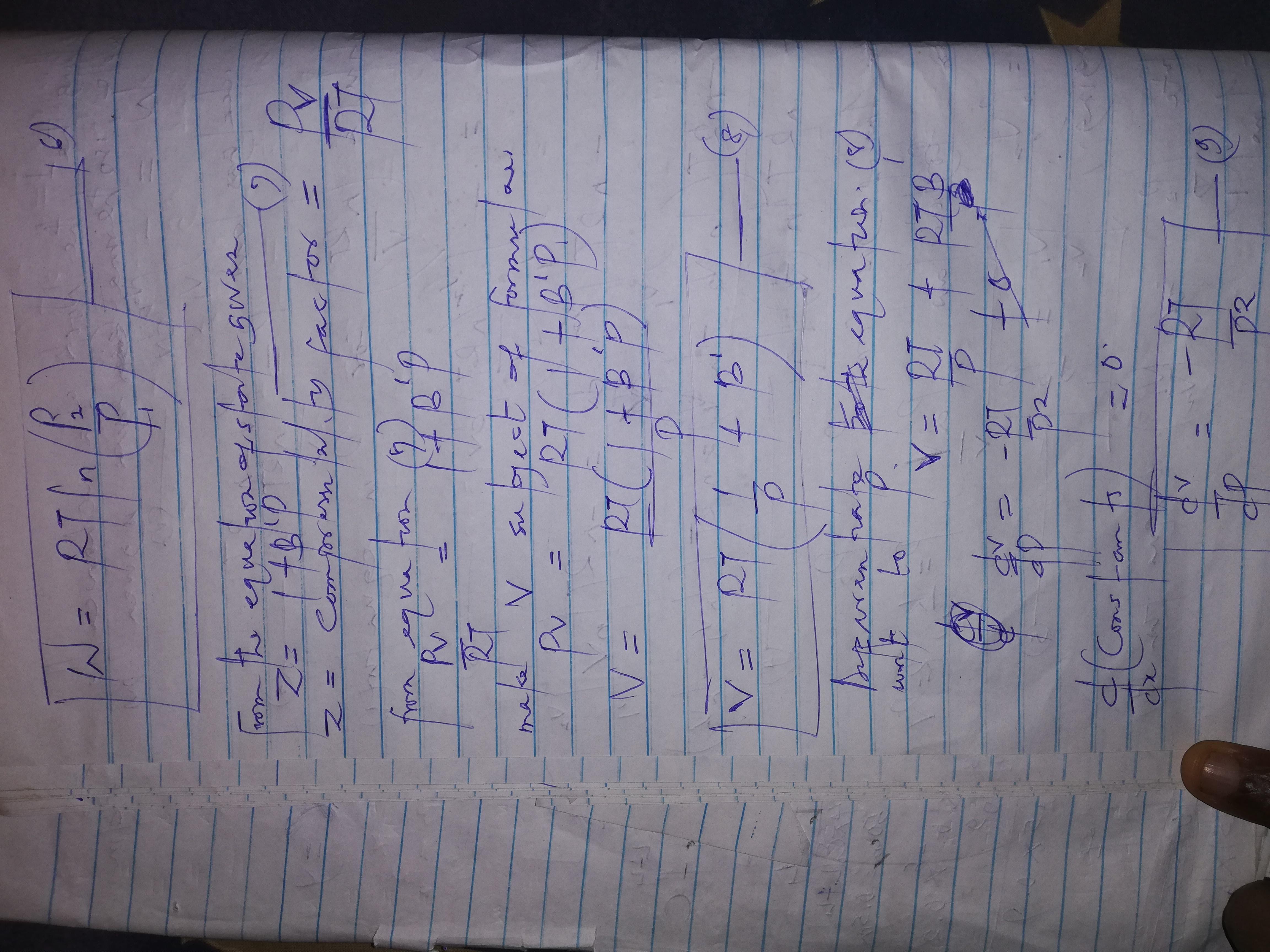
The long derivation for work of a mechanically reversible, isothermal compression was done with detailed steps as shown in the attachment.

Explanation:

what is applied here is a long derivation from Work done in an isobaric process, the expression for the compressibility factor (Z) and the equation of state that was given. The requisite knowledge of Differentiation and Integration was used.

The detailed derivation from firs principle is as shown in the attachment.

5 0
2 years ago
The 8-mm-thick bottom of a 220-mm-diameter pan may be made from aluminum (k = 240 W/m ⋅ K) or copper (k = 390 W/m ⋅ K). When use
Artemon [7]

Answer:

For aluminum 110.53 C

For copper 110.32 C

Explanation:

Heat transmission through a plate (considering it as an infinite plate, as in omitting the effects at the borders) follows this equation:

q = \frac{k * A * (th - tc)}{d}

Where

q: heat transferred

k: conduction coeficient

A: surface area

th: hot temperature

tc: cold temperature

d: thickness of the plate

Rearranging the terms:

d * q = k * A * (th - tc)

\frac{d * q}{k * A} = th - tc

th = \frac{d * q}{k * A} + tc

The surface area is:

A = \frac{\pi * d^2}{4}

A = \frac{\pi * 0.22^2}{4} = 0.038 m^2

If the pan is aluminum:

th = \frac{0.008 * 600}{240 * 0.038} + 110 = 110.53 C

If the pan is copper:

th = \frac{0.008 * 600}{390 * 0.038} + 110 = 110.32 C

7 0
2 years ago
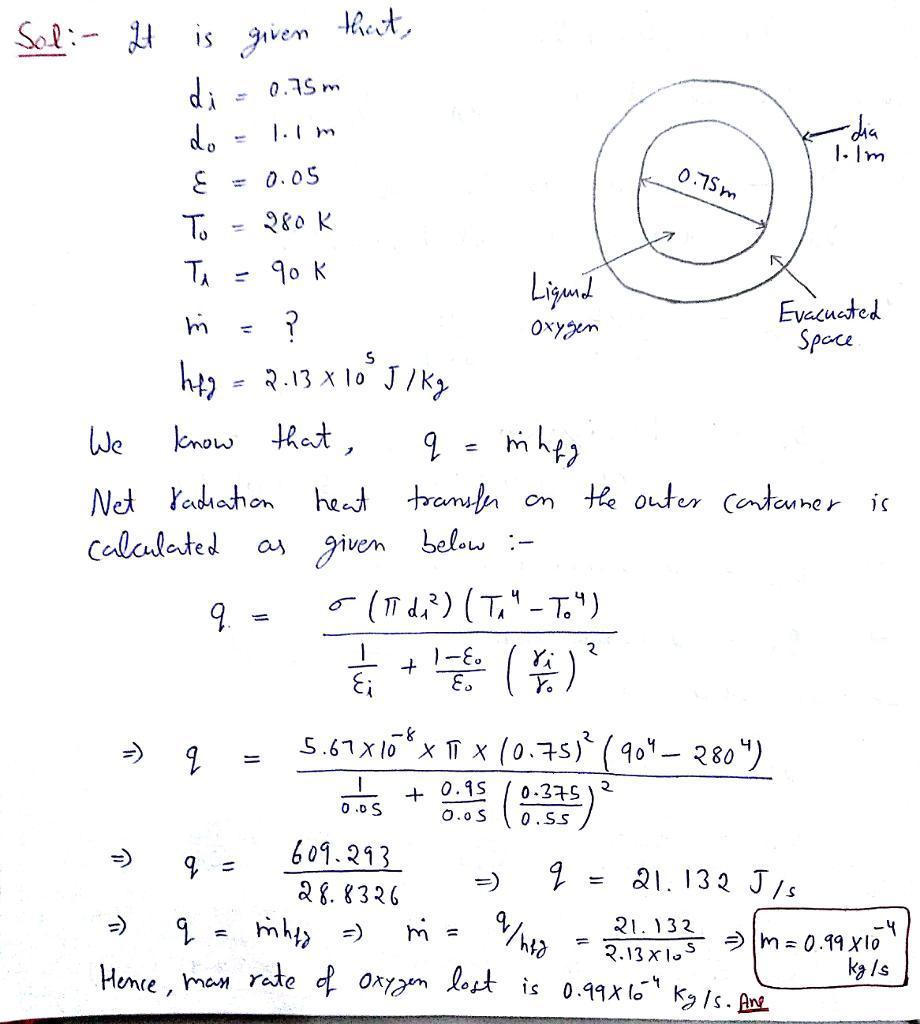
Liquid oxygen is stored in a thin-walled, spherical container 0.75 m in diameter, which is enclosed within a second thin-walled,
nadezda [96]

Answer:

Explanation:

the solution is well stated

3 0
2 years ago
Other questions:
  • A woman approaches a room attendant with a letter. She requests that the attendant leave the letter in Room 1201. Which is the m
    9·1 answer
  • Problem 5) Water is pumped through a 60 m long, 0.3 m diameter pipe from a lower reservoir to a higher reservoir whose surface i
    13·1 answer
  • A ________ is only achieved through control and involves a specific change in one event (dependent variable) that can reliably b
    5·1 answer
  • Prompt the user to enter five numbers, being five people's weights. Store the numbers in an array of doubles. Output the array's
    11·2 answers
  • 4.9 Given that I 4 amps when Vs 40 volts and Is 4 amps and I 1 amp when Vs 20 volts and Is 0, use superposition and linearity to
    5·1 answer
  • g The function below takes a single string parameter: sentence. Complete the function to return everything but the middle 10 cha
    15·1 answer
  • Benzene vapor at 480°C is cooled and converted to a liquid at 25°C in a continuous condenser. The condensate is drained into 1.7
    15·1 answer
  • Discuss your interpretation of the confidence-precision trade-off, and provide a few examples of how you might make a choice in
    14·1 answer
  • NEEDS TO BE IN PYTHON:ISBN-13 is a new standard for indentifying books. It uses 13 digits d1d2d3d4d5d6d7d8d910d11d12d13 . The la
    15·1 answer
  • The rate of flow through an ideal clarifier is 8000m3 /d, the detention time is 1h and the depth is 3m. If a full-length movable
    5·1 answer
Add answer
Login
Not registered? Fast signup
Signup
Login Signup
Ask question!