answer.
Ask question
Login Signup
Ask question
All categories
  • English
  • Mathematics
  • Social Studies
  • Business
  • History
  • Health
  • Geography
  • Biology
  • Physics
  • Chemistry
  • Computers and Technology
  • Arts
  • World Languages
  • Spanish
  • French
  • German
  • Advanced Placement (AP)
  • SAT
  • Medicine
  • Law
  • Engineering
Solnce55 [7]
2 years ago
4

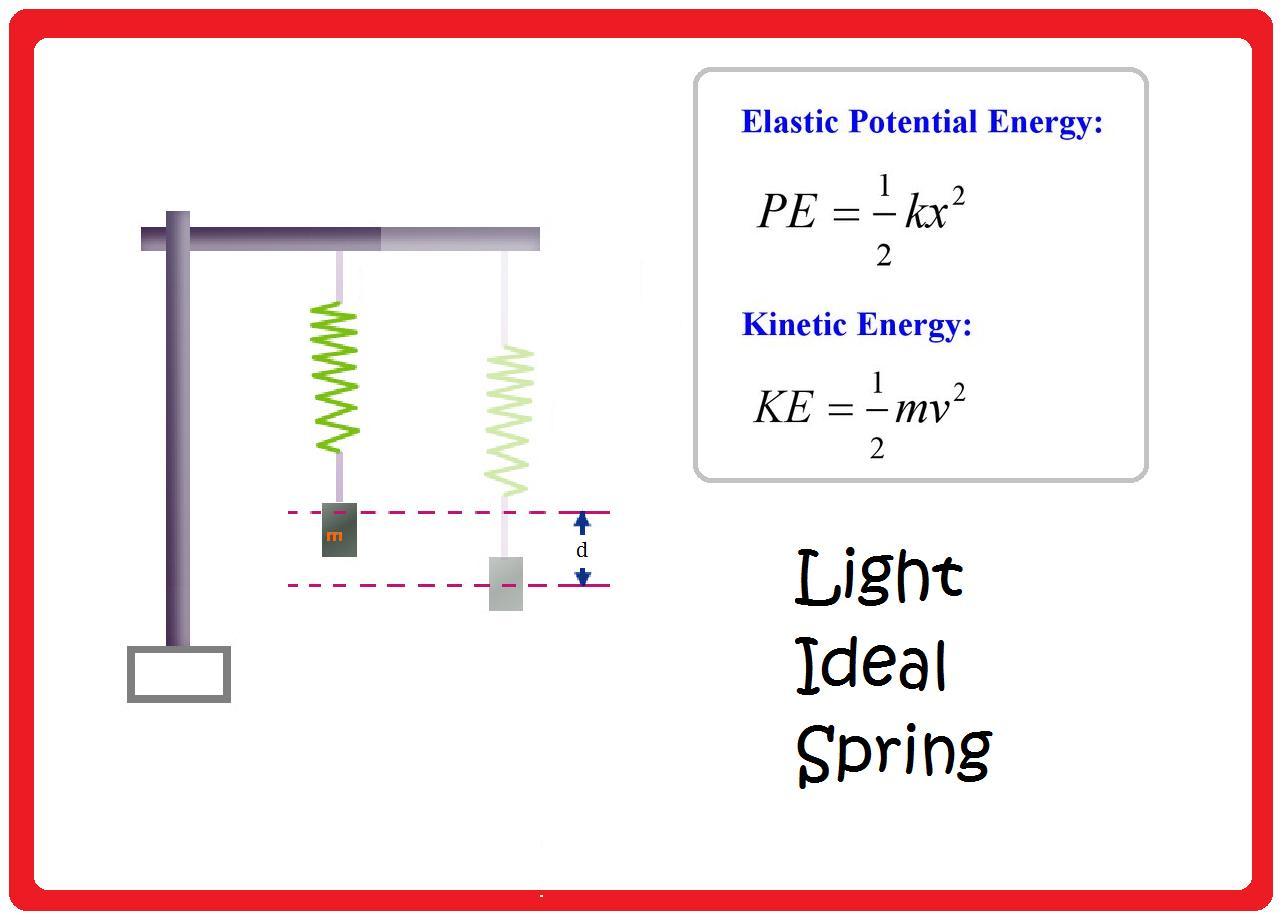
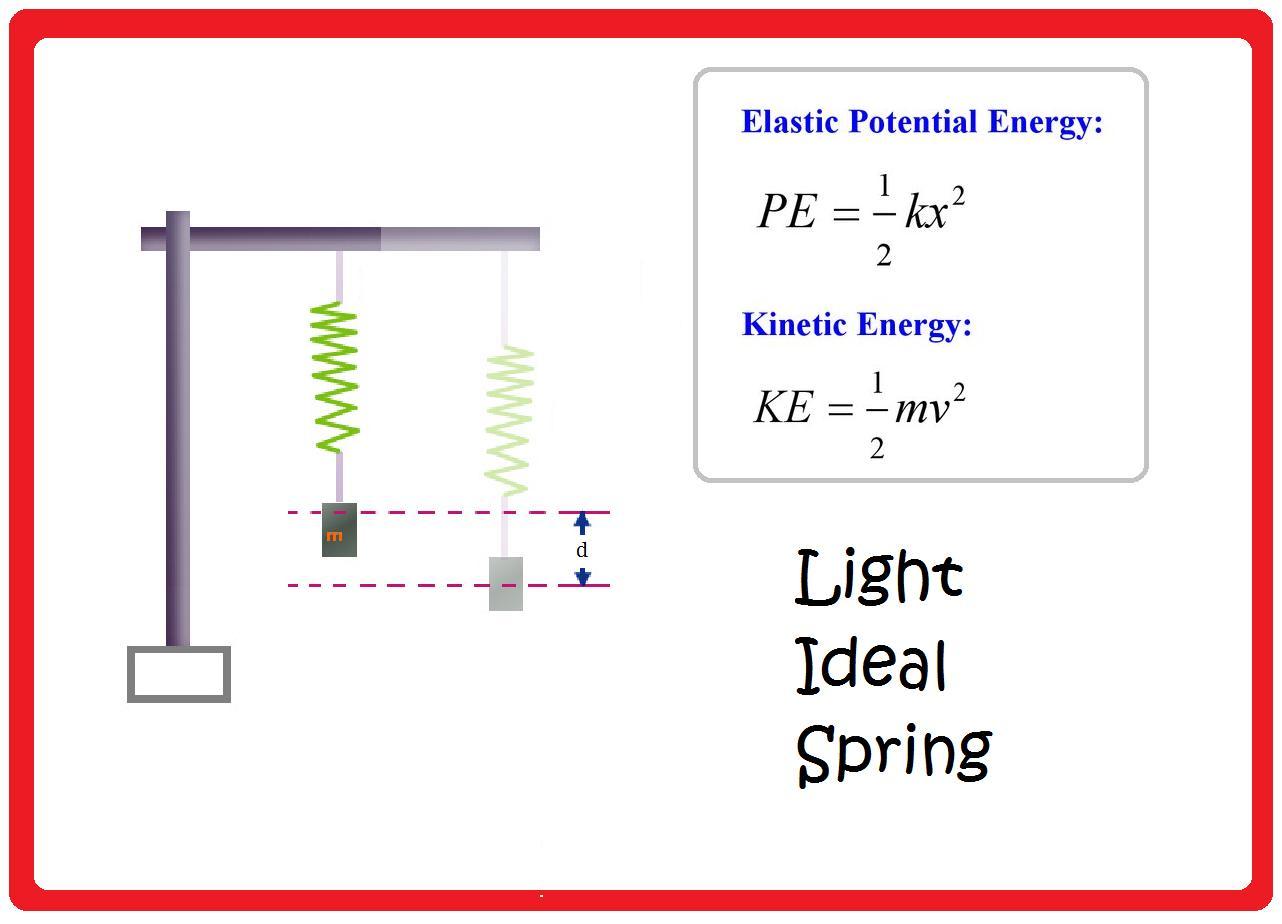
A 2.5-kg box, sliding on a rough horizontal surface, has a speed of 1.2 m/s when it makes contact with a spring (see the figure.

the block comes to a momentary halt when the compression of the spring is 5.0 cm. the work done by the friction, from the instant the block makes contact with the spring until is comes to a momentary halt, is -0.50 j.(a what is the spring constant of the spring?

Physics
2 answers:
lord [1]2 years ago
8 0

The spring constant of the spring is 1040 N/m

\texttt{ }

<h3>Further explanation</h3>

<em>Hooke's Law states that the length of a spring is directly proportional to the force acting on the spring.</em>

\boxed {F = k \times \Delta x}

<em>F = Force ( N )</em>

<em>k = Spring Constant ( N/m )</em>

<em>Δx = Extension ( m )</em>

\texttt{ }

The formula for finding Young's Modulus is as follows:

\boxed {E = \frac{F / A}{\Delta x / x_o}}

<em>E = Young's Modulus ( N/m² )</em>

<em>F = Force ( N )</em>

<em>A = Cross-Sectional Area ( m² )</em>

<em>Δx = Extension ( m )</em>

<em>x = Initial Length ( m )</em>

Let us now tackle the problem !

\texttt{ }

<u>Given:</u>

mass of the object = m = 2.5 kg

initial speed of the object = u = 1.2 m/s

final speed of the object = v = 0 m/s

compression of the spring = x = 5.0 cm = 0.05 m

work done by friction = W_f = -0.50 J

<u>Unknown:</u>

spring constant of the spring = k = ?

<u>Solution:</u>

We will use formula as follows:

W_f = ( Ek' + Ep' ) - ( Ek + Ep )

W_f = ( 0 + \frac{1}{2}kx^2 ) - ( \frac{1}{2}mv^2 + 0 )

\frac{1}{2}mv^2 = \frac{1}{2}kx^2 - W_f

\frac{1}{2}kx^2 = \frac{1}{2}mv^2 + W_f

kx^2 = mv^2 + 2W_f

k = ( mv^2 + 2W_f ) \div x^2

k = ( 2.5(1.2)^2 + 2(-0.50) ) \div (0.05)^2

k = ( 2.6 ) \div ( 0.05 )^2

k = 1040 \texttt { N/m}

\texttt{ }

<h3>Learn more</h3>
  • Young's modulus : brainly.com/question/6864866
  • Young's modulus for aluminum : brainly.com/question/7282579
  • Young's modulus of wire : brainly.com/question/9755626

\texttt{ }

<h3>Answer details</h3>

Grade: College

Subject: Physics

Chapter: Elasticity

\texttt{ }

Keywords: Elasticity , Diameter , Concrete , Column , Load , Compressed , Stretched , Modulus , Young
kogti [31]2 years ago
4 0
E = 0.5 * m * v² = 0.5 * k * x² - 0.5

m = 2.5
v = 1.2
x = 0.05

solve for k (spring constant).

You might be interested in
Water, of density 1000 kg/m3, is flowing in a drainage channel of rectangular cross-section. The width of the channel is 15 m, t
Rom4ik [11]

Answer:

Water flowing rate=  (300000kg/s) = (300000l/s)

Explanation:

First with the section of the channel, the depth of the water and the speed of the fluid we can determine the volume of fluid that circulates per second through the channel:

Volume per time= 15m × 8m × (2.5m/s)= 300 m³/s

With this volume of circulating fluid per second elapsed, we multiply it by the density of the water to determine the kilograms or liters of water that circulate through the channel per second elapsed:

Water flowing rate= (300m³/s) × (1000kg/m³)= (300000kg/s) = (300000l/s)

Taking into account that 1kg of water is approximately equal to 1 liter of water.

8 0
2 years ago
A stone is thrown vertically upward with a speed of 15.0 m/s from the edge of a cliff 75.0 m high.How much later does it reach t
Katarina [22]

Answer:

5.72 seconds

848.27 m/s

97.94 m

Explanation:

t = Time taken

u = Initial velocity = 15 m/s

v = Final velocity

s = Displacement

a = Acceleration due to gravity = 9.81 m/s²

v=u+at\\\Rightarrow 0=15-9.81\times t\\\Rightarrow \frac{-15}{-9.81}=t\\\Rightarrow t=1.52 \s

Time taken to reach maximum height is 0.97 seconds

s=ut+\frac{1}{2}at^2\\\Rightarrow s=15\times 1.52+\frac{1}{2}\times -9.81\times 1.52^2\\\Rightarrow s=11.47\ m

So, the stone would travel 11.47 m up

So, total height stone would fall is 75+11.47 = 86.47 m

Total distance travelled by the stone would be 75+11.47+11.47 = 97.94 m

s=ut+\frac{1}{2}at^2\\\Rightarrow 86.47=0t+\frac{1}{2}\times 9.8\times t^2\\\Rightarrow t=\sqrt{\frac{86.47\times 2}{9.81}}\\\Rightarrow t=4.2\ s

Time taken by the stone to travel 86.47 m to the water is is 4.2 seconds

The stone reaches the water after 4.2+1.52 = 5.72 seconds after throwing the stone

v=u+at\\\Rightarrow v=0+9.81\times 86.47 = 848.27\ m/s

Speed just before hitting the water is 848.27 m/s

3 0
2 years ago
You apply the brakes of your car abruptly and your book starts sliding off the front seat. Three observers sitting in the car ex
krek1111 [17]

Answer:

All the observers are correct.

Explanation:

This is simply a problem of reference frames from which the motion of the book is being viewed by the various observers.

From their various reference frames, they are all correct.

Observer A must be in the inertial reference frame.

<em>Observers who can explain the behavior of the book  and the car by using the relationship between the sum of  the forces and changing velocity are said to be observers in inertial reference frames.</em>

This is clearly shown by what observer A noticed. There was a relative motion between the book and the car as she pointed out, making her to be in an inertial reference frame.

<em>Similarly, observers in inertial reference frames can also explain the changes in velocity of objects  by considering the forces exerted on them by other objects.</em>

This is shown by observer B as he is able to notice how the force of the car affects the velocity of the book.

Observer C is actually in a non-inertial reference frame, as newtons law of force motion relationship are no longer observed. This occurs in the non inertial reference frame.

7 0
2 years ago
A rocket is sitting on the launch pad. The engines ignite, and the rocket begins to rise straight upward, picking up speed as it
grandymaker [24]

Answer:

e. Only the rocket's motion from the top of its flight path until just before landing is free-fall.

Explanation:

A free-fall  is a fall just under force of gravity. The rocket;s upward motion is result of engine push - even if it was shut down  - and rocket free of engine push effect when it reaches it's maximum height after shutting down of engine. Then rockets stops at it's maximum height for a moment and rtuens back as free fall with only force of gravitation pulling it back to ground with acceleration 'g'.

4 0
2 years ago
Substance X is placed in a container with substance Y. Both substances are fluids. Substance X initially sinks to the bottom of
Brut [27]

Answer: Option (A) is the correct answer.

Explanation:

Convection is a process in which heat transfers from a hotter substance to a colder substance.

As a result, the substance which is less dense will rise and the more denser substance will sink due to the influence of gravity.

Thus, we can conclude that in the given situation substance X will rise due to convection.

3 0
2 years ago
Read 2 more answers
Other questions:
  • Assume that a cloud consists of tiny water droplets suspended (uniformly distributed,
    13·1 answer
  • A strip 1.2 mm wide is moving at a speed of 25 cm/s through a uniform magnetic field of 5.6 t. what is the maximum hall voltage
    11·1 answer
  • Fred wants to summarize mitosis in the cell cycle. Which statement describes mitosis?
    12·2 answers
  • To warm 2.0 l of tea (d = 1.01 g/ml; sp. heat = a cook places a 500 g block of stone at a temperature of 200f into the teapot. a
    8·1 answer
  • Rod A and rod B are cylindrical rods made of the same metal. amd they differ only in size. Rod B has double the length and doubl
    14·2 answers
  • A 5⁢kg object is released from rest near the surface of a planet such that its gravitational field is considered to be constant.
    11·1 answer
  • Add a third force that will cause the object to remain at rest. Label the new force F⃗ 3. Draw the vector starting at the black
    8·1 answer
  • Bullets from two revolvers are fired with the same velocity. The bullet from gun #1 is twice as heavy as the bullet from gun #2.
    6·1 answer
  • Odległość między kolejnymi grzbietami fal na morzu wynosi 20 m. Łódź opada z grzbietu fali, unosi się i osiąga ponownie najwyższ
    5·1 answer
  • A wire of 5.8m long, 2mm diameter carries 750ma current when 22mv potential difference is applied at its ends. if drift speed of
    10·2 answers
Add answer
Login
Not registered? Fast signup
Signup
Login Signup
Ask question!
