answer.
Ask question
Login Signup
Ask question
All categories
  • English
  • Mathematics
  • Social Studies
  • Business
  • History
  • Health
  • Geography
  • Biology
  • Physics
  • Chemistry
  • Computers and Technology
  • Arts
  • World Languages
  • Spanish
  • French
  • German
  • Advanced Placement (AP)
  • SAT
  • Medicine
  • Law
  • Engineering
Sever21 [200]
2 years ago
3

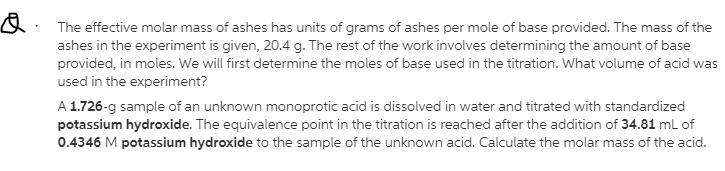
The effective molar mass of ashes has units of grams of ashes per mole of base provided. The mass of the ashes in the experiment

is given, 20.4 g. The rest of the work involves determining the amount of base provided, in moles. We will first determine the moles of base used in the titration. What volume of acid was used in the experiment
Chemistry
1 answer:
Sauron [17]2 years ago
5 0

Answer:

molar mass of  unknown monoprotic acid = 114.1 g / mole.

Explanation:

Note: This question is incomplete and lacks necessary data to solve for the required calculation. However, I have similar question on the internet and seen the question completely and will be using that data to solve for this question in order to solve required calculation. Besides that, complete question asks us to solve for molar mass of the acid used.

Note: I have attached the screenshot of the complete question, please have a look on it in the attachment below.

Calculation:

Volume = 34.81mL

34.81 mL of 0.4346 M potassium hydroxide

= 0.03481 L * 0.4346 mole / L

= 0.01513 mole.

Balance equation:

HA + KOH ----> KA + H2O

As we know from the question,

one mole HA neutralize with 1 mole KOH.

mole of unknown monoprotic acid = 0.01513 mole.

And we know that the formula for mole is:  

mole = mass / molar mass

Making molar mass as the subject:

 Molar mass = mass / mole

Molar mass = 1.726 g / 0.01513 mole

Molar mass = 114.1 g / mole.

So,  

Molar mass of  unknown monoprotic acid = 114.1 g / mole.

You might be interested in
Why does 5060 have three significant figures?
Morgarella [4.7K]
<h2>5060 have three significant figures : Explanation given below </h2>

Explanation:

Significant figures

The significant figures (also known as the significant digits and decimal places) of a number are digits that possess certain  meaning .

It  includes all digits except: zeros

Rules to find significant figures

1.All non-zero digits are considered significant. For example, 23  has two significant figures.

2.Zeros in between two non-zero digits are significant: like in 202.1201  has seven significant figures.

3.Zeros to the left of the significant figures are not significant. For example, .000021 has two significant figures, zeros have no value .

4.Zeros to the right of the significant figures are significant.

That is the reason in number 5060 , it has 3 significant figures .

3 0
2 years ago
he first-order rate constant for the gas-phase decomposition of dimethyl ether, (CH3)2O → CH4 + H2 + CO is 3.2 ✕ 10−4 s−1 at 450
seropon [69]

Answer:

0.290 atm is the pressure of the system after 7.7min

Explanation:

The general first-order rate constant is:

ln [A] = -kt + ln [A]₀

<em>Where [A] is concentration of A in time t,</em>

<em>K is rate constant, 3.2x10⁻⁴s⁻¹</em>

<em>[A]₀ is initial concentration = 0.336atm.</em>

<em />

7.7 min are:

7.7min * (60s / 1min) = 462s

Solving:

ln [A] = -kt + ln [A]₀

ln [A] = -<em>3.2x10⁻⁴s⁻¹*462s</em> + ln [0.336atm]

ln [A] = -1.238

[A] =

<h3>0.290 atm is the pressure of the system after 7.7min</h3>

<em />

6 0
2 years ago
A 0.286-g sample of gas occupies 125 ml at 60. cm of hg and 25°
irga5000 [103]
Using the Equation: PV=nRT
Where P is the pressure 60 cmHg or 600 mmHg or 600/760= 0.789 atm
V is the volume 125 ml or 0.125 L, n is the number of moles, R is a constant 0.082057, and T is temperature 25 °C or 298 K; 
Therefore:
0.789 × 0.125 = n × 0.082057 × 298
 n = 0.0987/24.45 
    = 0.004036 mol
0.004036 mole has a mass of  0.286 g
Hence; 1 mole has a mass of 0.286/0.004036 
  = 70.8 g /mol
Therefore the molar mass of the gas is 71 g/mol (2 sfg)


4 0
2 years ago
A student reacts 20.0 mL of 0.248 M H2SO4 with 15.0 mL of 0.195 M NaOH. Write a balanced chemical equation to show this reaction
Molodets [167]

<u>Answer:</u> The concentration of salt (sodium sulfate), sulfuric acid and NaOH in the solution is 0.0418 M, 0.0999 M and 0 M respectively.

<u>Explanation:</u>

To calculate the number of moles for given molarity, we use the equation:

\text{Molarity of the solution}=\frac{\text{Moles of solute}}{\text{Volume of solution (in L)}}     .....(1)

<u>For NaOH:</u>

Initial molarity of NaOH solution = 0.195 M

Volume of solution = 15.0 mL = 0.015 L   (Conversion factor:   1 L = 1000 mL)

Putting values in equation 1, we get:

0.195M=\frac{\text{Moles of NaOH}}{0.015L}\\\\\text{Moles of NaOH}=(0.195mol/L\times 0.015L)=2.925\times 10^{-3}mol

<u>For sulfuric acid:</u>

Initial molarity of sulfuric acid solution = 0.248 M

Volume of solution = 20.0 mL = 0.020 L

Putting values in equation 1, we get:

0.248M=\frac{\text{Moles of }H_2SO_4}{0.020L}\\\\\text{Moles of }H_2SO_4=(0.248mol/L\times 0.020L)=4.96\times 10^{-3}mol

The chemical equation for the reaction of NaOH and sulfuric acid follows:

2NaOH+H_2SO_4\rightarrow Na_2SO_4+2H_2O

By Stoichiometry of the reaction:

2 moles of NaOH reacts with 1 mole of sulfuric acid

So, 2.925\times 10^{-3} moles of KOH will react with = \frac{1}{2}\times 2.925\times 10^{-3}=1.462\times 10^{-3}mol of sulfuric acid

As, given amount of sulfuric acid is more than the required amount. So, it is considered as an excess reagent.

Thus, NaOH is considered as a limiting reagent because it limits the formation of product.

Excess moles of sulfuric acid = (4.96-1.462)\times 10^{-3}=3.498\times 10^{-3}mol

By Stoichiometry of the reaction:

2 moles of KOH produces 1 mole of sodium sulfate

So, 2.925\times 10^{-3} moles of KOH will produce = \frac{1}{2}\times 2.925\times 10^{-3}=1.462\times 10^{-3}mol of sodium sulfate

  • <u>For sodium sulfate:</u>

Moles of sodium sulfate = 1.462\times 10^{-3}moles

Volume of solution = [15.0 + 20.0] = 35.0 mL = 0.035 L

Putting values in equation 1, we get:

\text{Molarity of sodium sulfate}=\frac{1.462\times 10^{-3}}{0.035}=0.0418M

  • <u>For sulfuric acid:</u>

Moles of excess sulfuric acid = 3.498\times 10^{-3}mol

Volume of solution = [15.0 + 20.0] = 35.0 mL = 0.035 L

Putting values in equation 1, we get:

\text{Molarity of sulfuric acid}=\frac{3.498\times 10^{-3}}{0.035}=0.0999M

  • <u>For NaOH:</u>

Moles of NaOH remained = 0 moles

Volume of solution = [15.0 + 20.0] = 35.0 mL = 0.035 L

Putting values in equation 1, we get:

\text{Molarity of NaOH}=\frac{0}{0.050}=0M

Hence, the concentration of salt (sodium sulfate), sulfuric acid and NaOH in the solution is 0.0418 M, 0.0999 M and 0 M respectively.

8 0
2 years ago
Zinc has a specific heat capacity of 0.390 J/goC. What is its molar heat capacity? Enter your answer numerically to three signif
ch4aika [34]

Answer:

The answer to your questions is  Cm = 25.5 J/mol°C  

Explanation:

Data

Heat capacity = 0.390 J/g°C

Molar heat capacity = ?

Process

1.- Look for the atomic number of Zinc

     Z = 65.4 g/mol

2.- Convert heat capacity to molar heat capacity

       (0.390 J/g°C)(65.4 g/mol)

- Simplify and result

   Cm = 25.5 J/mol°C  

3 0
2 years ago
Other questions:
  • One mole of h2s gas escapes from a container by effusion in 77 seconds how long would it take one mole of nh3 gas to escape from
    10·2 answers
  • A sample weighing 30.0 grams contains 1.5g of salt/ determine the percent salt found in the sample
    15·1 answer
  • Convert 3.8 Km/sec to miles/year
    12·1 answer
  • For which property has Marvin forgotten to use an SI unit of measurement?
    13·2 answers
  • A 50.0 mL Erlenmeyer flask filled with 1-hexanol has a mass of
    10·2 answers
  • To maximize the yield in a certain manufacturing process, a solution of a weak monoprotic acid that has a concentration between
    6·1 answer
  • What mass of carbon monoxide is produced when 1.50 moles of oxygen react completely in the following equation? 2C + O₂ → 2CO
    9·1 answer
  • Some hydrogen gas is enclosed within a chamber being held at 200∘C∘C with a volume of 0.0250 m3m3. The chamber is fitted with a
    6·1 answer
  • Can you reverse grey hair?​
    10·1 answer
  • How does heat conduction work in the metal brownie pan?
    8·1 answer
Add answer
Login
Not registered? Fast signup
Signup
Login Signup
Ask question!