answer.
Ask question
Login Signup
Ask question
All categories
  • English
  • Mathematics
  • Social Studies
  • Business
  • History
  • Health
  • Geography
  • Biology
  • Physics
  • Chemistry
  • Computers and Technology
  • Arts
  • World Languages
  • Spanish
  • French
  • German
  • Advanced Placement (AP)
  • SAT
  • Medicine
  • Law
  • Engineering
Sati [7]
2 years ago
15

A horizontal piston/cylinder arrangement is placed in a constant-temperature bath. The piston sides in the cylinder with negligi

ble friction and an external force holds it in place against an initial gas pressure of 14 bar. The initial gas volume is 0.03 m3. The external fore on the piston is reduced gradually and the gas expands isothermally as its volume triples. If the volume of the gas is related to its pressure so that the product PV is constant.
(a) What is the work by the gas in moving the external force?
(b) How much work would be done if the external force were suddenly reduced to half its initial value instead of being gradually
reduced?
Engineering
1 answer:
pishuonlain [190]2 years ago
6 0

Answer:

W=46141.72~J

Explanation:

Given:

initial pressure, P_1=14~bar=1.4\times10^6~Pa

initial volume, V_1=0.03~m^3

After isothermal expansion:

final volume, V_2=3V_1=0.09~m^3

a)

We have the work done in isothermal process as:

W=P_1.V_1\ln(\frac{V_2}{V_1} )

W=1.4\times10^6\times 0.03\ln(\frac{0.09}{0.03} )

W=46141.72~J is the work by the gas in moving the external force

b)

When the force on piston is suddenly reduced to half the initial value then the process becomes near to adiabatic.

P_1V_1^{\gamma}=P_2V_2^{\gamma}

14\times 0.03^{1.4}=P_2\times 0.09^{1.4}

P_2=3~bar

Now, using the formula for work done in adiabatic process:

W=\frac{P_1V_1-P_2V_2}{\gamma-1}

W=\frac{1.4\times10^6\times 0.03-3\times10^5\times 0.09}{1.4-1}

W=3750~J

You might be interested in
A converging-diverging nozzle is designed to operate with an exit Mach number of 1.75 . The nozzle is supplied from an air reser
Flura [38]

Answer:

a. 4.279 MPa

b. 3.198 MPa to 4.279 MPa

c. 0.939 MPa

d. Below 3.198 MPa

Explanation:

From the given parameters

M_{exit} = 1.75 MPa  

M at 1.6 MPa gives A_{exit}/A* = 1.2502

M at 1.8 MPa gives  A_{exit}/A* = 1.4390

Therefore, by interpolation, we have M_{exit} = 1.75 MPa  gives A

However, we shall use M_{exit} = 1.75 MPa and A

Similarly,

P_{exit}/P₀ = 0.1878

a) Where the nozzle is choked at the throat there is subsonic flow in the following diverging part of the nozzle. From tables, we have

A_{exit}/A* = 1.387. by interpolation M

Therefore P_{exit} = P₀ × P

Which shows that the nozzle is choked for back pressures lower than 4.279 MPa

b) Where there is a normal shock at the exit of the nozzle, we have;

M₁ = 1.75 MPa, P₁ = 0.1878 × 5 = 0.939 MPa

Where the normal shock is at M₁ = 1.75 MPa, P₂/P₁ = 3.406

Where the normal shock occurs at the nozzle exit, we have

P_b = 3.406\times 0.939 = 3.198 MPa

Where the shock occurs t the section prior to the nozzle exit from the throat, the back pressure was derived as P_b = 4.279 MPa

Therefore the back pressure value ranges from 3.198 MPa to 4.279 MPa

c) At M_{exit} = 1.75 MPa  and P

d) Where the back pressure is less than 3.198 MPa according to isentropic flow relations supersonic flow will exist at the exit plane    

8 0
2 years ago
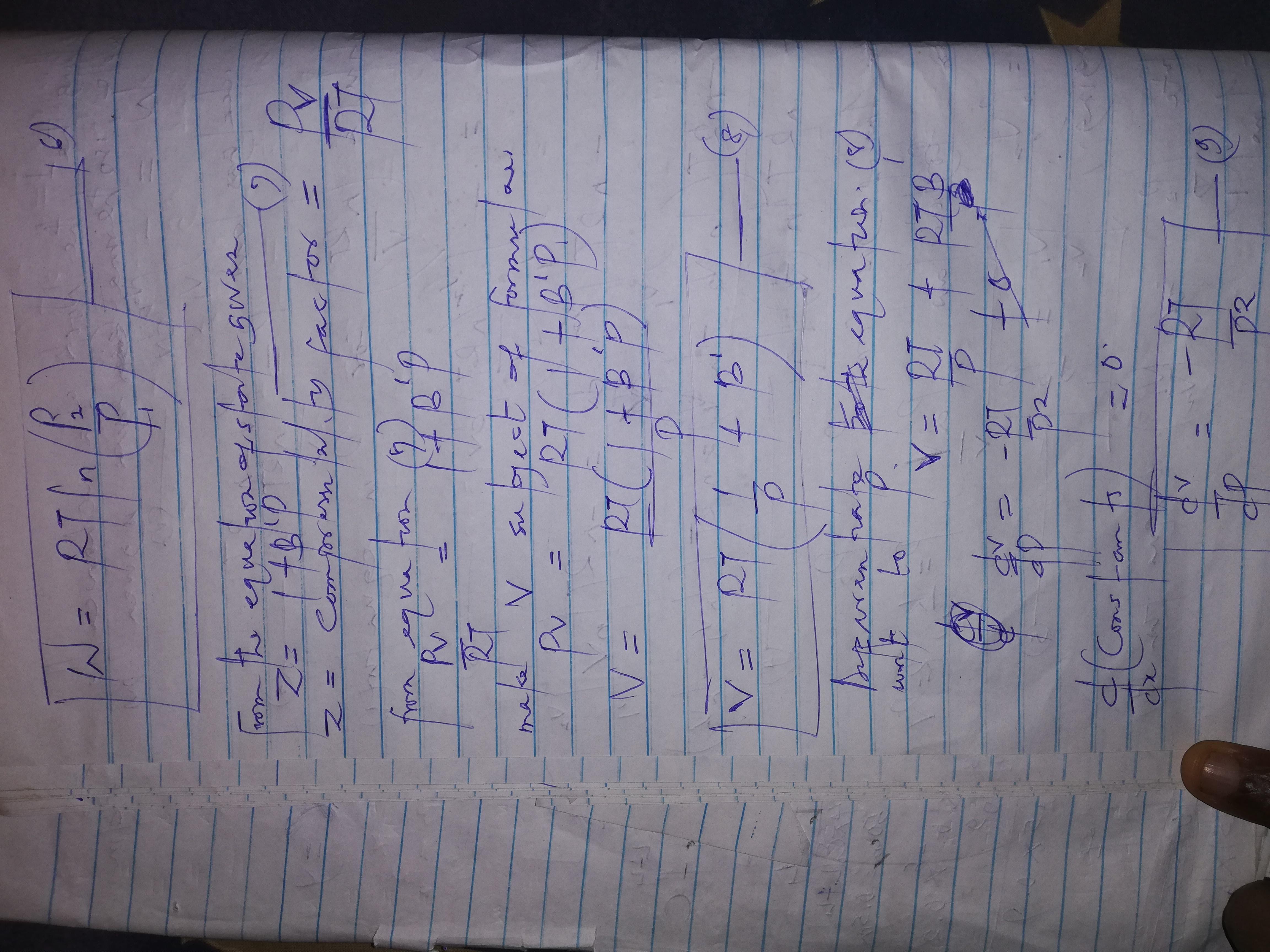
Derive an equation for the work of a mechanically reversible, isothermal compression of 1 mol of a gas from an initial pressure
Lyrx [107]

Answer:

The long derivation for work of a mechanically reversible, isothermal compression was done with detailed steps as shown in the attachment.

Explanation:

what is applied here is a long derivation from Work done in an isobaric process, the expression for the compressibility factor (Z) and the equation of state that was given. The requisite knowledge of Differentiation and Integration was used.

The detailed derivation from firs principle is as shown in the attachment.

5 0
2 years ago
Q3: Summation Write a recursive implementation of summation, which takes a positive integer n and a function term. It applies te
harina [27]

Answer:

Here is the recursive function summation:

def summation(n, term):      

   if n == 1:  

       return term(n)

   else:

       return term(n) + summation(n - 1, term)

Explanation:

The function summation() has two arguments where n is a positive integer and term is a function term. term has the lambda function which is a small function having an argument and an expression e.g lambda b: b+20

So the summation() function is a recursive function which returns sum of the first n terms in the sequence defined by term ( a lambda function).

If you want to check if this function works, you can call this function by passing values to it like given in the question.

summation(5, lambda x: 2**x)

Here the value of n is 5 and the term is a lambda function x: 2**x

If you want to see the results of this function on output screen then use:

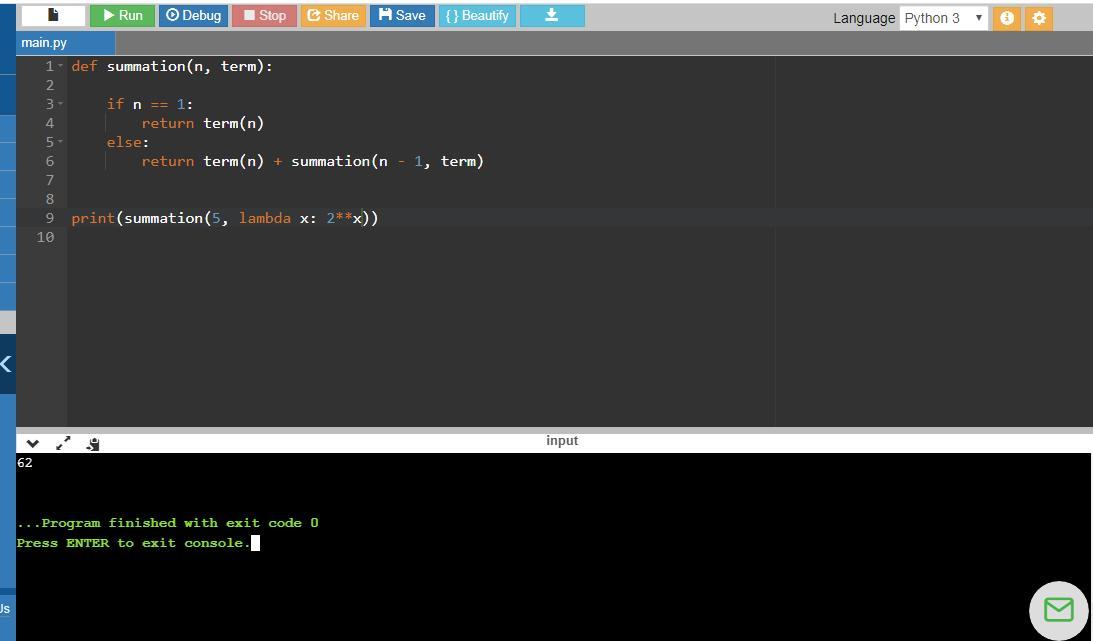
print(summation(5, lambda x: 2**x))

The print() function will print the results on screen.

This returns the sum of first 5 terms in sequence defined in the function x: 2**x

In recursive methods there are two cases: base case and recursive case. Base case is the stopping case which means that the recursion will stop when the base case/ base condition evaluates to true. The recursive case is when the function keeps calling itself so the recursive function keepsexecuting until the base case becomes true.

Here the base case is if n == 1:  So the recursive function calling itself until the value of n becomes 1.  

Recursive case is:

       return term(n) + summation(n - 1, term)

For the above example with n= 5 and term = x:2**x the recursions starts from n and adds all the terms of the series one by one and the value of n keeps decrementing by 1 at every recursive call.

When the value of n is equal to 1 the base case gets true and the recursion ends and the result of the sum is displayed in output.

This is how the summation() function works for the above function call:

2^1 + 2^2 + 2^3 + 2^4 + 2^5

n is 5 So this term function is called recursively 5 times and at every recursive call its value decreases by 1. Here the term function is used to compute 2 raise to power n. So in first recursive call the 2 raise to the power 5 is computed, then 5 is decremented and then in second recursive call to summation(), 2 raise to the power 4 is calculated, in third recursive call  to summation(), 2 raise to the power 3 is calculated, in fourth recursive call  to summation(), 2 raise to the power 2 is calculated, in fifth recursive call  to summation(), 2 raise to the power 1 is calculated, then the base condition is reached as n==1. So the recursion stops and the sum of the above computed power function results is returned which is 62.

2^1 + 2^2 + 2^3 + 2^4 + 2^5 = 62

The screen shot of recursive function along with the output of explained examples is attached.

6 0
2 years ago
The solid aluminum shaft has a diameter of 50 mm. Determine the absolute maximum shear stress in the shaft and sketch the shear-
jarptica [38.1K]

Answer:

Max shear = 8.15 x 10^7 N/m2

Explanation:

In order to find the maximum stress for a solid shaft having radius r, we will be applying the Torsion formula which can be written as;

Allowable Shear Stress = Torque x Radius / pi/2 x radius^4

Putting the values we have;

T = 2000 N/m

Radius = Diameter/2 = 0.05 / 2 = 0.025 m

Putting values in formula;

Max shear = 2000 x 0.025 / 3.14/2 x (0.025)^4

Max shear = 8.15 x 10^7 N/m2

5 0
2 years ago
Hot exhaust gases of an internal combustion engine are to be used to produce saturated water vapor at 2 MPa pressure. The exhaus
Anastaziya [24]

Answer:

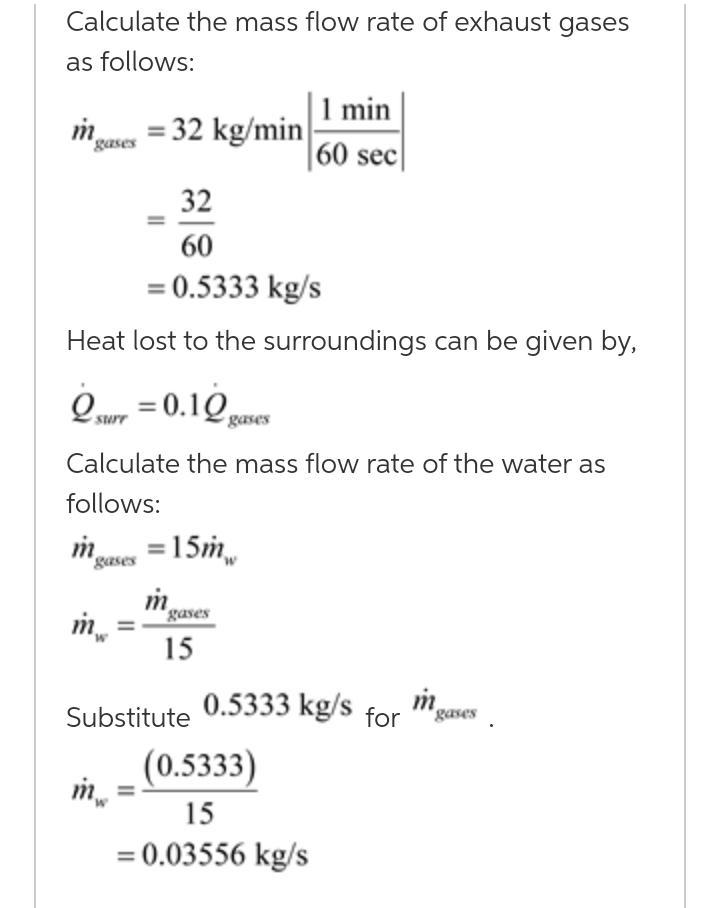
The flowrate of water is 0.03556kg/s

Explanation:

Exhaust gases inlet temperature T1=4000C

Water inlet temperature T3=150C Exit Pressure of water as saturated vapor P4=2MPa

Mass flow rate of exhaust gases Heat lost to the surroundings Qgases=32kg/min

Mass flow rate of exhaust gases is 15 times that of the water

Heat exchangers typically involve no work interactions (w = 0) and negligible...

7 0
2 years ago
Read 2 more answers
Other questions:
  • You are working in a lab where RC circuits are used to delay the initiation of a process. One particular experiment involves an
    13·1 answer
  • The hot water needs of an office are met by heating tab water by a heat pump from 16 C to 50 C at an average rate of 0.2 kg/min.
    5·1 answer
  • Compute the strain-hardening exponent (n) for an alloy in which a true stress of 415 MPa produces a true strain of 0.10; assume
    10·1 answer
  • tech A says that a Hall-effect sensor can be used in an electronic ignition system. Tech B says that an optical-type sensor can
    6·1 answer
  • Two resistors of values 7.0 and 15.0 Ω are connected in parallel. This combination in turn is hooked in series with a 3.8- Ω res
    7·1 answer
  • Oil enters a counterflow heat exchanger at 600 K with a mass flow rate of 10 kg/s and exits at 200 K. A separate stream of liqui
    12·1 answer
  • A pair of spur gears with 20 degree pressure angle, full-depth, involute teeth transmits 65 hp. The pinion is mounted on a shaft
    5·1 answer
  • Technician A says that weld-through primer can be removed from the immediate weld area to improve weld quality. Technician B say
    7·1 answer
  • what is the advantage of decreasing the field current of a separately excited dc motor below its nominal value
    7·1 answer
  • Who can work on a fixed ladder that extends more than 24 feet?
    11·1 answer
Add answer
Login
Not registered? Fast signup
Signup
Login Signup
Ask question!