answer.
Ask question
Login Signup
Ask question
All categories
  • English
  • Mathematics
  • Social Studies
  • Business
  • History
  • Health
  • Geography
  • Biology
  • Physics
  • Chemistry
  • Computers and Technology
  • Arts
  • World Languages
  • Spanish
  • French
  • German
  • Advanced Placement (AP)
  • SAT
  • Medicine
  • Law
  • Engineering
rjkz [21]
2 years ago
15

3. The coating on the head of a match is highly flammable. When it burns, it releases a great deal of energy. However, before th

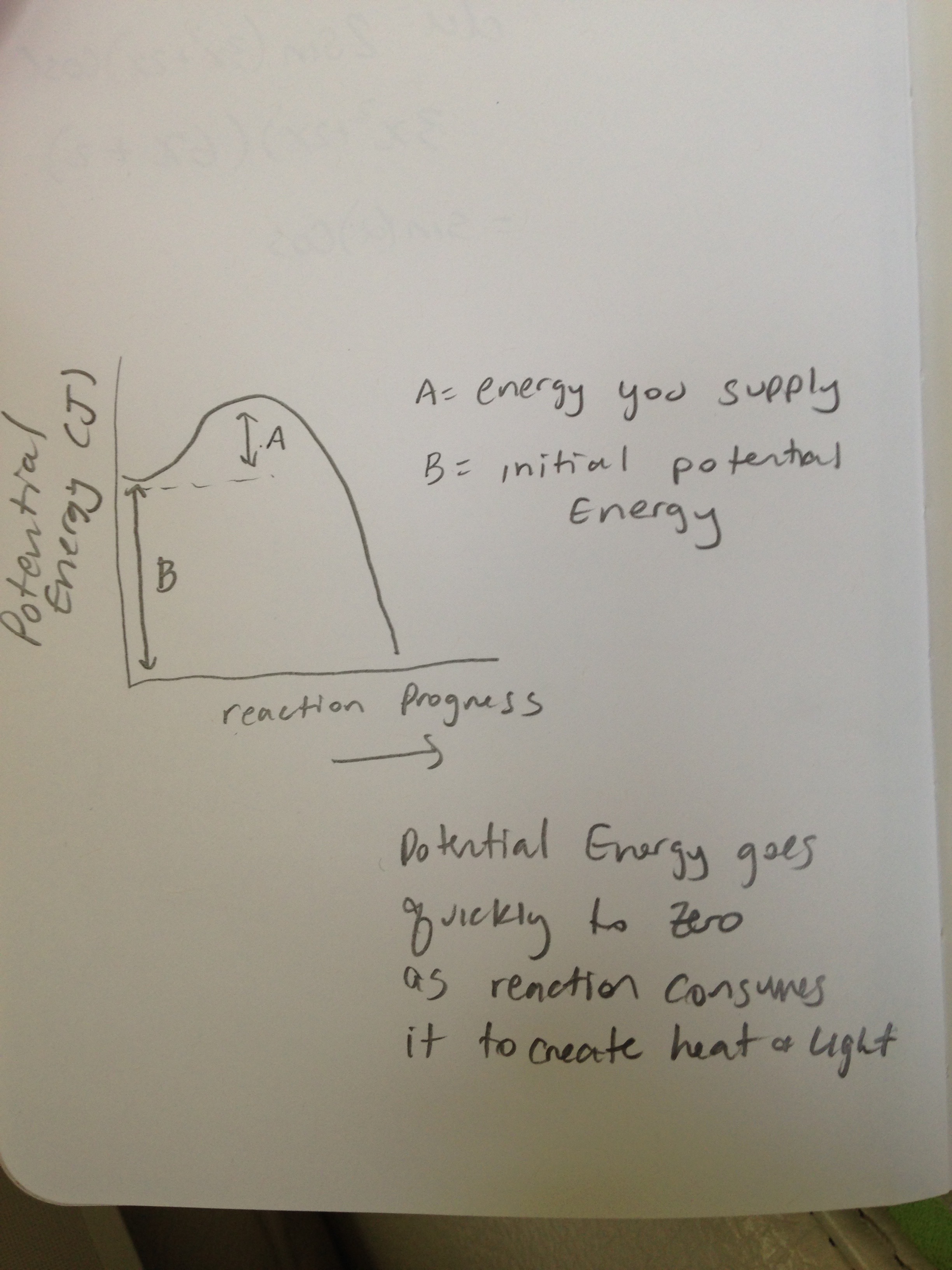
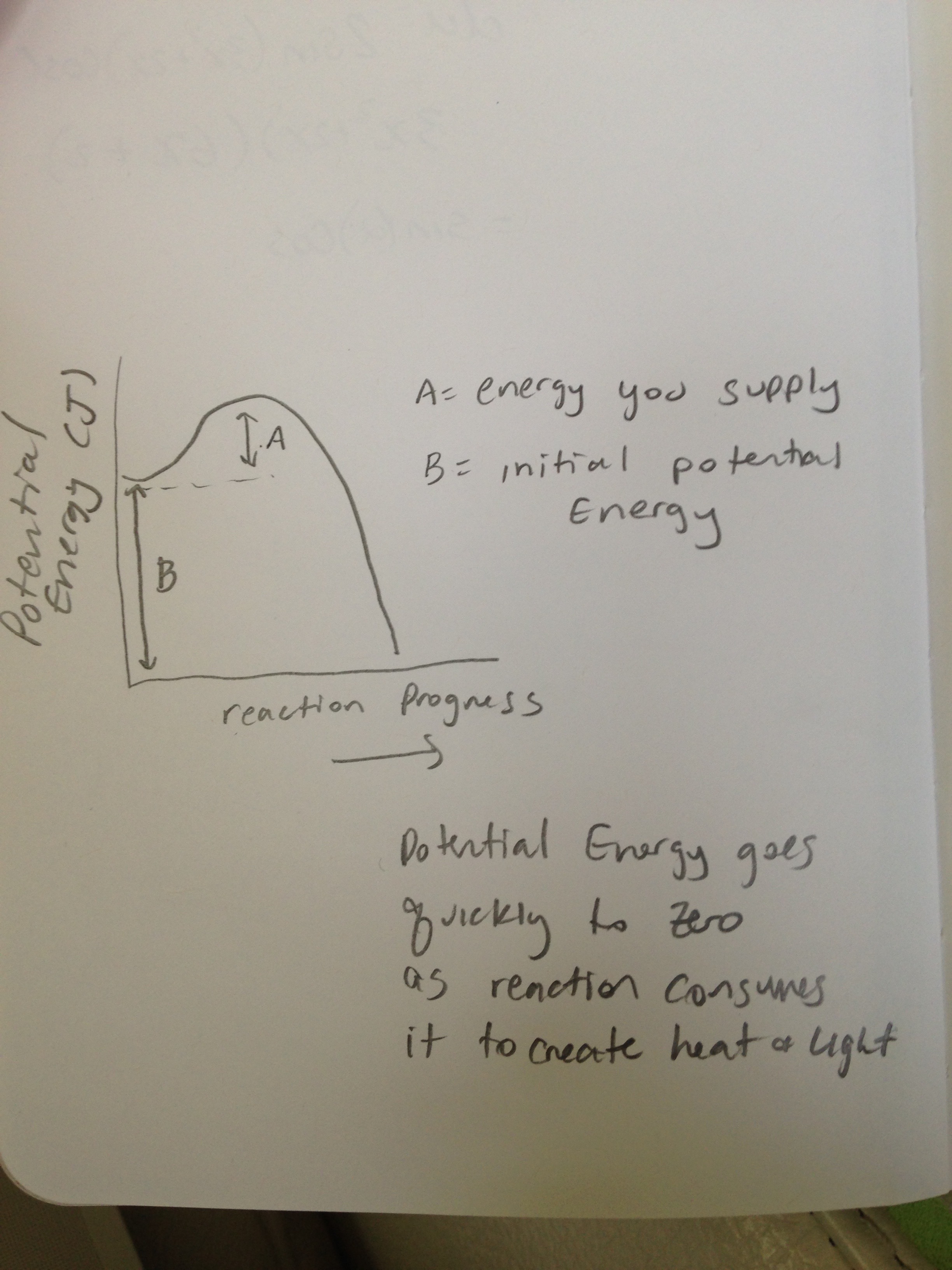
e match can burn, it must gain a small amount of energy from a spark. That spark is typically produced by striking (rubbing) the match head against a rough surface. Sketch and describe a potential energy diagram that represents the striking and burning of the match. Remember to label the diagram with the energy changes that occur. Your answer must include the potential energy diagram and a written description. (Note: you do not have to use actual energy values.)

Physics
1 answer:
SashulF [63]2 years ago
6 0
Ok here's a rough image of how a typical energy diagram works.  You give a little energy (A) and you get the potential that was in there all along.  Kinda like pushing a big rock off a cliff.  You do a little work then get a lot of energy out as the PE turns into other forms.  In a match it's heat and light

You might be interested in
Learning Goal: How do 2 ordinary waves build up a "standing" wave? A very generic formula for a traveling wave is: y1(x,t)=Asin(
zheka24 [161]

Answer:

Explanation:

=Asin(kx−ωt). This general mathematical form can represent the displacement of a string, or the strength of an electric field, or the height of the surface of water, or a large number of other physical waves!

Part C Find ye(x) and yt(t). Remember that yt(t) must be a trig function of unit amplitude. Express your answers in terms of A, k, x, ω, and t. Separate the two functions with a comma. Use parentheses around the argument of any trig functions.

Part E At the position x=0, what is the displacement of the string (assuming that the standing wave ys(x,t) is present)? Part G From

Part F we know that the string is perfectly straight at time t=π2ω. Which of the following statements does the string's being straight imply about the energy stored in the strJHJMNMMUJJHTGGHing?

a.There is no energy stored in the string: The string will remain straight for all subsequent times.

b.Energy will flow into the string, causing the standing wave to form at a later time.

c.Although the string is straight at time t=π2ω, parts of the string have nonzero velocity. Therefore, there is energy stored in the string.

d.The total mechanical energy in the string oscillates but is constant if averaged over a complete cycle.
3 0
2 years ago
01 – (Valor – 2,0) O maior campo de testes de veículos da América Latina, localizado na cidade de Indaiatuba (SP), tem forma cir
Scilla [17]

Answer:

a) Calcule a frequência em RPM

= 0.6 RPM

b) a velocidade escalar do carro em m/s.

= 20m/s

Explanation:

a) Calcule a frequência em RPM

A fórmula para calcular a frequência é: 1/T

onde T= Tempo (seconds)

T = 100s

A frequência = 1/100s

A frequência = 0.01Hz

em RPM

A fórmula para calcular a frequência em RPM =

1 Hz = 60RPM

0.01Hz =

A frequência em RPM = 0.01Hz × 60

= 0.6 RPM

b) a velocidade escalar do carro em m/s.

A fórmula para calcular a velocidade escalar = diâmetro ou distância (m) ÷ tempo (s)

Diâmetro ou Distância = 2.0km

Converter 2.0km para m

1 km = 1000m

2km =

2 km × 1000m

= 2000m

A velocidade escalar = 2000m ÷ 100s

A velocidade escalar = 20m/s

Answer:

a) Frequency in RPM

= 0.6 RPM

b) Scalar Velocity

= 20m/s

Explanation:

a) Frequently in RPM

Formula : 1/T

Where T= Time (seconds)

T = 100s

= 1/100s

= 0.01Hz

Frequency in RPM =

1 Hz = 60RPM

0.01Hz = 0.01Hz × 60

= 0.6 RPM

b) Scalar velocity

The formula = Diameter or Distance ÷ Time

Diameter or Distance = 2.0km

Convert 2.0km to m

1 km = 1000m

2km =

2 km × 1000m

= 2000m

Scalar Velocity = 2000m ÷ 100s

Scalar Velocity = 20m/s

8 0
2 years ago
What type of light does this light bulb produce most (i.e. at what wavelength does the spectrum have maximum intensity)?
lesantik [10]

Answer: The light bulb produces the continuous light. At minimum wavelength the spectrum have maximum intensity.

Explanation:

According to Wein's displacement law, the wavelength is inversely proportional to the temperature.

The intensity depends on the frequency. The frequency is inversely proportional to the wavelength.

Therefore, when the temperature of the light bulb will be maximum then the wavelength will be minimum. At minimum wavelength the spectrum have maximum intensity.

4 0
2 years ago
You and your friend throw balloons filled with water from the roof of a several story apartment house. You simply drop a balloon
Aleks [24]

Answer:

Height = 53.361 m

Explanation:

There are two balloons being thrown down, one with initial speed (u1) = 0 and the other with initial speed (u2) = 43.12

From the given information we make the following summary

u_{1} = 0m/s

t_{1} = t

u_{2} = 43.12m/s

t_{2} = (t-2.2)s

The distance by the first balloon is

D = u_{1} t_{1}  + \frac{1}{2} at_{1}^2

where

a = 9.8m/s2

Inputting the values

D = (0)t + \frac{1}{2} (9.8)t^2\\ D = 4.9t^2

The distance traveled by the second balloon

D = u_{2} t_{2}  + \frac{1}{2} at_{2}^2

Inputting the values

D = (43.12)(t-2.2)  + \frac{1}{2} (9.8)(t-2.2)^2

simplifying

D = 4.9t^2 + 21.56t -71.148

Substituting D of the first balloon into the D of the second balloon and solving

4.9t^2 = 4.9t^2 + 21.56t -71.148 \\ 21.56t = 71.148\\ t = 3.3s

Now we know the value of t. We input this into the equation of the first balloon the to get height of the apartment

D = 4.9(3.3)^2\\ D = 53.361 m

7 0
2 years ago
A camera gives a proper exposure when set to a shutter speed of 1/250 s at f-number F8.0. The photographer wants to change the s
Oksana_A [137]

Answer:

F4.0

Explanation:

To obtain a shutter speed of 1/1000 s to avoid any blur motion the f-number should be changed to F4.0 because the light intensity goes up by a factor of 2 when the f-number is decreased by the square root of 2.

5 0
2 years ago
Other questions:
  • Give two ways in which the water vapour changes as it passes down the glass tube in the condenser
    12·1 answer
  • A 5.0 kg cannonball is dropped from the top of a tower. It falls for 1.6 seconds before slamming into a sand pile at the base of
    8·1 answer
  • As you build circuits, you will alter voltage, which is the variable. You will measure how changing the voltage affects the curr
    6·2 answers
  • The pupil of an eagle’s eye has a diameter of 6.0 mm. Two field mice are separated by 0.010 m. From a distance of 204 m, the eag
    5·1 answer
  • A bowling ball of mass m=1.7kg is launched from a spring compressed by a distance d=0.31m at an angle of theta=37 measured from
    12·1 answer
  • Biologists think that some spiders "tune" strands of their web to give enhanced response at frequencies corresponding to those a
    12·1 answer
  • Carry's car has a mass of 1000 kg and its brakes can apply 8000 N of force. If she is driving at 24 m/s and sees something in th
    5·1 answer
  • if a toaster transfers 100 joules of energy every ten seconds, what is the power rating of the toaster include the units in your
    13·2 answers
  • 8. An unpowered flywheel is slowed by a constant frictional torque. At time t = 0 it has an angular velocity of 200 rad/s. Ten s
    7·1 answer
  • In a liquid with a density of 1050 kg/m3, longitudinal waves with a frequency of 450 Hz are found to have a wavelength of 7.90 m
    5·1 answer
Add answer
Login
Not registered? Fast signup
Signup
Login Signup
Ask question!
