answer.
Ask question
Login Signup
Ask question
All categories
  • English
  • Mathematics
  • Social Studies
  • Business
  • History
  • Health
  • Geography
  • Biology
  • Physics
  • Chemistry
  • Computers and Technology
  • Arts
  • World Languages
  • Spanish
  • French
  • German
  • Advanced Placement (AP)
  • SAT
  • Medicine
  • Law
  • Engineering
weeeeeb [17]
2 years ago
6

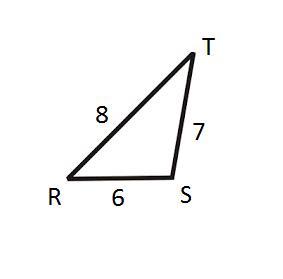
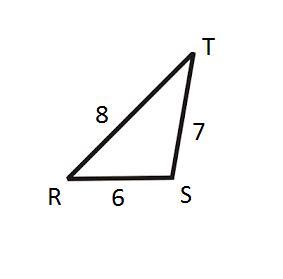
In triangle RST, RS = 6 cm, ST = 7 cm, and RT = 8 cm. What is the approximate measure of the largest angle in the triangle?

Mathematics
2 answers:
olga nikolaevna [1]2 years ago
7 0

Answer:

The approximate measure of largest angle is 76°

Step-by-step explanation:

Given in triangle RST, RS = 6 cm, ST = 7 cm, and RT = 8 cm. we have to find the measure of the largest angle in the triangle.

By theorem If one side of a triangle is longer than the another side, then the angle opposite to the longer side of triangle will be larger than the angle opposite to the shorter side.

As longest side is RT.

∴ the angle opposite to the side RT is largest i.e ∠S is largest.

By cosine law,

cos \angleS=\frac{RS^2+ST^2-RT^2}{2(RS)(ST)}

⇒ cos \angleS=\frac{6^2+7^2-8^2}{2(6)(7)}

⇒ cos \angleS=\frac{6^2+7^2-8^2}{2(6)(7)}

⇒ cos \angleS=\frac{1}{4}

⇒ \angleS=cos^{-1}(\frac{1}{4})=75.5224878141
\sim76^{/circ}

The approximate measure of largest angle is 76°


zubka84 [21]2 years ago
4 0
<span>the approximate measure of the largest angle in the triangle is 75.5 degrees</span>


You might be interested in
HELP PLEASE HELP!!!!! 20 POINTS!!!
ivann1987 [24]
The answer should be C. By combining like terms you can find the answer. 1.75a+2.75a = 4.5a
2.25b + 1.75b = 4b
2.25c + 1.25c = 3.5c
3 0
2 years ago
Read 2 more answers
A bicycle tire has a radius of 26 inches. How many revolutions will this tire make if the bicycle is pedaled 1 mile? (Use 3.14 f
Fittoniya [83]
How far does a wheel move when it rotates once? The length of the outside of the tyre? Isn't that the same as the circumference?
4 0
1 year ago
Which expressions simplify to a rational answer? Select each correct answer. 29√⋅4√ 3√⋅16−−√ 73⋅−√3√ 5√⋅5√
PolarNik [594]

Answer:

The correct options are 1, 3 and 4.

Step-by-step explanation:

We need to find the expressions whose simplified form is a rational number.

Rational number: If a number is defined in the form of p/q where p and q are integers and q≠0, then it is called a rational number.

For example: 0,2, 4.3 etc.

Irrational number: If a number can not defined in the form of p/q, where p and q are integers and q≠0, then it is called an irrational number.

First expression is

2\sqrt{9}\cdot \sqrt{4}=2(3)\cdot (2)\Rightarrow 6\cdot 2=12

12 is a rational number.

Second expression is

\sqrt{3}\cdot \sqrt{16}=\sqrt{3}\cdot 4\Rightarrow 4\sqrt{3}

4\sqrt{3} is an irrational number.

Third expression is

7\sqrt{3}\cdot \sqrt{3}\Rightarrow 7\cdot 3=21

21 is a rational number.

Fourth expression is

\sqrt{5}\cdot \sqrt{5}=5

5 is a rational number.

Therefore, the correct options are 1, 3 and 4.

4 0
2 years ago
∆ABC is translated 2 units down and 1 unit to the left. Then it is rotated 90° clockwise about the origin to form ∆A′B′C′. The c
Ivenika [448]

Answer:

A'(-2, 1), B'(1, 0), C'(-1, 0)

Step-by-step explanation:

Transformation is the movement of a point from its initial location to a new location. Types of transformation are rotation, reflection, dilation and translation.

If a point X(x, y) is translated a units right and b units down, the new location is X'(x + a, y + b) whereas if a point X(x, y) is translated a units left and b units up, the new location is X'(x - a, y - b).

If a point X(x, y) is rotated 90° clockwise about the origin, the new location is X'(y, -x)

From the image attached, ∆ABC is at A(0, 0), B(1,3) C(1, 1)

If ∆ABC is translated 2 units down and 1 unit to the left (x - 1, y - 2), the vertices would be A*(-1, -2), B*(0, 1), C*(0, -1)

If it is then rotated 90° clockwise about the origin, the new location is A'(-2, 1), B'(1, 0), C'(-1, 0)

7 0
2 years ago
) What is the difference between a sequence and a series? A sequence is an ordered list of numbers whereas a series is an unorde
vivado [14]

Answer:

a) A sequence is an ordered list of numbers whereas a series is the sum of a list of numbers; b) A series is divergent if it is not convergent. A convergent series is a series for which lim n → ∞ an exists.

Step-by-step explanation:

A sequence is a pattern; it is an ordered list of numbers.  A series, however, is the sum of a sequence.

A convergent series is a series for which the sequence of its partial sums tends to a limit; this means the limit exists.  A divergent series is a series that is not convergent.

7 0
2 years ago
Other questions:
  • Jeanne babysits for $6 per hour. She also works as a reading tutor for $10 per hour. She is only allowed to work 20 hours per we
    9·2 answers
  • the area of a Blackboard is 1 1/3 square yards posters area is 8/9 square yards find the unit rate and explain in words with uni
    15·2 answers
  • Mrs. Thomas has $71.00 to purchase bottles of juice for her class. If the bottles of juice cost $3.55 each, how many bottles can
    11·1 answer
  • What happened to the snowman during the heat wave?
    7·1 answer
  • A healthcare provider monitors the number of CAT scans performed each month in each of its clinics. The most recent year of data
    6·1 answer
  • E varies directly with the square root of C. If E=40 when C=25, find: C when E = 10.4
    5·2 answers
  • Assume that a study of 500 randomly selected airplane routes showed that 482 arrived on time. Select the correct interpretation
    14·1 answer
  • 21. Mickey earned $475 from mowing lawns last summer. He deposited this money in an
    14·1 answer
  • PLZ HELP ASAP WILL MARK BRAINLIEST!!!!! Ying Ying wants to buy some petunias. The table compares the number of petunias Ying Yin
    7·1 answer
  • Excel:In cell B13, create a formula using the VLOOKUP function that looks up the value from cell A11 in the range A5:B7, returns
    14·1 answer
Add answer
Login
Not registered? Fast signup
Signup
Login Signup
Ask question!