answer.
Ask question
Login Signup
Ask question
All categories
  • English
  • Mathematics
  • Social Studies
  • Business
  • History
  • Health
  • Geography
  • Biology
  • Physics
  • Chemistry
  • Computers and Technology
  • Arts
  • World Languages
  • Spanish
  • French
  • German
  • Advanced Placement (AP)
  • SAT
  • Medicine
  • Law
  • Engineering
jeka57 [31]
2 years ago
10

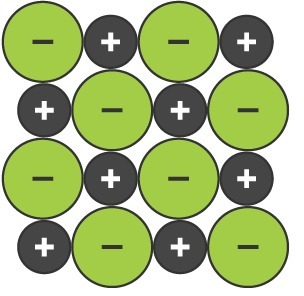
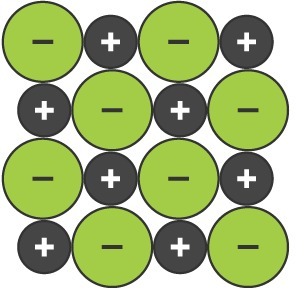
Calcium chloride forms an ionic solid. how are the particles held together and arranged in the solid

Chemistry
2 answers:
Advocard [28]2 years ago
7 0
Calcium chloride forms an ionic compound with a regularly arranged lattice of oppositely charged ions.

The Na+ and Cl- ions are held together by strong electrostatic forces. 

Hope that helps


Ymorist [56]2 years ago
4 0

Explanation:

As we known that an ionic solid is a solid whose atoms chemically combine together by transfer of electrons from one atom to another.

For example, CaCl_{2} is an ionic solid because transfer of electrons take place from calcium to chlorine.

As a result, calcium atom has a partial positive change and chlorine atom has a partial negative charge. Hence, there will be strong intermolecular forces of attraction between the two because opposite charges attract each other.

Therefore, particles will be arranged in a regular crystal lattice of opposite charges.

You might be interested in
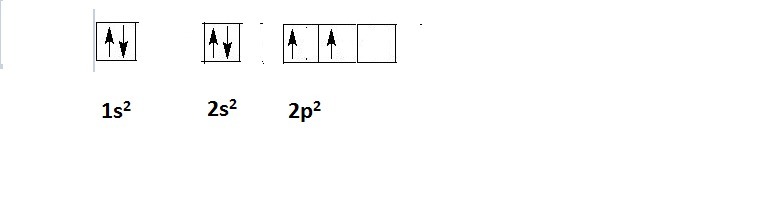
In which orbitals would the valence electrons for carbon <br> c. be placed?
katrin2010 [14]

Answer: 2s and 2p

Explanation: Carbon is an element with atomic number of 6 and thus contains 6 electrons. The electrons are filled in order of increasing energies and follows Afbau's rule.The electrons are singly filled first in each orbital having same spin, then only pairing occurs. This rule was known as Hund's Rule.

The valence electrons are the electrons which are present in last shell. Thus valence electrons are 4, two in s and 2 in p orbitals.

C: 6:1s^22s^22p_x^12p_y^1


8 0
2 years ago
Read 2 more answers
The interior of a refrigerator has a volume of 0.600 m3. the temperature inside the refrigerator in 282 k, and the pressure is 1
Dafna11 [192]
In this instance we can use the ideal gas law equation to find the number of moles of gas inside the refrigerator 
PV = nRT
where 
P - pressure - 101 000 Pa
V - volume - 0.600 m³
n - number of moles
R - universal gas constant - 8.314 J/mol.K
T - temperature - 282 K
substituting these values in the equation 
101 000 Pa x 0.600 m³ = n x  8.314 J/mol.K x 282 K
n = 25.8 mol
there are 25.8 mol of the gas
to find the mass of gas
mass of gas = number of moles x molar mass of gas
mass = 25.8 mol x 29 g/mol  = 748.2 g
mass of gas present is 748.2 g 
6 0
2 years ago
A bottle containing 1,665 g of sulfuric acid (H2SO4, 98.08 g/mol) was spilled in a laboratory. The emergency spill kit contained
Tamiku [17]

Answer:

A. Yes, there is more than enough sodium carbonate.

Explanation:

Hello,

In this case, based on the given reaction which is:

H_2SO_4(aq) + Na_2CO_3(s) \rightarrow  Na_2SO_4(aq) + CO_2(g) + H_2O(l)

By stoichiometry, one computes the grams of sodium carbonate that will neutralize 1,665 g of sulfuric acid as shown below:

1,665gH_2SO_4*\frac{1molH_2SO_4}{98.08gH_2SO_4}*\frac{1molNa_2CO_3}{1molH_2SO_4} *\frac{105.99gNa_2CO_3}{1molNa_2CO_3}*\frac{1kgNa_2CO_3}{1000gNa_2CO_3}\\m_{Na_2CO_3}=1.80gNa_2CO_3

Thus, the available mass is 2.0 kg so 0.2 kg are in excess, therefore: A. Yes, there is more than enough sodium carbonate.

Best regards.

5 0
2 years ago
A vessel contained N2, Ar, He, and Ne. The total pressure in the vessel was 987 torr. The partial pressures of nitrogen, argon,
xz_007 [3.2K]

Answer:

The partial pressure of neon in the vessel was 239 torr.

Explanation:

In all cases involving gas mixtures, the total gas pressure is related to the partial pressures, that is, the pressures of the individual gaseous components of the mixture. Put simply, the partial pressure of a gas is the pressure it exerts on a mixture of gases.

Dalton's law states that the total pressure of a mixture of gases is equal to the sum of the pressures that each gas would exert if it were alone. Then:

PT= P1 + P2 + P3 + P4…+ Pn

where n is the amount of gases present in the mixture.

In this case:

PT=PN₂ + PAr + PHe + PNe

where:

  • PT= 987 torr
  • PN₂= 44 torr
  • PAr= 486 torr
  • PHe= 218 torr
  • PNe= ?

Replacing:

987 torr= 44 torr + 486 torr + 218 torr + PNe

Solving:

987 torr= 748 torr + PNe

PNe= 987 torr - 748 torr

PNe= 239 torr

<u><em>The partial pressure of neon in the vessel was 239 torr.</em></u>

4 0
2 years ago
On a trip to the natural history museum you find two minerals that are similar in color. You can see from their chemical formula
lianna [129]

Answer:Yes they are in the same mineral group

Explanation:zinc is the central elements there. The rest of the elements are present as impurities due to where it was found. Like carbon is can be found in the soil, silicon with oxygen is basically sand, hydrogen is in the atmosphere and also in water and soil too. So apart from zinc, the rest are normal day to day elements.

7 0
2 years ago
Other questions:
  • Which polyatomic ion is found in the compound represented by the formula NaHCO3?
    9·2 answers
  • Benzene, C6H6, reacts with oxygen, O2, to form CO2 and H2O. How much O2 is required for the complete combustion of 1.0 mol C6H6?
    6·2 answers
  • An impure sample of zinc (zn) is treated with an excess of sulfuric acid (h 2 so 4) to form zinc sulfate (znso4) and molecular h
    5·1 answer
  • Write the equation for the production of one hexose sugar molecule from carbon dioxide
    5·2 answers
  • Write a balanced half-reaction describing the oxidation of gaseous dihydrogen to aqueous hydrogen cations.
    12·2 answers
  • Help please?
    9·2 answers
  • Methane and chlorine react to form chloromethane, CH3Cl and hydrogen chloride. When 29.8 g of methane and 40.3 g of chlorine gas
    10·2 answers
  • A big bully is having a tug-of-war with a small child. There is a ball attached to the middle of the rope.
    11·1 answer
  • Sodium is a soft metal with a relatively low work function. Light corresponding to 476 kJmol−1 was shone on the sodium metal, an
    6·1 answer
  • A sample of baking soda contains 34.48 g of sodium, 1.51 g of hydrogen, 18.02 g of carbon, and 72.00 g of oxygen.
    6·1 answer
Add answer
Login
Not registered? Fast signup
Signup
Login Signup
Ask question!