answer.
Ask question
Login Signup
Ask question
All categories
  • English
  • Mathematics
  • Social Studies
  • Business
  • History
  • Health
  • Geography
  • Biology
  • Physics
  • Chemistry
  • Computers and Technology
  • Arts
  • World Languages
  • Spanish
  • French
  • German
  • Advanced Placement (AP)
  • SAT
  • Medicine
  • Law
  • Engineering
Ede4ka [16]
2 years ago
6

In a certain experiment 1.00 g of sodium bicarbonate and 1.00 g of citric acid are allowed to react. (a) which is the limiting r

eactant? (b) how many grams of carbon dioxide form? (c) how many
Chemistry
2 answers:
snow_lady [41]2 years ago
7 0

Answer:

a) Citric acid is the limiting reactant.

b) 0.45804 grams of carbon dioxide formed.

Explanation:

2NaHCO_3+H_3C_6H_5O_7\rightarrow Na_2(HC_6H_5O_7)+2 H_2O+2CO_2

a) Moles of sodium bicarbonate  :

\frac{1.00 g}{84 g/mol}=0.01190 mol

According to reaction,2 moles sodium bicarbonate reacts with 1 mole of citric acid.

Then 0.01190 moles of sodium bicarbonate will react with:

\frac{1}{2}\times 0.01190 mol=0.005950 mol of citric acid

Moles of citric acid :

\frac{1 g}{192.12 g/mol}=0.005205 mol

According to reaction, 1 moles of citric acid reacts with 2 moles sodium bicarbonate.

Then 0.005205 moles of citric acid will react with:

\frac{2}{1}\times 0.005205 mol=0.01041 mol of sodium bicarbonate.

Citric acid is the limiting reactant.

b) Since, citric acid is in limiting amount, amount of carbon dioxide produce  will depend upon on citric acid .

According to reaction , 1 mole of citrc acid gives 2 moles of carbon dioxide.

Then 0.005205 moles of citric acid will give:

\frac{2}{1}\times 0.005205 mol=0.01041 mol of carbon dioxide

Mass of 0.01041 moles of carbon dioxide:

0.01041 mol × 44 g/mol= 0.45804 g

0.45804 grams of carbon dioxide formed.

Lelu [443]2 years ago
3 0

The complete balanced chemical reaction for this is:

C6H8O7 + 3 NaHCO3 ---> 3 H2O + 3 CO2 + Na3C6H5O7


First calculate for the number of moles of each reactant.

moles C6H8O7 = 1 g / (192.124 g / mol) = 5.2 * 10^-3 mol

moles NaHCO3 = 1 g / (84.01 g / mol) = 11.9 * 10^-3 mol


A. The ratio of the reactant from the chemical reaction is 3NaHCO3:1C6H8O7, while the given chemicals are in the ratio of:

11.9 * 10^-3NaHCO3: 5.2 * 10^-3 C6H8O7 = 2.29NaHCO3:1C6H8O7


Therefore this means that there is less amount of NaHCO3 supplied than what is required therefore the limiting reactant is:

NaHCO3


B. We calculate based on the limiting reactant.

mass CO2 = 11.9 * 10^-3 mol NaHCO3 (3 mol CO2/1 mol NaHCO3) (44.01 g/mol)

mass CO2 = 1.57 g


C. I believe what is asked here is the amount of excess reactant which remains. The excess reactant is C6H8O7.

mass C6H8O7 left = [5.2 * 10^-3 mol – (11.9 * 10^-3 mol NaHCO3 (1 mol C6H8O7/ 3 mol NaHCO3))] * (192.124 g / mol)

mass C6H8O7 left = 0.237 g

You might be interested in
Write the empirical formula of at least four binary ionic compounds that could be formed from the following ions: Ca2+, V5+, Br-
Jet001 [13]

Answer:

CaS, CaBr₂, VBr₅, and V₂S₅.

Explanation:

  • The ionic compound should be neutral; the overall charge of it is equal to zero.
  • Binary ionic compound is composed of two different ions.

<u>Ca²⁺ can combined with either Br⁻ or S²⁻ to form binary ionic compounds.</u>

  • CaS can be formed via combining Ca²⁺ with S²⁻ to form the neutral binary ionic compound CaS.
  • CaBr₂ can be formed via combining 1 mole of Ca²⁺ with 2 moles of Br⁻ to form the neutral binary ionic compound CaBr₂.

<u>V⁵⁺ can combined with either Br⁻ or S²⁻ to form binary ionic compounds.</u>

  • V₂S₅ can be formed via combining 2 moles of V⁵⁺ with 5 moles of S²⁻ to form the neutral binary ionic compound V₂S₅.
  • VBr₅ can be formed via combining 1 mole of V⁵⁺ with 5 moles of Br⁻ to form the neutral binary ionic compound VBr₅.

<em>So, the empirical formula of four binary ionic compounds that could be formed is: CaS, CaBr₂, VBr₅, and V₂S₅.</em>

<em></em>

5 0
2 years ago
When 0.270 mol of a nondissociating solute is dissolved in 410.0 mL of CS2, the solution boils at 47.52 ∘C. What is the molal bo
grandymaker [24]

Answer:

Kb = 0.428 m/°C

Explanation:

To solve this problem we need to use the <em>boiling-point elevation formula</em>:

  • <em>Tsolution</em> - <em>Tpure solvent</em> = Kb * m

Where <em>Tsolution</em> and <em>Tpure solvent</em> are the boiling point of the CS₂ solution (47.52 °C) and of pure CS₂ (46.3 °C), respectively. Kb is the constant asked by the problem, and m is the molality of the solution.

So in order to use that equation and solve for Kb, first we <em>calculate the molality of the solution</em>.

molality = mol solute / kg solvent

  • Density of CS₂ = 1.26 g/cm³
  • Mass of 410.0 mL of CS₂ ⇒ 410 cm³ * 1.26 g/cm³ = 516.6 g = 0.5166 kg

molality = 0.270 mol / 0.5166 kg = 0.5226 m

Now we <u>solve for Kb</u>:

<em>Tsolution</em> - <em>Tpure solvent</em> = Kb * m

  • 47.52 °C - 46.3 °C = Kb * 0.5226 m
  • Kb = 0.428 m/°C
3 0
2 years ago
Hydroxyapatite, Ca 10 ( PO 4 ) 6 ( OH ) 2 Ca10(PO4)6(OH)2 , has a solubility constant of Ksp = 2.34 × 10 − 59 2.34×10−59 , and d
Margarita [4]

Answer:

1.315x10⁻³M = [Ca²⁺]

Explanation:

Based in the reaction:

Ca₁₀(PO₄)₆(OH)₂(s) ⇄ 10Ca²⁺(aq) + 6PO₄³⁻(aq) + 2OH⁻(aq)

Solubility product, ksp, is defined as:

ksp = [Ca²⁺]¹⁰ [PO₄³⁻]⁶ [OH⁻]²

From 1 mole of hydroxyapatite are produced  10 moles of Ca²⁺ and 6 moles of PO₄³⁻. That means moles of PO₄³⁻ are:

6/10 Ca²⁺ = PO₄³⁻

Replacing in ksp formula:

ksp = [Ca²⁺]¹⁰ [0.6Ca²⁺]⁶ [OH⁻]²

As [OH⁻] is 2.50x10⁻⁶M and ksp is 2.34x10⁻⁵⁹:

2.34x10⁻⁵⁹ =  [Ca²⁺]¹⁰ [0.6Ca²⁺]⁶ [2.50x10⁻⁶]²

3.744x10⁻⁴⁸ = 0.046656[Ca²⁺]¹⁶

<em />

<em>1.315x10⁻³M = [Ca²⁺]</em>

<em />

I hope it helps!

5 0
2 years ago
7. Two teams are competing in a tug-of-war contest. Team A is pulling at 4000N and Team B is pulling at 4900N is the opposite di
Leto [7]
Basically team B would win since it is exerting a force of 900N unlike team A ( you can tell by doing 4900N minus 4000N ). It is very unbalanced.

5 0
2 years ago
Read 2 more answers
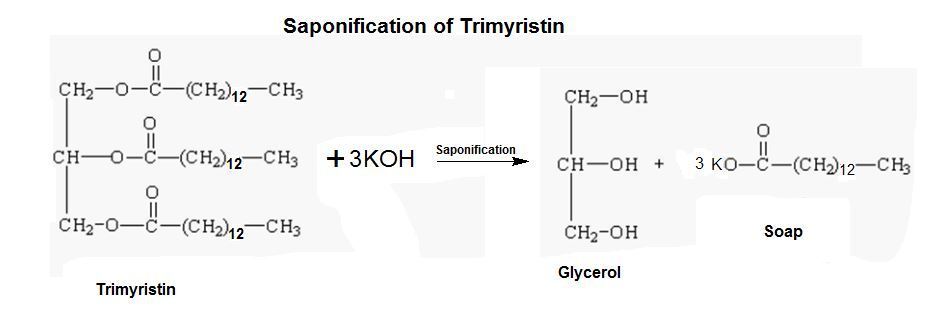
Draw the condensed structural formula in the equation for the saponification of trimyristin with koh
Ludmilka [50]

Explanation: Saponification reaction is a reaction in which hydrolysis of fats takes place under basic conditions giving glycerol and a salt of corresponding fatty acid.

We are given a Fatty acid called as Trimyristin.

Its reaction with KOH leads to the formation of soap and is given by the equation:

Trimyristin+3 KOH\rightarrow Glycerol+Soap

C_{45}H_{86}O_6+3KOH\rightarrow C_3H_5(OH)_3+3CH_3(CH_2)_{12}CO_2K

The condensed structural formula for the equation is given in the image attached.

4 0
2 years ago
Read 2 more answers
Other questions:
  • Examine the sets of bonds given in the choices. which one arranges the bonds in order of increasing (shortest to longest) bond l
    11·1 answer
  • Which missing item would complete this beta decay reaction?<br> PLATO
    12·2 answers
  • The dry adiabatic rate, characterized by rising unsaturated air, can be expressed as a temperature change of _____ Celsius for e
    10·1 answer
  • Complete the following sentence: The cathode in a voltaic cell is the electrode _____________.
    5·1 answer
  • Match the specific enzyme to its class. A. oxidoreductase B. hydrolase C. transferase D. ligase E. lyase aminase
    8·1 answer
  • Using only the following elements P, Br, and Mg, give the formulas for:A. an ionic compound. B. a molecular compound with polar
    10·1 answer
  • Calculate the number of C atoms in 9.837 x 1024 molecules of CO2. <br><br>Please help
    15·1 answer
  • A laser with a wavelength of 225 nm is shown on an isolated gas-phase sodium atom. Calculate the velocity of the ejected electro
    10·1 answer
  • Select the term that matches each definition:
    5·1 answer
  • How many mm are equal to 4.75 x 10⁻² m?
    11·1 answer
Add answer
Login
Not registered? Fast signup
Signup
Login Signup
Ask question!