answer.
Ask question
Login Signup
Ask question
All categories
  • English
  • Mathematics
  • Social Studies
  • Business
  • History
  • Health
  • Geography
  • Biology
  • Physics
  • Chemistry
  • Computers and Technology
  • Arts
  • World Languages
  • Spanish
  • French
  • German
  • Advanced Placement (AP)
  • SAT
  • Medicine
  • Law
  • Engineering
sergij07 [2.7K]
2 years ago
8

Nasa has developed deep-space 1 (ds-1), a spacecraft that is scheduled to rendezvous with the asteroid named 1992 kd (which orbi

ts the sun millions of miles from the earth). the propulsion system of ds-1 works by ejecting high-speed argon ions out the rear of the engine. the engine slowly increases the velocity of ds-1 by about +9.23 m/s per day. (a) how many days will it take to increase the velocity of ds-1 by +3440 m/s? (b) what is the acceleration of ds-1?
Physics
1 answer:
andrezito [222]2 years ago
6 0
I can't give an exact number if the original velocity of ds-1 is not given. In that case, the final answer should just be in terms of an equation. Let's denote the original velocity to be v₀ and the days to be d.

Part a.)
v = v₀ + 9.23d
3440 = v₀ + 9.23d
9.23d = 3,440 - v₀
d = (3,440 - v₀)/9.23

Part b.)

The acceleration is the change in velocity per unit time. So, that would be 9.23 m/s per day. Since there are 86,400 s in a day:

a = 9.23 m/s / day * 1 day/ 86,400 s
a = 0.0001068 m/s²
You might be interested in
An electric ceiling fan is rotating about a fixed axis with an initial angular velocity magnitude of 0.240 rev/s. The magnitude
bazaltina [42]

Explanation:

Given that,

Angular velocity = 0.240 rev/s

Angular acceleration = 0.917 rev/s²

Diameter = 0.720 m

(a). We need to calculate the angular velocity after time 0.203 s

Using equation of angular motion

\omega_{f}=\omega_{i}+\alpha t

Put the value in the equation

\omega_{f}=0.240+0.917\times0.203

\omega_{f}=0.426\ rev/s

The angular velocity is 0.426 rev/s.

(b). We need to calculate the tangential speed of the blade

Using formula of  tangential speed

v= r\omega

Put the value into the formula

v = \dfrac{0.720 }{2}\times0.426\times2\pi

v=0.963\ m/s

The tangential speed of the blade is 0.963 m/s.

(c). We need to calculate the magnitude at of the tangential acceleration

Using formula of tangential acceleration

a_{t}=r\alpha

Put the value into the formula

a_{t}=0.36\times0.917\times2\pi

a_{c}=2.074\ m/s^2

The tangential acceleration is 2.074 m/s².

Hence, This is required solution.

4 0
2 years ago
If 300. mL of water are poured into the measuring cup, the volume reading is 10.1 oz . This indicates that 300. mL and 10.1 oz a
tigry1 [53]

Answer:

Milliliters to Ounces Conversions

some results rounded

mL    - fl oz

200.00 6.7628

200.01 6.7631

200.02 6.7635

200.03 6.7638

200.04 6.7642

200.05 6.7645

200.06 6.7648

200.07 6.7652

200.08 6.7655

200.09 6.7658

200.10 6.7662

200.11 6.7665

200.12 6.7669

200.13 6.7672

200.14 6.7675

200.15 6.7679

200.16 6.7682

200.17 6.7686

200.18 6.7689

200.19 6.7692

200.20 6.7696

200.21 6.7699

200.22 6.7702

200.23 6.7706

200.24 6.7709

mL fl oz

200.25 6.7713

200.26 6.7716

200.27 6.7719

200.28 6.7723

200.29 6.7726

200.30 6.7729

200.31 6.7733

200.32 6.7736

200.33 6.7740

200.34 6.7743

200.35 6.7746

200.36 6.7750

200.37 6.7753

200.38 6.7757

200.39 6.7760

200.40 6.7763

200.41 6.7767

200.42 6.7770

200.43 6.7773

200.44 6.7777

200.45 6.7780

200.46 6.7784

200.47 6.7787

200.48 6.7790

200.49 6.7794

mL fl oz

200.50 6.7797

200.51 6.7800

200.52 6.7804

200.53 6.7807

200.54 6.7811

200.55 6.7814

200.56 6.7817

200.57 6.7821

200.58 6.7824

200.59 6.7828

200.60 6.7831

200.61 6.7834

200.62 6.7838

200.63 6.7841

200.64 6.7844

200.65 6.7848

200.66 6.7851

200.67 6.7855

200.68 6.7858

200.69 6.7861

200.70 6.7865

200.71 6.7868

200.72 6.7872

200.73 6.7875

200.74 6.7878

mL fl oz

200.75 6.7882

200.76 6.7885

200.77 6.7888

200.78 6.7892

200.79 6.7895

200.80 6.7899

200.81 6.7902

200.82 6.7905

200.83 6.7909

200.84 6.7912

200.85 6.7915

200.86 6.7919

200.87 6.7922

200.88 6.7926

200.89 6.7929

200.90 6.7932

200.91 6.7936

200.92 6.7939

200.93 6.7943

200.94 6.7946

200.95 6.7949

200.96 6.7953

200.97 6.7956

200.98 6.7959

200.99 6.7963

Explanation:

5 0
2 years ago
Read 2 more answers
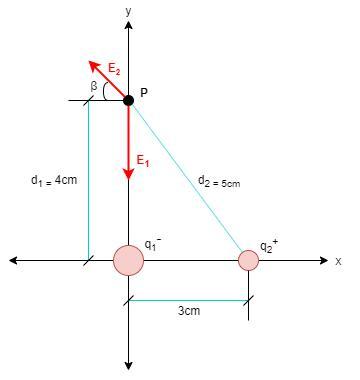
Fields of Point Charges Two point charges are fixed in the x-y plane. At the origin is q1 = -6.00 nC . and at a point on the x-a
My name is Ann [436]

Answer:

Part A) Electric fields at the point due to q₁ and q₂:

E₁ = 33.75*10³ N/C (-j) , E₂= ( 6.48 (-i) + 8.64 (+j) )*10³ N/C

Part B) Net electric field at P (Ep)

Ep=   (6.48*10³ (-i)+25.11 10³ (-j) )N/C

Explanation:

Conceptual analysis

The electric field at a point P due to a point charge is calculated as follows:

E = k*q/d²

E: Electric field in N/C

q: charge in Newtons (N)

k: electric constant in N*m²/C²

d: distance from charge q to point P in meters (m)

Equivalence

1nC= 10⁻⁹C

1cm= 10⁻²m

Data

k= 9*10⁹ N*m²/C²

q₁ = -6.00 nC = -6 *10⁻⁹C

q₂ = +3.00 nC = +3*10⁻⁹C

d₁ = 4cm = 4 *10⁻²m

d_{2} =\sqrt{(4*10^{-2})^{2}+((3*10^{-2})^{2} }

d₂ = 5 *10⁻²m

Part A) Calculation of the electric fields at the point due to q₁ and q₂

Look at the attached graphic:

E₁: Electric Field at point  P(0,4) cm due to charge q₁. As the charge q₁ is negative (q₁-), the field enters the charge

E₂: Electric Field at point  P(0,4) cm  due to charge q₂. As the charge q₂ is positive (q₂+) ,the field leaves the charge

E₁ = k*q₁/d₁² = 9*10⁹ *6 *10⁻⁹/ (4 *10⁻²)² = 33.75*10³ N/C

E₂ = k*q₂/d₂²= 9*10⁹ *3*10⁻⁹/(5 *10⁻²)² =  10.8*10³ N/C

E₁ = 33.75*10³ N/C (-j)

E₂x=E₂cosβ = 10.8*(3/5) = 6.48*10³ N/C

E₂y=E₂sinβ = 10.8*(4/5) =  8.64*10³ N/C

E₂= ( 6.48 (-i) + 8.64 (+j) )*10³ N/C

Part B) Calculation of the net electric field at P (Ep)

The electric field at a point P due to several point charges is the vector sum of the electric field due to individual charges.

Ep=Epx (i) + Epy (j)

Epx= E₂x= 6.48*10³ N/C (-i)

Epy= E₁y+E₂y= (33.75*10³ (-j) + 8.64*10³ (+j) ) N/C=25.11 10³ (-j) N/C

Ep=   (6.48*10³ (-i)+25.11 10³ (-j) )N/C

Ep=   (6.48*10³ (-i)+25.11 10³ (-j) )N/C

3 0
2 years ago
A 57 kg paratrooper falls through the air. How much force is pulling him down?
just olya [345]

Answer:

Explanation:

Force = Mass * acceleration due to gravity.

Given

Mass of the paratrooper = 57kg

Acceleration due to gravity = 9.81m/s²

Required

Force pulling him down

Substitute unto formula;

F = 57 * 9.81

Force = 559.17 N

Hence the force pulling him down is 559.17N

7 0
2 years ago
When a hot and cold object are placed in contact, the hot one loses energy. Does this violate energy conservation? Why or why no
blsea [12.9K]

Answer:

This does not violate the conservation of energy.

Explanation:

This does not violate the conservation of energy because the hot body gives energy in the form of heat to the colder body, this second absorbs energy. This will be the case until both bodies reach the same temperature, reaching thermal equilibrium and reducing the transfer of thermal energy. In this way the energy was only transferred from one body to another but the total energy of the system (body 1 plus body 2) will be the same as in the beginning, respecting the principle of conservation of energy or also called the first principle of thermodynamics .

The part of physics that studies these processes is in turn called heat transfer or heat transfer or thermal transfer. Heat transfer occurs whenever there is a thermal gradient or when two systems with different temperatures come into contact. The process persists until thermal equilibrium is reached, that is, until temperatures are equalized. When there is a temperature difference between two objects or regions close enough, the heat transfer cannot be stopped, it can only be slowed down.

8 0
2 years ago
Other questions:
  • 3. You have three stars. Star A has an apparent magnitude of 7, Star B has an apparent magnitude of 2, and Star C has an apparen
    14·1 answer
  • Titanium metal requires a photon with a minimum energy of 6.94×10⁻¹⁹J to emit electrons. If titanium is irradiated with light of
    10·1 answer
  • A plastic cube with a coin taped to its top surface is floating partially submerged in water. A student marks the level of the w
    8·1 answer
  • Which description best explains a molecular bonding?
    5·1 answer
  • The acceleration due to gravity at the north pole of Neptune is approximately 11.2 m/s2. Neptune has mass 1.02×1026 kg and radiu
    11·1 answer
  • Which type of multi-load circuit can turn off one load without affecting the other loads?
    14·2 answers
  • Does a fish appear closer or farther from a person wearing swim goggles with an air pocket in front of their eyes than the fish
    8·1 answer
  • A student on a skateboard is moving at a speed of 1.40 m/s at the start of a 2.15 m high and 12.4 m long incline. The total mass
    9·1 answer
  • How can philosophy help you become a productive citizen<br>​
    13·1 answer
  • Fiber optic (FO) cables are based upon the concept of total internal reflection (TIR), which is achieved when the FO core and cl
    8·1 answer
Add answer
Login
Not registered? Fast signup
Signup
Login Signup
Ask question!