answer.
Ask question
Login Signup
Ask question
All categories
  • English
  • Mathematics
  • Social Studies
  • Business
  • History
  • Health
  • Geography
  • Biology
  • Physics
  • Chemistry
  • Computers and Technology
  • Arts
  • World Languages
  • Spanish
  • French
  • German
  • Advanced Placement (AP)
  • SAT
  • Medicine
  • Law
  • Engineering
almond37 [142]
2 years ago
11

Fields of Point Charges Two point charges are fixed in the x-y plane. At the origin is q1 = -6.00 nC . and at a point on the x-a

xis 3.00 cm from the origin is q2 = +3.00 n C. Now consider Point P, which is on the y-axis. 4.00 cm from the origin. Part A Find the electric fields E1 and E2 at point P due to the charges q1 and q2. Express your results in terms of unit vectors. Express your answer in terms of the unit vectors i, j. Enter your answers separated by a comma. Part B Determine the net electric field at P. expressing your answer in unit vector form. Express your answer in terms of the unit vectors i, j.

Physics
1 answer:
My name is Ann [436]2 years ago
3 0

Answer:

Part A) Electric fields at the point due to q₁ and q₂:

E₁ = 33.75*10³ N/C (-j) , E₂= ( 6.48 (-i) + 8.64 (+j) )*10³ N/C

Part B) Net electric field at P (Ep)

Ep=   (6.48*10³ (-i)+25.11 10³ (-j) )N/C

Explanation:

Conceptual analysis

The electric field at a point P due to a point charge is calculated as follows:

E = k*q/d²

E: Electric field in N/C

q: charge in Newtons (N)

k: electric constant in N*m²/C²

d: distance from charge q to point P in meters (m)

Equivalence

1nC= 10⁻⁹C

1cm= 10⁻²m

Data

k= 9*10⁹ N*m²/C²

q₁ = -6.00 nC = -6 *10⁻⁹C

q₂ = +3.00 nC = +3*10⁻⁹C

d₁ = 4cm = 4 *10⁻²m

d_{2} =\sqrt{(4*10^{-2})^{2}+((3*10^{-2})^{2} }

d₂ = 5 *10⁻²m

Part A) Calculation of the electric fields at the point due to q₁ and q₂

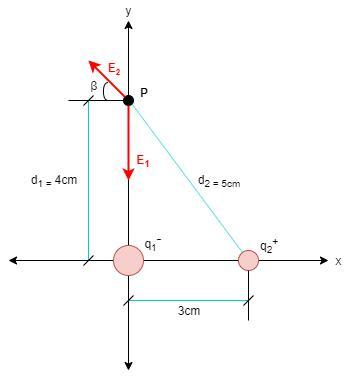
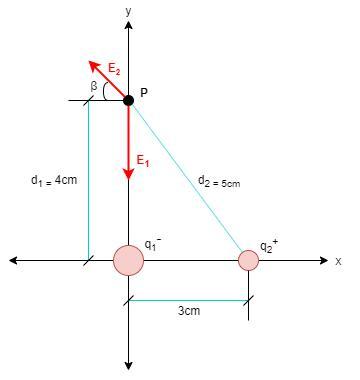
Look at the attached graphic:

E₁: Electric Field at point  P(0,4) cm due to charge q₁. As the charge q₁ is negative (q₁-), the field enters the charge

E₂: Electric Field at point  P(0,4) cm  due to charge q₂. As the charge q₂ is positive (q₂+) ,the field leaves the charge

E₁ = k*q₁/d₁² = 9*10⁹ *6 *10⁻⁹/ (4 *10⁻²)² = 33.75*10³ N/C

E₂ = k*q₂/d₂²= 9*10⁹ *3*10⁻⁹/(5 *10⁻²)² =  10.8*10³ N/C

E₁ = 33.75*10³ N/C (-j)

E₂x=E₂cosβ = 10.8*(3/5) = 6.48*10³ N/C

E₂y=E₂sinβ = 10.8*(4/5) =  8.64*10³ N/C

E₂= ( 6.48 (-i) + 8.64 (+j) )*10³ N/C

Part B) Calculation of the net electric field at P (Ep)

The electric field at a point P due to several point charges is the vector sum of the electric field due to individual charges.

Ep=Epx (i) + Epy (j)

Epx= E₂x= 6.48*10³ N/C (-i)

Epy= E₁y+E₂y= (33.75*10³ (-j) + 8.64*10³ (+j) ) N/C=25.11 10³ (-j) N/C

Ep=   (6.48*10³ (-i)+25.11 10³ (-j) )N/C

Ep=   (6.48*10³ (-i)+25.11 10³ (-j) )N/C

You might be interested in
POINTS + BRAINLIEST TO CORRECT ANSWER
Elza [17]

Answer:

<h2>5.3 m</h2>

Explanation:

The standard film size for one popular camera was<u> 79 mm square</u>.

The film was <u>116 mm behind the lens</u>.

If you wanted a picture of your<u> 1.8-m-tall friend to fill half the frame</u>,

find:

how far away from you did she need to stand?

solution:

the other person called friend is 1.8 m tall (1,800mm) stood from the other side to fill up half of the frame of 79mm / 2 = 35 mm.

where the film behind the lens is 116mm as given.

so its a ratio and proportion:

<u>1800 mm </u> =  <u>     39.5 mm   </u>

     x                    116 mm

39.5 (x) = 1800 (116)

x =  <u> 208,800</u>

         39.5

x = 5286 mm * <u>      1  m     </u>

                          1000 mm

x = 5.3 m

4 0
2 years ago
Each metal is illuminated with 400 nm (3.10 eV) light. Rank the metals on the basis of the maximum kinetic energy of the emitted
34kurt

Answer:

K.E(K) > K.E(Cs) > 0 (others)

Explanation:

Given the Work functions of the metal as

Aluminium (Wo)=4eV

Platinum(Wo) =6.4eV

Cesium (Wo) =2.1eV

Beryllium (Wo) = 5.0eV

Magnesium (Wo) = 3.7eV

Potassium (Wo) = 2.3eV

Using the formula:

K.E = hf - Wo........(1)

Wo = hfo..............(2)

From these the fo can be calculated for all the metals

Where K.E =Kinetic Energy

hf = energy of illumination = 3.10eV

h is Planck constant and has the value 6.6 × 10^-34JS^-1

The frequency f of the illumination is given by

f = 3.10 × 1.6 × 10^-19/6.6 × 10^-34

f = 7.51 × 10¹⁴ Hz..........(*)

Now an electron is only ejected if the threshold frequency of the metal is reached.

The work function has a threshold frequency (fo) for all the metals and this minimum frequency required to required to remove an electron from the surface of a metal.

We need to compare f with fo

If fo >= f there is emission, otherwise there is no emission

So using (2) we calculate for all fo and compare with f

K.E(Al) = 3.10 - 4.0 - 3.10 = -0.9eV, fo = 9.70 × 10¹⁴ Hz (no emission)

K.E(Pt) = 3.10 - 6.40 = -3.30eV, fo = 1.55 × 10^15 Hz, ( no emission)

K.E(Cs) = 3.10 - 2.10 = -1.0eV, fo = 5.09×10¹⁴ Hz, (emission)

K.E(Be) =3.10-5.0 = -1.90eV, fo = 12.12 ×10^15 Hz.,(no emission)

K.E(Mg) = 3.10-3.70 = -0.6eV, fo = 8.97 × 10¹⁴Hz, (no emission)

K.E(K) = 3.10 - 2.30= 0.9eV, fo = 5.58 × 10¹⁴ Hz, (emission)

So the metals whose electron gain Kinetic energy are:

Cesium

Potassium

Others have zero kinetic energy since no electron is emitted.

Hence the rank is:

K.E(K) > K.E(Cs) > 0 (others)

6 0
2 years ago
How does climate change lead to an increase in algal blooms? a. Decreased temperatures lead to an increase in phytoplankton grow
asambeis [7]

Answer;

B. Increased levels of carbon dioxide, a greenhouse gas, leads to increased phytoplankton growth.

Explanation;

-A combination of warm water, high nutrient levels, and adequate sunlight may cause a harmful algae bloom. These blooms may damage aquatic ecosystems by blocking sunlight and depleting oxygen that other organisms need to survive.

-Algae blooms have been increasing globally, and climate change may be playing a role in the increment. For instance, during the warm summer season or when water is warmer, some harmful types of algae to grow faster than other, more benign varieties.

-Additionally, the warmer surface water also prevents water from mixing vertically, allowing algae to grow thicker and faster.

4 0
2 years ago
Read 2 more answers
A couch is pushed with a horizontal force of 80 N and moves the couch a
Lapatulllka [165]

Answer:

400 J

Explanation:

Work = force × distance

W = (80 N) (5 m)

W = 400 J

5 0
2 years ago
Read 2 more answers
The force sensor measures the force on the sensor due to the bumper, but the cart's momentum change arises from the force on the
Irina-Kira [14]

Answer:

Answered

Explanation:

1 and 3 are necessary

Every bit of force applied to the bumper will be transmitted to the cart EXCEPT for the force needed to accelerate the bumper. This is the net force on the bumper.

If the bumper was heavy then a significant amount of force might be needed to accelerate the bumper so the amount transmitted to the cart would be substantially reduced.

If the net force on the bumper is small then the amount transmitted to the cart is almost the entire force applied.

5 0
2 years ago
Other questions:
  • Thermals created by warm air rising and cold air sinking are called___?
    11·1 answer
  • What voltage is delivered to a 120-volt/5,000-watt load that is fed with #10 awg wire (1.24 ohms/1,000 feet) and located 750 fee
    8·1 answer
  • If the current in a wire increases from 5 A to 10 A, what happens to its magnetic field? If the distance of a charged particle f
    14·2 answers
  • A 25-turn circular coil of wire has diameter 1.00 m. It is placed with its axis along the direction of the Earth’s magnetic fiel
    10·1 answer
  • Which of the following statements is false?
    6·2 answers
  • The wheel having a mass of 100 kg and a radius of gyration about the z axis of kz=300mm, rests on the smooth horizontal plane.a.
    11·1 answer
  • A 25-kg iron block initially at 350oC is quenched in an insulated tank that contains 100 kg of water at 18oC. Assuming the water
    13·1 answer
  • A student slides her 80.0-kg desk across the level floor of her dormitory room a distance 4.00 m at constant speed. If the coeff
    7·1 answer
  • Consider a steel tape measure with cross-sectional area, A = 0.0625 inches squared, and length L = 3, 600 inches at room tempera
    8·1 answer
  • What is the magnitude of the momentum of a 11kg object moving at 2.2 m/s?
    11·1 answer
Add answer
Login
Not registered? Fast signup
Signup
Login Signup
Ask question!