answer.
Ask question
Login Signup
Ask question
All categories
  • English
  • Mathematics
  • Social Studies
  • Business
  • History
  • Health
  • Geography
  • Biology
  • Physics
  • Chemistry
  • Computers and Technology
  • Arts
  • World Languages
  • Spanish
  • French
  • German
  • Advanced Placement (AP)
  • SAT
  • Medicine
  • Law
  • Engineering
Rzqust [24]
2 years ago
12

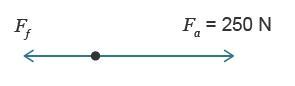
An object has a mass of 15 kg and is accelerating to the right at 16.3 m/s2. The free-body diagram shows the horizontal forces a

cting on the object.
What is the frictional force, Ff, acting on the object?

5.5 N
15 N
244.5 N
494.5 N


Answer :
5.5 N

Physics
2 answers:
marshall27 [118]2 years ago
8 0
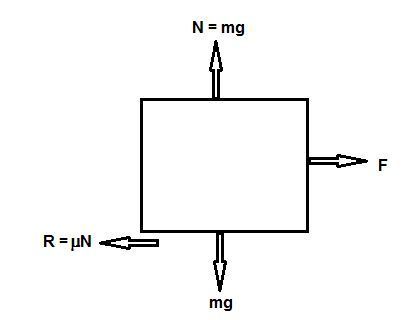
Refer to the free body diagram shown melow.

F =  applied force
R =  frictional force
m = 15 kg, the mass of the object

The acceleration (to the right) is 16.3 m/s², therefore
F - R = (15 kg)*(16.3 m/s²) = 244.5 N

The normal reaction is
N = mg = (15 kg)*(9.8 m/s²)  = 147 N
The frictional force is
R = μN = 147μ N,  where μ =  coefficient of kinetic friction.

Let us check possible answers:
If R = 5.5 N, then μ = 5.5/147 = 0.0374 (very likely)
If R = 15 N, then μ = 15/147 = 0.102 (possible)
If R = 244.5 N,   (Highly unlikely, exceed mg)
If R = 494.5 N, (highly unlikely, exceeds mg)

Answer:
The most reasonable answer is R = 5.5 N

tangare [24]2 years ago
3 0

Answer:

Ff = 5.5 N

Explanation:

Given:

M: 15kg

A: 16.3 m/s2

We use:

f=ma

force=mass*acceleration

(15kg)(16.3m/s^{2} )=244.5N

This means that 244.5 N is the net force on the object, and the right vector is showing 250 N, so to find the left vector - which would be a negative number (left direction) - we do

(-Ff)+250N= 244.5N (net force)

<h3>Which would give us 5.5 N in the left direction (Ff) </h3>

Hope This Helps!

You might be interested in
Heat engines were first envisioned and built during the industrial revolution. Explain the thermodynamics of a heat engine comme
Artyom0805 [142]

Heat engines were developed during industrial revolution.

Generally a heat engine contains three parts i.e source, sink and working substance.

The source of a heat engine is present at a higher temperature as compared to the sink. Due to the temperature difference, the heat will flow from source to sink through working substance.

Let us consider  T_{1}\ and\ T_{2} are the temperature of source and sink.

As the source is at higher temperature as compared to sink, heat will flow from source to sink.

Let\ Q_{1}\ and\ Q_{2} are the heat provided by source and heat rejected to sink.

Hence, the work done by the working substance will be -

                                                W\ =\ Q_{1}-Q_{2}

The efficiency of a heat engine is defined as the ratio of output to the input energy.

Here output = workdone [W]

Hence, the efficiency of a heat engine is calculated as -

                     Efficiency\ [\eta]=\frac{W}{Q_{1}}

                                        \eta\ =\frac{Q_{1}- Q_{2}} {Q_{1}}

                                               =\ 1-\frac{Q_{2}} {Q_{1}}

This is the expression for the efficiency of heat engine.

Here, all the heat absorbed by the working substance can not be converted to desired output. The efficiency of a heat engine can not be 100 percent. Some amount of heat is lost in the form of sound and heat due to the friction which is produced due to the relative motion between various parts of the machine.
6 0
2 years ago
Read 2 more answers
Angular and Linear Quantities: A child is riding a merry-go-round that has an instantaneous angular speed of 1.25 rad/s and an a
serious [3.7K]

To solve this problem we will use the kinematic equations of angular motion in relation to those of linear / tangential motion.

We will proceed to find the centripetal acceleration (From the ratio of the radius and angular velocity to the linear velocity) and the tangential acceleration to finally find the total acceleration of the body.

Our data is given as:

\omega = 1.25 rad/s \rightarrow The angular speed

\alpha = 0.745 rad/s2 \rightarrow The angular acceleration

r = 4.65 m \rightarrow The distance

The relation between the linear velocity and angular velocity is

v = r\omega

Where,

r = Radius

\omega = Angular velocity

At the same time we have that the centripetal acceleration is

a_c = \frac{v^2}{r}

a_c = \frac{(r\omega)^2}{r}

a_c = \frac{r^2\omega^2}{r}

a_c = r \omega^2

a_c = (4.65 )(1.25 rad/s)^2

a_c = 7.265625 m/s^2

Now the tangential acceleration is given as,

a_t = \alpha r

Here,

\alpha = Angular acceleration

r = Radius

\alpha = (0.745)(4.65)

\alpha = 3.46425 m/s^2

Finally using the properties of the vectors, we will have that the resulting component of the acceleration would be

|a| = \sqrt{a_c^2+a_t^2}

|a| = \sqrt{(7.265625)^2+(3.46425)^2}

|a| = 8.049 m/s^2 \approx 8.05 m/s2

Therefore the correct answer is C.

7 0
2 years ago
A plane took 7 hours to travel 2020 km. For the first 4 hours,
kicyunya [14]

Answer:

-6.6 km/h

Explanation:

In 7hr plane travelled 2020km;

For the first 4hr the average speed was 310km/h;

d=st, s=d/t;

Distance covered in first 4h is d = 310km/h×4h = 1240km;

See the image attached for further solution

8 0
2 years ago
Read 2 more answers
Optical tweezers use light from a laser to move single atoms and molecules around. Suppose the intensity of light from the tweez
Zanzabum

(a)  3.3\cdot 10^{-6} Pa

The radiation pressure exerted by an electromagnetic wave on a surface that totally absorbs the radiation is given by

p=\frac{I}{c}

where

I is the intensity of the wave

c is the speed of light

In this problem,

I=1000 W/m^2

and substituting c=3\cdot 10^8 m/s, we find the radiation pressure

p=\frac{1000 W/m^2}{3\cdot 10^8 m/s}=3.3\cdot 10^{-6}Pa

(b) 4.4\cdot 10^{-8} m/s^2

Since we know the cross-sectional area of the laser beam:

A=6.65\cdot 10^{-29}m^2

starting from the radiation pressure found at point (a), we can calculate the force exerted on a tritium atom:

F=pa=(3.3\cdot 10^{-6}Pa)(6.65\cdot 10^{-29} m^2)=2.2\cdot 10^{-34}N

And then, since we know the mass of the atom

m=5.01\cdot 10^{-27}kg

we can find the acceleration, by using Newton's second law:

a=\frac{F}{m}=\frac{2.2\cdot 10^{-34} N}{5.01\cdot 10^{-27} kg}=4.4\cdot 10^{-8} m/s^2

6 0
2 years ago
1. If a fast-moving car making a loud noise approaches and moves past the person, what will happen as the distance between the t
PilotLPTM [1.2K]
<span>So we want to know what will happen when the fast moving car that is making loud noise that is initially approaching the person, passes the person and starts to move away. So Doppler effect is a phenomenon where when the source of a sound is approaching a person, the person hears the sound as higher than if the source was standing still with respect to the person because the wavelength is getting shorter, and as the source is moving avay from the person the sound is getting deeper because the wavelength is getting longer. So the correct answer is A. </span>
4 0
2 years ago
Read 2 more answers
Other questions:
  • Water is projected from two rubber pipes at the same speed from one at an angle of 30°and from the other at 60°.why are the rang
    6·1 answer
  • A space shuttle was launched from the Earth to the moon. The average, or accepted, value of the distance of the Earth to the moo
    13·1 answer
  • A car traveling at speed v takes distance d to stop after the brakes are applied. What is the stopping distance if the car is in
    14·2 answers
  • Given a die, would it be more likely to get a single 6 in six rolls, at least two 6s in twelve rolls, or at least one-hundred 6s
    14·1 answer
  • A power plant burns 1000 kg of coal each hour and produces 500 kW of power. Calculate the overall thermal efficiency if each kg
    7·1 answer
  • A large, metallic, spherical shell has no net charge. It is supported on an insulating stand and has a small hole at the top. A
    14·1 answer
  • La luz pasa del medio A al medio B formando un ángulo de 35° con la frontera horizontal entre ambos. Si el ángulo de refracción
    7·1 answer
  • You work for an advertising company and have been hired to place a blimp above a football stadium. The angle of elevation from a
    12·1 answer
  • A 615 watt refrigerator runs 24 hours/day. How much energy is used per month (30 days)?
    12·1 answer
  • In certain cases, using both the momentum principle and energy principle to analyze a system is useful, as they each can reveal
    9·1 answer
Add answer
Login
Not registered? Fast signup
Signup
Login Signup
Ask question!