answer.
Ask question
Login Signup
Ask question
All categories
  • English
  • Mathematics
  • Social Studies
  • Business
  • History
  • Health
  • Geography
  • Biology
  • Physics
  • Chemistry
  • Computers and Technology
  • Arts
  • World Languages
  • Spanish
  • French
  • German
  • Advanced Placement (AP)
  • SAT
  • Medicine
  • Law
  • Engineering
mrs_skeptik [129]
2 years ago
4

Find and report the reduction potentials of lithium, sodium, and potassium.

Chemistry
2 answers:
laiz [17]2 years ago
8 0
<span>Reduction potential (V) Li -3.045 Na -2.7109 K -2.924 Rb -2.925 Cs -2.923</span>
n200080 [17]2 years ago
6 0

The electrode potential values of {\text{L}}{{\text{i}}^ + }, {\text{N}}{{\text{a}}^ + } and {{\text{K}}^ + } are \boxed{ - 3.045{\text{ V}}}, \boxed{ - {\text{2}}{\text{.714 V}}} and \boxed{ - {\text{2}}{\text{.925 V}}} respectively.

Further explanation:

Electrochemical cells are the devices that are used to generate an electric current from the energy released by the spontaneous redox reaction. Redox reactions involve the transfer of electrons between the chemical species by oxidation and reduction process. The oxidation process represents the loss of electrons and reduction process represents the gain of electrons.

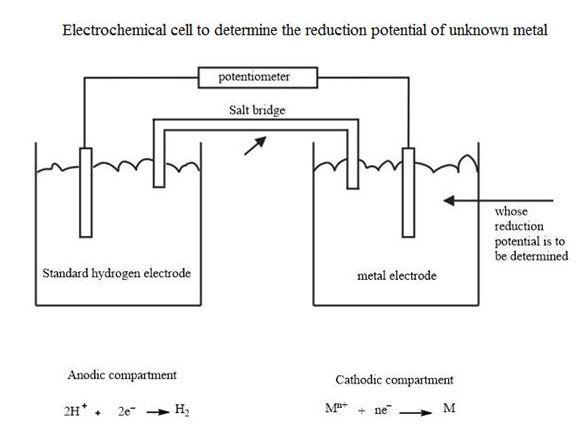
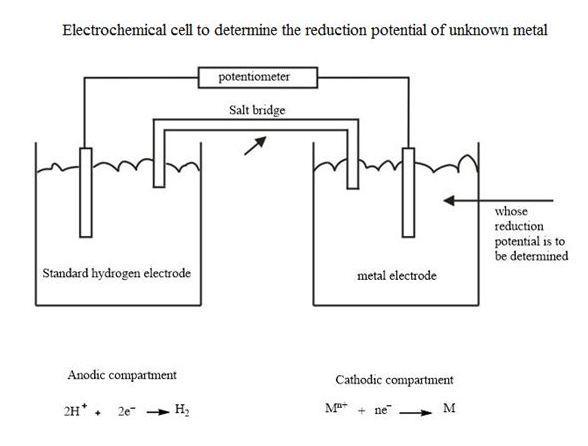
In order to determine the standard reduction potential, the electrode is coupled with standard hydrogen electrode as illustrated in the attached image. The SHE acts as anode and the metal electrode acts as the cathode. The value of reduction potential for hydrogen has been assigned as 0.00 V.

The formula to calculate cell potential \left( {{E_{{\text{cell}}}}} \right) of the reaction when the reduction occurs as cathode and oxidation occur at anode is as follows:

{E_{{\text{cell}}}} = {E_{{\text{cathode}}}} - {E_{{\text{anode}}}}

The expression of Nernst equation that relates the reduction potential of a half or full electrochemical cell reaction to the standard electrode potential is given as,

{E_{{\text{cell}}}} = E_{{\text{cell}}}^\circ - \dfrac{{2.303RT}}{{nF}}\log \dfrac{{\left[ P \right]}}{{\left[ R \right]}}               ……. (1)

Here,

{E_{{\text{cell}}}} is cell potential.

E_{{\text{cell}}}^\circ is standard cell potential.

R is gas constant and is equal to 8.314{\text{ J/K}} \cdot {\text{mol}}.

T is temperature.

n denotes the number of moles of electrons transferred in the reaction.

F is Faraday constant and is equal to 95484.56{\text{ C/mol}}.

\left[ P \right] is the concentration of product.

\left[ R \right] is the concentration of reactant.

At standard temperature 25\;^\circ {\text{C}}\left( {298{\text{ K}}} \right) the value of \dfrac{{2.303RT}}{F} is equal to 0.0592{\text{ V}}. Thus the equation(1) is written as,

{E_{{\text{cell}}}} = E_{{\text{cell}}}^\circ - \dfrac{{0.0591}}{n}\log \dfrac{{\left[ P \right]}}{{\left[ R \right]}}         …… (2)

Knowing the concentration of the electrolyte solutions taken in the cathodic compartment and substituting the values in the Nernst equation gives the reduction potential for the half cell.

The electrode potential values of {\mathbf{L}}{{\mathbf{i}}^{\mathbf{ + }}}, {\mathbf{N}}{{\mathbf{a}}^{\mathbf{ + }}} and {{\mathbf{K}}^{\mathbf{ + }}} are {\mathbf{ - 3}}{\mathbf{.045 V}}, {\mathbf{ - 2}}{\mathbf{.714 V}} and {\mathbf{ - 2}}{\mathbf{.925 V}} respectively as determined with respect to standard hydrogen electrode at {\mathbf{298 K}}.

Learn more:

1. Effectiveness of detergent: brainly.com/question/10136601

2. Scientific notation: brainly.com/question/4935921

Answer details:  

Grade: Senior School

Subject: Chemistry

Chapter: Electrochemistry

Keywords: Electrochemical cells, Redox reactions, Oxidation, reduction, cell potential, half-cell, Nernst equation, Faraday constant.
You might be interested in
A bird building a nest for its young is a reproductive strategy. Based on this example, what do you think the term “reproductive
Scilla [17]
A reproductive strategy is something done with the intent of preserving a family line so that life can continue.

please vote my answer branliest! Thanks.
8 0
2 years ago
Read 2 more answers
Balance the reactions which form ions. Choose "blank" if no other coefficient is needed. Writing the symbol implies "1."
Minchanka [31]
Following are the Balanced Reactions,

Reaction 1:


                            (NH₄)₂CO₃     →    <u>2</u> NH₄⁺  +  CO3⁻²

Reaction 2:

                                     PbI₂    →    Pb⁺²<span>  +  <u>2</u> I</span>⁻¹

Reaction 3:

                              <span>(NH</span>₂<span>)</span>₃<span>PO</span>₄     →     <span><u>3</u> NH</span>₄⁺  <span>+   PO</span>₄⁻³
7 0
2 years ago
Read 2 more answers
Alex's teacher showed him a model of gas particles in a sealed container. How should Alex change the model to show the particles
Inessa05 [86]

Answer:

  • Increased volume of particles in the container
  • greater vibration of particles

Explanation:

At higher temperature, the particles of the gas would be more active and vibrate more, or even have greater collisions. Alex can indicate this in the altered model to depict higher temperature.

Consequently, Charles law gives meaning to why there would be an increased volume of gas in the stable pressurized container, if the temperature were to be increased.

I hope this explanation was clear and concise?

7 0
2 years ago
In Part B the given conditions were 1.00 mol of argon in a 0.500-L container at 27.0 ∘C . You identified that the ideal pressure
dimaraw [331]

Answer : The percent difference between the ideal and real gas is, 4.06 %.

Explanation : Given,

Ideal pressure (true value) = 49.3 atm

Real pressure (measured value) = 47.3 atm

The formula used to calculate percent difference is :

Percent difference = \frac{\text{True value - Measured value}}{\text{True value}} \times 100

Percent difference = \frac{(49.3- 47.3)atm}{49.3atm}\times 100

Percent difference = 4.06 %

Therefore, the percent difference between the ideal and real gas is, 4.06 %.

4 0
2 years ago
A student titrates 10.00 milliliters of hydrochloric acid of unknown molarity with 1.000 m naoh. it takes 21.17 milliliters of b
Dima020 [189]
Mole ratio for the reaction is 1:1
no of moles in NaOH that reacted= 1*21.17/1000=0.02117mols
 molarity of HCl=0.02117*10/1000
                         =2.117M
4 0
2 years ago
Other questions:
  • White phosphorus, P4, is prepared by fusing
    12·1 answer
  • A stone of mass 0.55 kilograms is released and falls to the ground. Measurements show that the stone has a kinetic energy of 9.8
    6·2 answers
  • astronauts brought back 500 lb rock samples from the moon. how many kilograms did they bring back (1 kg = 2.20 lbs)
    12·2 answers
  • Identify the limiting reactant when 1.22 g of O2 reacts with 1.05 g H2 to produce water.
    5·1 answer
  • A particular experiment requires 13.5 µl hydrochloric acid solution. if 250 ml hydrochloric acid solution is available, how many
    6·2 answers
  • Air pressure is lower at high altitudes. An airplane cabin can adjust, but as the plane rises, passengers can experience tempora
    14·2 answers
  • A sodium ion, Na+, with a charge of 1.6×10⁻¹⁹C and a chloride ion, Cl− , with charge of −1.6×10⁻¹⁹C, are separated by a distance
    5·1 answer
  • Phosphorous and chlorine gases combine to produce phosphorous trichloride: P2(g)+3Cl2(g)→2PCl3(g) ΔG∘ at 298K for this reaction
    14·1 answer
  • A 1.555-g sample of baking soda decomposes with heat to produce 0.991 g Na2CO3. Refer to Example Exercise 14.l and show the calc
    10·1 answer
  • What is osmotic pressure of a solution that contains 13.7 g of propyl alcohol (C3H7OH) dissolved in enough water to make 500 mL
    9·1 answer
Add answer
Login
Not registered? Fast signup
Signup
Login Signup
Ask question!
