answer.
Ask question
Login Signup
Ask question
All categories
  • English
  • Mathematics
  • Social Studies
  • Business
  • History
  • Health
  • Geography
  • Biology
  • Physics
  • Chemistry
  • Computers and Technology
  • Arts
  • World Languages
  • Spanish
  • French
  • German
  • Advanced Placement (AP)
  • SAT
  • Medicine
  • Law
  • Engineering
Anna71 [15]
2 years ago
4

Refrigerant 134a enters an insulated diffuser as a saturated vapor at 80°f with a velocity of 1453.4 ft/s. at the exit, the tem

perature is 280°f and the velocity is negligible. the diffuser operates at steady state and potential energy effects can be neglected. determine the exit pressure in lbf/in2 .

Physics
1 answer:
jeyben [28]2 years ago
5 0
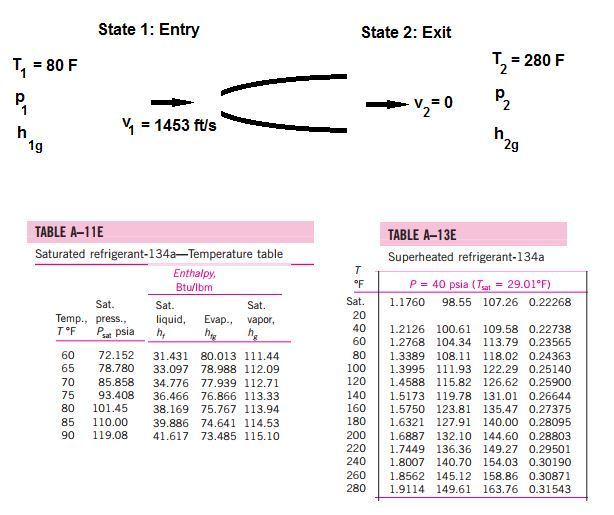
Refer to the diagram shown below.

State 1: The inlet
T₁ = 80°F, the inlet temperature
v₁ = 1453 ft/s, the inlet velocity
Saturated vapor

From thermodynamic tables, obtain
h₁ = 113.94 Btu/lbm, the enthalpy
p₁ = 101.45 psia, the inlet pressure

State 2: The outlet
T₂ = 280 F, the outlet temperature
v₂ = 0, the outlet velocity

From thermodynamic tables, obtain
h₂ = 163.76 Btu/(lbm-R)
p₂ = 40 psia, the exit pressure

Answer:  40 psia
You might be interested in
two negative charge of -2.0 c and a positive charge of 3.0 c are separated by 80 m what is the force between two charges
kozerog [31]
The Coulomb force is equal to the constant k times the product of charge one and charge two over radius.

F=k((q1q2)/r)
6 0
2 years ago
Two flat 4.0 cm × 4.0 cm electrodes carrying equal but opposite charges are spaced 2.0 mm apart with their midpoints opposite ea
serious [3.7K]

Answer:

1.77 x 10^-8 C

Explanation:

Let the surface charge density of each of the plate is σ.

A = 4 x 4 = 16 cm^2 = 16 x 10^-4 m^2

d = 2 mm

E = 2.5 x 10^6 N/C

ε0 = 8.85 × 10⁻¹² C2/N ∙ m2

Electric filed between the plates (two oppositively charged)

E = σ / ε0

σ = ε0 x E

σ = 8.85 x 10^-12 x 2.5 x 10^6 = 22.125 x 10^-6 C/m^2

The surface charge density of each plate is ± σ / 2

So, the surface charge density on each = ± 22.125 x 10^-6 / 2

                                                                 = ± 11.0625 x 10^-6 C/m^2  

Charge on each plate = Surface charge density on each plate x area of each plate

Charge on each plate = ± 11.0625 x 10^-6  x 16 x 10^-4 = ± 1.77 x 10^-8 C

7 0
2 years ago
Two sources emit beams of light of wavelength 550 nm. The light from source A has an intensity of 10 μW/m2, and the light from s
alexira [117]

Answer:

<em>A) Beam B carries twice as many photons per second as beam A.</em>

Explanation:

If we have two waves with the same wavelength, then their intensity is proportional to their power, or the energy per unit time.

We also know that the amount of photon present in an electromagnetic beam is proportional to the energy of the beam, hence the amount of beam per second is proportional to the power.

With these two facts, we can say that the intensity is a measure of the amount of photon per second in an electromagnetic beam. So we can say that <em>beam B carries twice as more power than beam A, or Beam B carries twice as many photons per second as beam A.</em>

3 0
2 years ago
Which of these discoveries contradict components of Dalton’s atomic theory? Check all of the boxes that apply. Atoms contain sma
EastWind [94]

Explanation:

According to Dalton's atomic theory, all the atoms are individual, all the atoms of the same element are identical in properties and mass, the compound is formed from two or more kinds of the atoms, all the matter is made up of small atoms and the chemical reaction is a rearrangement of the atoms.

The discoveries which contradicts the components of Dalton's atomic theory from the given discoveries are:

Nuclear reactions can change an atom of one element into an atom of another element.

Atoms of a given element can have different numbers of neutrons.

Atoms contain smaller particles: protons, neutrons, and electrons.

4 0
2 years ago
Read 2 more answers
Dawn and Aram have stretched a slinky between them and begin experimenting with waves. As the frequency of the waves is doubled
m_a_m_a [10]

Answer:

halved

Explanation:

The velocity of the a wave is obtained by multiplying the frequency and wavelength.

v=f\lambda\\\Rightarrow f=\frac{v}{\lambda}\\\Rightarrow \lambda=\frac{v}{f}

Where

v = Velocity

f = Frequency

\lambda = Wavelength

The velocity here is constant. So, if the frequency is doubled the wavelength is halved.

6 0
2 years ago
Other questions:
  • A cart moves along a track at a velocity of 3.5 cm/s. when a force is applied to the cart, its velocity increases to 8.2 cm/s. i
    15·2 answers
  • A lawn sprinkler sprays water 8 feet at full pressure as it rotates 360 degrees. if the water pressure is reduced by 50%, what i
    9·1 answer
  • a proton is moving horizontally at 7.9 x 10^5 m/s. It passes through a vertical magnetic field that points downward. In which di
    7·1 answer
  • A point charge of 6.8 C moves at 6.5 × 10⁴ m/s at an angle of 15° to a magnetic field that has a field strength of 1.4 T.
    5·2 answers
  • Suppose you sketch a model of an atom using the ones here as a guide. How would you build a model that is ionized? How would you
    15·1 answer
  • In a certain clock, a pendulum of length L1 has a period T1 = 0.95s. The length of the pendulum
    15·1 answer
  • The figure above represents a stick of uniform density that is attached to a pivot at the right end and has equally spaced marks
    13·1 answer
  • Nerve impulses are carried along axons, the elongated fibers that transmit neural signals. We can model an axon as a tube with a
    5·1 answer
  • Calculate the mag-netic field (magnitude and direc-tion) at a point p due to a current i=12.0 a in the wire shown in fig. p28.68
    10·1 answer
  • Four rods that obey Hooke's law are each put under tension. (a) A rod 50.0 cm50.0 cm long with cross-sectional area 1.00 mm21.00
    5·1 answer
Add answer
Login
Not registered? Fast signup
Signup
Login Signup
Ask question!