answer.
Ask question
Login Signup
Ask question
All categories
  • English
  • Mathematics
  • Social Studies
  • Business
  • History
  • Health
  • Geography
  • Biology
  • Physics
  • Chemistry
  • Computers and Technology
  • Arts
  • World Languages
  • Spanish
  • French
  • German
  • Advanced Placement (AP)
  • SAT
  • Medicine
  • Law
  • Engineering
kvasek [131]
2 years ago
3

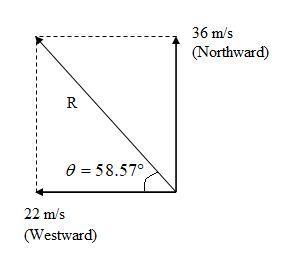
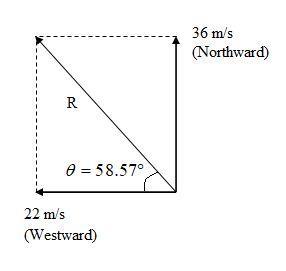
2)A velocity vector has components 36 m/s westward and 22 m/s northward. What are the magnitude and direction of this vector?

Physics
2 answers:
ad-work [718]2 years ago
7 0

The magnitude of the velocity vector is \boxed{42.19\,{{\text{m}} \mathord{\left/{\vphantom {{\text{m}} {\text{s}}}}\right.\kern-\nulldelimiterspace} {\text{s}}}} and the direction of the vector is \boxed{58.57^\circ } north of west.

Further Explanation:

Given:  

The component of velocity vector in the westward direction is 22\,{{\text{m}}\mathord{\left/{\vphantom {{\text{m}} {\text{s}}}}\right.\kern-\nulldelimiterspace} {\text{s}}}.  

The component of velocity vector in the north direction is 36\,{{\text{m}}\mathord{\left/{\vphantom{{\text{m}} {\text{s}}}}\right.\kern-\nulldelimiterspace} {\text{s}}}.

Concept:  

Since the velocity components are in the west direction and the north direction, they are perpendicular to each other. The magnitude of the actual velocity vector can be determined as resultant of the two components that are perpendicular to each other.  

The resultant of the vector can be expressed as:

R = \sqrt {v_1^2 + v_2^2 +2{v_1}{v_2}\cos\theta }

Here, {v_1}\,\&\,{v_2} are the components of velocity vector and \theta is the angle between them.  

Substitute the values in the above expression  

\begin{aligned}R&= \sqrt {{{\left( {36} \right)}^2} + {{\left( {22}\right)}^2} + 2 \times 36\times 22 \times\cos 90^\circ }\\&=\sqrt {1296 + 484}\\&= \sqrt {1780} \,{{\text{m}} \mathord{\left/{\vphantom {{\text{m}} {\text{s}}}} \right.\kern-\nulldelimiterspace} {\text{s}}}\\&= 42.19\,{{\text{m}} \mathord{\left/{\vphantom {{\text{m}} {\text{s}}}} \right.\kern-\nulldelimiterspace} {\text{s}}}\\\end{aligned}

The direction of the velocity vector is given by:

\begin{aligned}\alpha&={\tan ^{ - 1}}\left( {\frac{{{v_2}}}{{{v_1}}}} \right)\\&= {\tan ^{ - 1}}\left( {\frac{{36}}{{22}}} \right)\\&= 58.57^\circ \,{\text{north}}\,{\text{of}}\,{\text{west}}\\\end{aligned}

Thus, the magnitude of the velocity vector is \boxed{42.19\,{{\text{m}} \mathord{\left/{\vphantom {{\text{m}} {\text{s}}}}\right.\kern-\nulldelimiterspace} {\text{s}}}}  and the direction of the vector is \boxed{58.57^\circ } north of west.

Learn More:

1. Which of the following is not a component of a lever brainly.com/question/1073452

2. In the calorimetry experiment which energy will be calculated during the heat exchange if water is used brainly.com/question/2566525

3. What is ax, the x-component of the object's acceleration brainly.com/question/7114558

Answer Details:

Grade: High School

Subject: Physics

Chapter: Vector and Scalar

Keywords:  Velocity vector, component, westward, northward, magnitude of velocity, direction of the velocity, resultant, perpendicular, two components of velocity.
blsea [12.9K]2 years ago
3 0
The magnitude:
 →
| a | = √ ( 22² + 36² ) = √ ( 484 + 1296 ) = √ 1780 = 42.19 m/s
The direction:
tan α = 22/36 = 0.61111
α = tan^(-1) 0.61111 = 31.43 ° = 31° 26`
Answer:
The magnitude is 42.19 m/s and the direction is 31° 26`north from west.
You might be interested in
A solid cube of edge length r, a solid sphere of radius r, and a solid hemisphere of radius r, all made of the same material, ar
juin [17]

Answer:

Explanation:

The rate at which heat will be radiated is given by the expression

E = e Aσ ( T⁴ - T₀⁴ )

E is heat radiated , e is emissivity , A is area of surface , σ  is stephan's constant T is temperature of the object and T₀ is temperature of the surrounding .

For all the objects given , e , σ T and T₀ are same so E will solely dependent on area of the surface

surface area of cube= 6 r² ,

surface area of sphere = 4 π r²

= 12.56 r²

hemisphere = 2 π r²

= 6.28 r²

12.56 r² >6.28 r² > 6 r²

heat radiated by sphere > heat radiated by hemisphere > heat radiated by cube .

8 0
2 years ago
What makes the subject of star formation so difficult and complex? Star formation is too expensive to study in detail. Stars liv
marta [7]

Answer:

Stars live to long to be observed from birth to death

Explanation:

The life expectancy of a star are millions of years compared to that of human thereby making it difficult to study the life path and activities of the stars till the point of extinction. This brought about scientist studying different star with different ages in order to answer their burning question on formation of stars which is called the figuring out process(stellar activity) and this makes it difficult and tedious.

5 0
2 years ago
Assume you are driving 20 mph on a straight road. Also, assume that at a speed of 20 miles per hour, it takes 100 feet to stop.
Viefleur [7K]

Answer:900  feet

Explanation:

Given

Velocity \left ( V_1\right )=20 mph\approx 29.334 ft/s

it take 100 feet to stop

Using Equation of motion

v^2-u^2=2as

where

v,u=Final and initial velocity

a=acceleration

s=distance moved

0-\left ( 29.334\right )^2=2\left (-a\right )\left ( 100\right )

a=\frac{29.334^2}{2\times 100}=4.302 ft/s^2

When velocity is 60 mph\approx 88.002 ft/s

v^2-u^2=2as

0-\left ( 88.002\right )^2=2\left ( -4.302\right )\left ( s\right )

s=900.08 feet

8 0
2 years ago
Read 2 more answers
A 7.0-kilogram cart, A, and a 3.0-kilogram cart, B, are initially held together at rest on a horizontal, frictionless surface. W
7nadin3 [17]
For this problem, we use the conservation of momentum as a solution. Since momentum is mass times velocity, then,

m₁v₁ + m₂v₂ = m₁v₁' + m₂v₂'
where
v₁ and v₂ are initial velocities of cart A and B, respectively
v₁' and v₂' are final velocities of cart A and B, respectively
m₁ and m₂ are masses of cart A and B, respectively

(7 kg)(0 m/s) + (3 kg)(0 m/s) = (7 kg)(v₁') + (3 kg)(6 m/s)
Solving for v₁',
v₁' = -2.57 m/s

<em>Therefore, the speed of cart A is at 2.57 m/s at the direction opposite of cart B.</em>
7 0
2 years ago
A catcher stops a 0.15-kg ball traveling at 40 m/s in a distance of 20 cm. what is the magnitude of the average force that the b
iren2701 [21]

The magnitude of the average force that the ball exerts against his glove is 600 N

\texttt{ }

<h3>Further explanation</h3>

Newton's second law of motion states that the resultant force applied to an object is directly proportional to the mass and acceleration of the object.

\boxed {F = ma }

F = Force ( Newton )

m = Object's Mass ( kg )

a = Acceleration ( m )

Let us now tackle the problem !

\texttt{ }

<u>Given:</u>

mass of ball = m = 0.15 kg

initial speed of ball = u = 40 m/s

final speed of ball = v = 0 m/s

distance = d = 20 cm = 0.2 m

<u>Asked:</u>

average force = F = ?

<u>Solution:</u>

<em>We will use </em><em>Newton's Law of Motion</em><em> to solve this problem as follows:</em>

F = m a

F = m (\frac { u^2 - v^2 } { 2d } )

F = 0.15 \times \frac { 40^2 - 0^2 } { 2 \times 0.2 }

F = 0.15 \times \frac { 1600 } { 0.4 }

F = 0.15 \times 4000

\boxed {F = 600 \texttt{ N}}

\texttt{ }

<h3>Learn more</h3>
  • Impacts of Gravity : brainly.com/question/5330244
  • Effect of Earth’s Gravity on Objects : brainly.com/question/8844454
  • The Acceleration Due To Gravity : brainly.com/question/4189441
  • Newton's Law of Motion: brainly.com/question/10431582
  • Example of Newton's Law: brainly.com/question/498822

\texttt{ }

<h3>Answer details</h3>

Grade: High School

Subject: Physics

Chapter: Dynamics

8 0
2 years ago
Read 2 more answers
Other questions:
  • A sample of gas has a volume of 215 cm3 at 23.5 °c and 84.6 kpa. what volume (cm3 will the gas occupy at stp
    12·1 answer
  • The energy difference between the 5d and the 6s sublevels in gold accounts for its color. If this energy difference is about 2.7
    6·1 answer
  • The first and second coils have the same length, and the third and fourth coils have the same length. They differ only in the cr
    8·1 answer
  • Indigenous people sometimes cook in watertight baskets by placing hot rocks into water to bring it to a boil. What mass of 500ºC
    7·1 answer
  • In Hooke's law, Fspring=kΔx , what does the Fspring stand for?
    8·2 answers
  • Express the volume expansivity and the isothermal compressibility as functions of density rho and its partial derivatives. For w
    6·1 answer
  • Consider three identical metal spheres, A, B, and C. Sphere A carries a charge of -2.0 µC; sphere B carries a charge of -6.0 µC;
    6·1 answer
  • Water flows without friction vertically downward through a pipe and enters a section where the cross sectional area is larger. T
    9·1 answer
  • g A coil formed by wrapping 50 turns of wire in the shape of a square is positioned in a magnetic field so that the normal to th
    5·1 answer
  • An astronaut holds a rock 100m above the surface of Planet XX. The rock is then thrown upward with a speed of 15m/s, as shown in
    11·1 answer
Add answer
Login
Not registered? Fast signup
Signup
Login Signup
Ask question!
