answer.
Ask question
Login Signup
Ask question
All categories
  • English
  • Mathematics
  • Social Studies
  • Business
  • History
  • Health
  • Geography
  • Biology
  • Physics
  • Chemistry
  • Computers and Technology
  • Arts
  • World Languages
  • Spanish
  • French
  • German
  • Advanced Placement (AP)
  • SAT
  • Medicine
  • Law
  • Engineering
Leno4ka [110]
2 years ago
11

A city’s bus line is used more as the urban population density increases. The more people in an area, the more likely bus lines

will be utilized. The population of Belmont, MA, is 24,729 and covers an area of 4.66 mi2. The population of Easton, MA, is 23,112 and covers an area of 28.4 mi2. Which city’s residents are more likely to use public buses? Explain. The residents of Belmont are more likely to use public transportation because the city has the highest population density. The residents of Easton are more likely to use public transportation because the city has the highest population density. The residents of both cities will not use the bus line because the population density is too high. The residents of both cities are equally likely to use public transportation because the population densities are equal.
Mathematics
1 answer:
nevsk [136]2 years ago
7 0

Answer:

(A) The residents of Belmont are more likely to use public transportation because the city has the highest population density.

Step-by-step explanation:

correct on edge

You might be interested in
"Immediately after a ban on using hand-held cell phones while driving was implemented, compliance with the law was measured. A r
sergiy2304 [10]

Answer:

(a) Null Hypothesis, H_0 : p_1-p_2=0  or  p_1= p_2  

    Alternate Hypothesis, H_A : p_1-p_2\neq 0  or  p_1\neq p_2

(b) We conclude that there is a statistical difference in these two proportions measured initially and then one year later.

Step-by-step explanation:

We are given that a random sample of 1,250 drivers found that 98.9% were in compliance. A year after the implementation, compliance was again measured to see if compliance was the same (or not) as previously measured.

A different random sample of 1,100 drivers found 96.9% compliance."

<em />

<em>Let </em>p_1<em> = proportion of drivers that were in compliance initially</em>

p_2<em> = proportion of drivers that were in compliance one year later</em>

(a) <u>Null Hypothesis</u>, H_0 : p_1-p_2=0  or  p_1= p_2      {means that there is not any statistical difference in these two proportions measured initially and then one year later}

<u>Alternate Hypothesis</u>, H_A : p_1-p_2\neq 0  or  p_1\neq p_2     {means that there is a statistical difference in these two proportions measured initially and then one year later}

The test statistics that will be used here is <u>Two-sample z proportion statistics</u>;

                     T.S.  = \frac{(\hat p_1-\hat p_2)-(p_1-p_2)}{\sqrt{ \frac{\hat p_1(1-\hat p_1)}{n_1} + \frac{\hat p_2(1-\hat p_2)}{n_2}} }  ~ N(0,1)

where, \hat p_1 = sample proportion of drivers in compliance initially = 98.9%

\hat p_2 = sample proportion of drivers in compliance one year later = 96.9%

n_1 = sample of drivers initially = 1,250

n_2 = sample of drivers one year later = 1,100

(b) So, <u><em>the test statistics</em></u>  =  \frac{(0.989-0.969)-(0)}{\sqrt{ \frac{0.989(1-0.989)}{1,250} + \frac{0.969(1-0.969)}{1,100}} }  

                                           =  3.33

<u>Now, P-value of the test statistics is given by;</u>

         P-value = P(Z > 3.33) = 1 - P(Z \leq 3.33)

                                            = 1 - 0.99957 = <u>0.00043</u>

Since in the question we are not given with the level of significance so we assume it to be 5%. Now at 5% significance level, the z table gives critical values between -1.96 and 1.96 for two-tailed test.

<em>Since our test statistics does not lies within the range of critical values of z, so we have sufficient evidence to reject our null hypothesis as it will fall in the rejection region due to which </em><u><em>we reject our null hypothesis.</em></u>

Therefore, we conclude that there is a statistical difference in these two proportions measured initially and then one year later.


7 0
2 years ago
a perpendicular bisector to is drawn through point c and extended to point d. arrange the pairs of points in order of the y-inte
nirvana33 [79]
Pair 1: slope = (9 - 5)/(8+4) = 1/3
midpoint = ((-4+8)/2, (5+9)/2) = (2, 7)
perpendicular bisector passes through point (2, 7) with slope = -1/(1/3) = -3 giving the equation (y - 7)/(x - 2) = -3 or y - 7 = -3(x - 2) or y = -3x + 13 and y-intercept at y = 13.

Pair 2: slope = (6 - 4)/(-8-2) = -1/5
midpoint = ((2-8)/2, (4+6)/2) = (-3, 5)
perpendicular bisector passes through point (-3, 5) with slope = -1/(-1/5) = 5 giving the equation (y - 5)/(x + 3) = 5 or y - 5 = 5(x + 3) or y = 5x + 20 and y-intercept at y = 20.

Pair 3: slope = (2 - 4)/(7 - 5) = -1
midpoint = ((5+7)/2, (4+2)/2) = (6, 3)
perpendicular bisector passes through point (6, 3) with slope = -1/(-1) = 1 giving the equation (y - 3)/(x - 6) = 1 or y - 3 = (x - 6) or y = x - 3 and y-intercept at y = -3.

Pair 4: slope = (3 - 9)/(-4 - 2) = 1
midpoint = ((2-4)/2, (9+3)/2) = (-1, 6)
perpendicular bisector passes through point (-1, 6) with slope = -1(1) = -1 giving the equation (y - 6)/(x + 1) = -1 or y - 6 = -1(x + 1) or y = -x + 5 and y-intercept at y = 5.

Pair 5: slope = (-12 + 2)/(9 - 3) = -5/3
midpoint = ((3+9)/2, (-2-12)/2) = (6, -7)
perpendicular bisector passes through point (6, -7) with slope = -1(-5/3) = 3/5 giving the equation (y + 7)/(x - 6) = 3/5 or 5(y + 7) = 3(x - 6) or 5y = 3x - 53 and y-intercept at y = -10.6.

Pair 6: slope = (12 - 10)/(8 - 4) = 1/2
midpoint = ((4+8)/2, (10+12)/2) = (6, 11)
perpendicular bisector passes through point (6, 11) with slope = -1(1/2) = -2 giving the equation (y - 11)/(x - 6) = -2 or y - 11 = -2(x - 6) or y = -2x + 23 and y-intercept at y = 23.

Arrangement in order of y-intercepts from smallest to largest
a(3, -2) and b(9, -12)
a(5, 4) and b(7, 2)
a(2, 9) and b(-4, 3)
a(-4, 5) and b(8, 9)
a(2, 4) and b(-8, 6)
a(4, 10) and b(8, 12)

5 0
2 years ago
Read 2 more answers
What is the probability of rolling an odd number and spinning "B," given the sample space below? 1 2 3 4 5 6 A A1 A2 A3 A4 A5 A6
Zielflug [23.3K]
There are 3 odd numbers out of 6 numbers and  7 B's out of  28  so

required probability =  3/6 * 7/28 = 1/2 * 1/4 = 1/8 Answer
6 0
2 years ago
liquid product with 10% product solids is blended withsugar before being concentrated (removal of water) to obtaina final produc
Nookie1986 [14]

Answer:

mass of the water removed =  66.67 kg

Step-by-step explanation:

given data

solids is blended with sugar = 10%

obtain  final product = 15% product

obtain  final product = 15% sugar solids

The initial product is = 200 kg

solution

we get here amount of sugar required that is

amount of sugar required = 200 × \frac{10}{100}

amount of sugar required =  20 kg

and we know total solid  = product solids +  sugar solids    ...............1

and

initial product =  final product    

so

0.20 ×  200kg= 0.30 ×  mass of the final product

mass of final product = 133.33 kg

but here

final product = 15% product solids and 15% sugar solids

so that amount of product solid = sugar solid

so

mass of the water removed = 200 kg - 133.33 kg

mass of the water removed =  66.67 kg

7 0
2 years ago
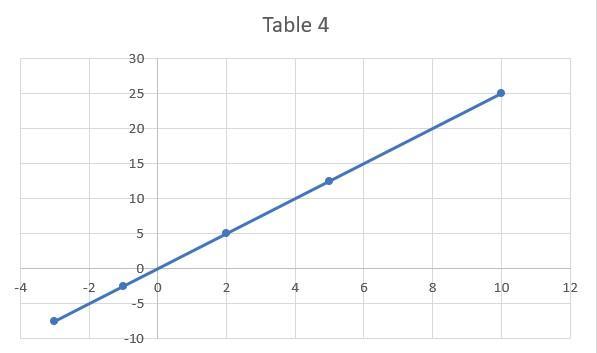
Which table represents a direct variation function? A table with 6 columns and 2 rows. The first row, x, has the entries, negati
IceJOKER [234]

Answer:

The correct option is;

A table with 6 columns and 2 rows. The first row, x, has entries, negative 3, negative 1, 2, 5, 10. The second row, y, has entries, negative 7.5, negative 2.5, 5.0, 12.5, 25

Please find attached the graphs of the table data

Step-by-step explanation:

Each of the given table data of in the tables are analysed to find direct variation;

Table 1

x,               -3,                 -1,                 2,                5,                10

y,              -4.5,              -3.0,             -1.5,             0.0,              1.5              

-4.5/-3  = 1.5 ≠ -3.0/-1 = 3

No direct variation

Table 2      

x,             -5.5,               -4.5,            -3.5,            -2.5,             -1.5

y,              10,                   8,                 6,              4,                  2

10/(-5.5) = -20/11  ≠ 8/(-4.5) = -16/9

However, 10/(-5.5 + 0.5) = -2 = 8/(-4.5 + 0.5) = -2

Adjusted direct variation

Table 3              

x,              -5.5,               -5.5,             -5.5,           -5.5,            -5.5

y,              -3,                    -1,                 2,                5 ,              10                  

-3/(-5.5) ≠ -1/-5.5

No direct variation

Table 4

x,              -3,                    -1,                2,                  5,             10

y,              -7.5,                 -2.5,            5.0 ,              12.5,         25  

 -7.5/-3 = 2.5 = -2.5/(-1) = 5.0/2 = 12.5/5 =25/10

Direct variation exists        

8 0
2 years ago
Read 2 more answers
Other questions:
  • how much material was used in the manufacture of 24000 celluloid dice,if each dice has an edge of 1/4 inches?
    6·2 answers
  • According to the Journal of the American Medical Association (JAMA), hospitals that routinely staff with 1:8 nurse-to-patient ra
    11·2 answers
  • The graph of y=|x| is transformed as shown in the graph below. Which equation represents the transformed function?
    12·2 answers
  • 80 percent of 90 is the same as 40 percent of what number?
    15·2 answers
  • At a gas station the price of gas is $2.40 a gallon. Draw a graph to represent the relationship between the cost of gas and the
    12·1 answer
  • Triangles ΔABC ≅ ΔBAD so that C and D lie in the opposite semi-planes of segment AB. Prove that segment CD bisects segment AD.
    14·1 answer
  • Which equation correctly uses point (–2, –6) to write the equation of this line in point-slope form? Y – 6 = y minus 6 equals St
    6·2 answers
  • The cost of producing x soccer balls in thousands of dollars is represented by h(x) = 5x + 6. The revenue is represented by
    6·2 answers
  • Applying descriptive statistics and data visualization to the training set to understand the data and assist in the selection of
    11·1 answer
  • A company makes 150 bags.
    6·1 answer
Add answer
Login
Not registered? Fast signup
Signup
Login Signup
Ask question!