answer.
Ask question
Login Signup
Ask question
All categories
  • English
  • Mathematics
  • Social Studies
  • Business
  • History
  • Health
  • Geography
  • Biology
  • Physics
  • Chemistry
  • Computers and Technology
  • Arts
  • World Languages
  • Spanish
  • French
  • German
  • Advanced Placement (AP)
  • SAT
  • Medicine
  • Law
  • Engineering
djverab [1.8K]
2 years ago
3

If the inner accretion disk around a black hole has a temperature of 106 k, at what wavelength will it radiate the most energy?

(hint: from wien's law, λt =3,000,000 where λ is in nm and t is in k.)

Physics
1 answer:
irina [24]2 years ago
4 0
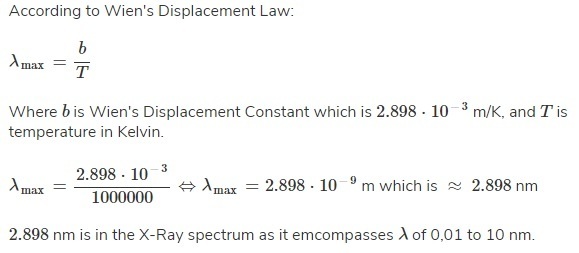
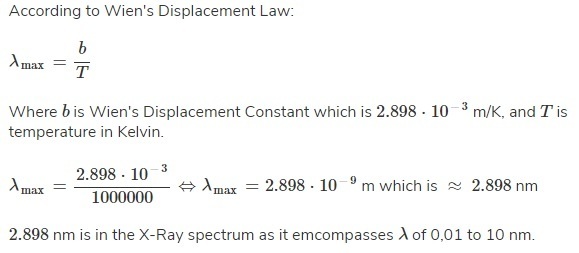
What you meant was 10^6 k. Check the attached file for the solution. The answer is 3.0 nm.

You might be interested in
A physics department has a Foucault pendulum, a long-period pendulum suspended from the ceiling. The pendulum has an electric ci
antoniya [11.8K]

Answer:

t=37 mins -> 2220sec

We want "T" which is the pendulum time constant

Using this equation

.5A=Ae^(-t/T)

The .5A is half the amplitude

Take ln of both sides to get ride of Ae

=ln(.5)=-2220/T

Now rearrange to = T

T=-2220/ln(.5) = 3202.78sec / 60 secs = 53.38 mins -> first part of the answer.

The second part is really easy. It took 37 mins to decay half way. meaning to decay another half of 50% which equals 25% it will take an additional 37 mins!

8 0
2 years ago
What phenomenon does this image demonstrate? *
Ostrovityanka [42]

Answer:

Constructive Interference

Explanation:

8 0
2 years ago
Read 2 more answers
A boy uses a slingshot to launch a pebble straight up into the air. The pebble reaches a height of 37.0 m above the launch point
denis-greek [22]

Answer:

V0=27.4 m/s; t=0.8 s

Explanation:

Final position y=37.0 m, time = 2.3 s; Initial position is set to be zero. We calculate the initial speed with the kinematics equation:

y_f=v_0t-0.5*g*t^2 We solve for initial speed

v_0=\frac{y_f+0.5gt^2}{t}=\frac{37+4.9*2.3^2}{2.3}=27.4m/s

Now, using the same expression we estimated time to first reach 18.5 m :

18.5=27.4t-4.9t^2 Second order equation with solutions

t1=0.8 s and t2=4.8 s

The first time corresponds to the first reach.

7 0
2 years ago
Consider an object with s=12cm that produces an image with s′=15cm. Note that whenever you are working with a physical object, t
Leni [432]

A. 6.67 cm

The focal length of the lens can be found by using the lens equation:

\frac{1}{f}=\frac{1}{s}+\frac{1}{s'}

where we have

f = focal length

s = 12 cm is the distance of the object from the lens

s' = 15 cm is the distance of the image from the lens

Solving the equation for f, we find

\frac{1}{f}=\frac{1}{12 cm}+\frac{1}{15 cm}=0.15 cm^{-1}\\f=\frac{1}{0.15 cm^{-1}}=6.67 cm

B. Converging

According to sign convention for lenses, we have:

- Converging (convex) lenses have focal length with positive sign

- Diverging (concave) lenses have focal length with negative sign

In this case, the focal length of the lens is positive, so the lens is a converging lens.

C. -1.25

The magnification of the lens is given by

M=-\frac{s'}{s}

where

s' = 15 cm is the distance of the image from the lens

s = 12 cm is the distance of the object from the lens

Substituting into the equation, we find

M=-\frac{15 cm}{12 cm}=-1.25

D. Real and inverted

The magnification equation can be also rewritten as

M=\frac{y'}{y}

where

y' is the size of the image

y is the size of the object

Re-arranging it, we have

y'=My

Since in this case M is negative, it means that y' has opposite sign compared to y: this means that the image is inverted.

Also, the sign of s' tells us if the image is real of virtual. In fact:

- s' is positive: image is real

- s' is negative: image is virtual

In this case, s' is positive, so the image is real.

E. Virtual

In this case, the magnification is 5/9, so we have

M=\frac{5}{9}=-\frac{s'}{s}

which can be rewritten as

s'=-M s = -\frac{5}{9}s

which means that s' has opposite sign than s: therefore, the image is virtual.

F. 12.0 cm

From the magnification equation, we can write

s'=-Ms

and then we can substitute it into the lens equation:

\frac{1}{f}=\frac{1}{s}+\frac{1}{s'}\\\frac{1}{f}=\frac{1}{s}+\frac{1}{-Ms}

and we can solve for s:

\frac{1}{f}=\frac{M-1}{Ms}\\f=\frac{Ms}{M-1}\\s=\frac{f(M-1)}{M}=\frac{(-15 cm)(\frac{5}{9}-1}{\frac{5}{9}}=12.0 cm

G. -6.67 cm

Now the image distance can be directly found by using again the magnification equation:

s'=-Ms=-\frac{5}{9}(12.0 cm)=-6.67 cm

And the sign of s' (negative) also tells us that the image is virtual.

H. -24.0 cm

In this case, the image is twice as tall as the object, so the magnification is

M = 2

and the distance of the image from the lens is

s' = -24 cm

The problem is asking us for the image distance: however, this is already given by the problem,

s' = -24 cm

so, this is the answer. And the fact that its sign is negative tells us that the image is virtual.
3 0
2 years ago
A crate slides down a ramp that makes a 20∘ angle with the ground. To keep the crate moving at a steady speed, Paige pushes back
VMariaS [17]

Answer:

Hence, work done= 287.54 J

Explanation:

Given data:

angle of ramp with the ground θ =20°

force applied = 76 N

work done on the crate to slide down 4 m down the ramp

W= F×d cosθ ( only the cos component of the force will slide the crate down)

W= 76×4×cos20= 287.54 J

4 0
2 years ago
Other questions:
  • Where is the steering nozzle located on a pwc?
    14·2 answers
  • A lawn sprinkler sprays water 8 feet at full pressure as it rotates 360 degrees. if the water pressure is reduced by 50%, what i
    9·1 answer
  • Using the superposition method, calculate the current through R5 in Figure 8-71
    14·1 answer
  • A body covers a semicircle of radius 7cm in 5s .find its linear speed
    9·1 answer
  • A car traveling at 91.0 km/h approaches the turn off for a restaurant 30.0 m ahead. If the driver slams on the brakes with the a
    15·1 answer
  • Calculate the magnitude of the gravitational force exerted by Mars on a 80 kg human standing on the surface of Mars. (The mass o
    15·1 answer
  • Both Sony's PlayStation Network and FedEx's systems were developed and are continuously updated to help the companies ________.
    14·1 answer
  • A propeller blade at rest starts to rotate from t = 0 s to t = 5.0 s with a tangential acceleration of the tip of the blade at 3
    6·1 answer
  • An archer draws her bow and stores 34.8 J of elastic potential energy in the bow. She releases the 63 g arrow, giving it an init
    10·1 answer
  • 1. Order the materials from smallest refractive index to largest refractive index.
    6·1 answer
Add answer
Login
Not registered? Fast signup
Signup
Login Signup
Ask question!
