answer.
Ask question
Login Signup
Ask question
All categories
  • English
  • Mathematics
  • Social Studies
  • Business
  • History
  • Health
  • Geography
  • Biology
  • Physics
  • Chemistry
  • Computers and Technology
  • Arts
  • World Languages
  • Spanish
  • French
  • German
  • Advanced Placement (AP)
  • SAT
  • Medicine
  • Law
  • Engineering
Serhud [2]
2 years ago
13

How many liters of nh3, at stp, will react with 5.3 g o2 to form no2 and water? 4nh3(g) + 7o2(g) -> 4no2 + 6h2o(g)?

Chemistry
2 answers:
hodyreva [135]2 years ago
3 0

Answer: 2.12 L of NH3

Explanation:

g100num [7]2 years ago
3 0

Answer:

2.12 L

Explanation:

using the "molar volume " ratio for gases times STP, find the litres of NH3:

0.09464 moles NH3 times 22.4 litres / mole STP = 2.12 litres

You might be interested in
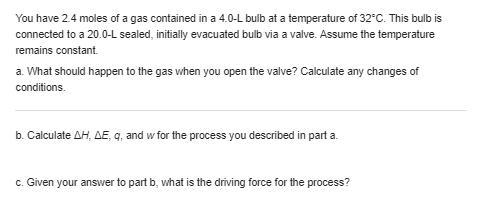
Consider 2.4 moles of a gas contained in a 4.0 L bulb at a constant temperature of 32°C. This bulb is connected to an evacuated
Luden [163]

Complete Question

The complete question is shown on the first uploaded image

Answer

a

As the valve is opened , the gas will flow into the empty container until the both containers have the same pressure

b

\Delta H = 0\ , \Delta E = 0 , q= 0 , w= 0

c

The driving force for this process is the increase in entropy this is because the movement of the internal energy of the gas into a larger volume, what this does is that it increases the amount of disorder(entropy).

Explanation

In order to obtain the parameter in the part B of the question we are first obtain the initial pressure, using the ideal gas equation  

                      P = \frac{nRT}{V}

                     P = \frac{(2.4mol)(0.0821\frac{1 atm}{K \cdot \ mol} )}{4.0L}

                         P =15 \ atm

The next thing is to obtain the new pressure of the gas , using boyle's law

              P_1V_1 = P_2V_2

                  P_2 = \frac{P_1 V_1}{V_2}

                  P_2 = \frac{(15 \ atm)(4.0L)}{24.0 L}

                  P_2 = 2.5 \ atm    

Since the this process is isothermal , the change in heat is equal to zero

                      i.e  q = 0 J

  The workdone to move  the gas to the other container is zero because the  the pressure at this second container is zero due to the fact that it is a vacuum

    i.e  w = -P_{external} \Delta V

              =-(0 \ atm) (24.0 - 4.0L)

              = 0L \cdot atm

  Since the change in heat is zero and the workdone is zero then the change in internal energy is equal to 0

     This is because the change in internal energy is equal to a summation of change in heat and the workdone

                i.e \Delta E = q + w

                            = 0J

Generally the change in enthalpy is mathematically represented as

                \Delta H = n C_p \Delta T

Since the temperature is zero this means that the change in temperature is zero , substituting this value for change in temperature into the equation for  change in enthalpy

           \Delta H = n C_p (0)

                   = 0J


7 0
2 years ago
Tamara is doing a scientific investigation to answer the question, "Do corn seeds germinate faster at warmer temperatures than t
sashaice [31]

Answer:

The tools/instruments, the type of seed, the soil or planting products, the amount of germination time/days, and where the seedling is placed.

Explanation:

If anything but the temperature is changed, it can result in false results. For instance, if Tamera uses red corn for one but yellow corn for the other, it can change the germination rate. So can the type of soil, water or the amount of time each plant has to grow. If she changes thermometers or any other tool she uses, it may give her a different result than the ones she used before. And finally, if she moves the warm plant from the windowsill to her bedroom, it can mess with the results she gets from the heated sample.

8 0
2 years ago
Explain how interactions between Earth’s spheres keep water cycling between them
Elenna [48]
There are several process in the nature, which keeps water cycling between them. By Precipitation, Earth's sphere gets water which we use in several ways, and by evaporation & sublimation, it goes back to upper spheres of the Earth's atmosphere and cycle happens again & again.

Hope this helps!
3 0
2 years ago
Elena has two magnets. She puts one under a piece of paper. She holds the other one above it. The magnets attract each other. Th
Sonbull [250]
A) Magnets can attract through solid materials.
6 0
2 years ago
consideras util conocer las propiedades extensivas e intensivas de los insumos utilizados para la elaboración de producto ¿por q
Brums [2.3K]

Answer:

Explanation:

No.

Las propiedades físicas de los materiales y sistemas a menudo se pueden clasificar como intensivas o extensivas, según cómo cambia la propiedad cuando cambia el tamaño (o extensión) del sistema. Según la IUPAC, una cantidad intensiva es aquella cuya magnitud es independiente del tamaño del sistema, mientras que una cantidad extensiva es aquella cuya magnitud es aditiva para los subsistemas. Esto refleja las ideas matemáticas correspondientes de media y medida, respectivamente.

Una propiedad intensiva es una propiedad a granel, lo que significa que es una propiedad física local de un sistema que no depende del tamaño del sistema o de la cantidad de material en el sistema. Los ejemplos de propiedades intensivas incluyen temperatura, T; índice de refracción, n; densidad, ρ; y dureza de un objeto.

Por el contrario, propiedades extensivas como la masa, el volumen y la entropía de los sistemas son aditivas para los subsistemas porque aumentan y disminuyen a medida que crecen y se reducen, respectivamente.  

Estas dos categorías no son exhaustivas, ya que algunas propiedades, físicas no son exclusivamente intensivas ni extensivas. Por ejemplo, la impedancia eléctrica de dos subsistemas es aditiva cuando, y solo cuando, se combinan en serie; mientras que si se combinan en paralelo, la impedancia resultante es menor que la de cualquiera de los subsistemas.

¡Espero haberte ayudado!  :)

7 0
2 years ago
Other questions:
  • What is the main difference between the alpine tundra and the arctic tundra? a. The alpine tundra includes trees. b. The alpine
    10·2 answers
  • What do pH and conductivity have in common?
    6·2 answers
  • How many equivalents are in 0.60 mole of Mg2+
    7·1 answer
  • In general, which attractions are stronger: intermolecular or intramolecular? Research and explain a quantitative comparison bet
    6·1 answer
  • The atomic mass of carbon is 12.01, sodium is 22.99, and oxygen is 16.00. What is the molar mass of sodium oxalate (Na2C2O4)?
    6·1 answer
  • A pot of water is heated over a fire, and then frozen peas are added to the hot water. What happens to the energy in this situat
    9·2 answers
  • Which statement about the spectrophotometric analysis of Red 40 dye is TRUE?
    8·1 answer
  • Draw the structures of two different compounds that have the composition CH3NO2. All three H atoms must remain bonded to the C a
    6·1 answer
  • Old aspirin exposed to moisture often smells like acetic acid (vinegar). When aspirin is heated in boiling water, it decomposes
    8·1 answer
  • The average distance between nitrogen and oxygen atoms is 115 pm in a compound called nitric oxide. What is this distance in mil
    14·1 answer
Add answer
Login
Not registered? Fast signup
Signup
Login Signup
Ask question!