answer.
Ask question
Login Signup
Ask question
All categories
  • English
  • Mathematics
  • Social Studies
  • Business
  • History
  • Health
  • Geography
  • Biology
  • Physics
  • Chemistry
  • Computers and Technology
  • Arts
  • World Languages
  • Spanish
  • French
  • German
  • Advanced Placement (AP)
  • SAT
  • Medicine
  • Law
  • Engineering
vredina [299]
2 years ago
3

What is the acceleration along the ground of a 10 kg wagon when its pulled with a force of 44 N at an angle of 35° above the hor

izontal?
A. 0.23 m/s
B. 0.28 m/s
C. 2.52 m/s
D. 3.60 m/s
Physics
2 answers:
diamong [38]2 years ago
6 0
The correct answer is D I hope this helps you i just took the test and got it right have an amazing day

Gala2k [10]2 years ago
4 0

Answer:

D. 3.60 m/s^2

Explanation:

First of all, we need to find the horizontal force acting on the wagon, which is given by:

F_x = F cos \theta=(44 N)(cos 35^{\circ})=36.0 N

And now we can calculate the wagon's acceleration by using Newton's second law:

a=\frac{F_x}{m}=\frac{36.0 N}{10 kg}=3.60 m/s^2

You might be interested in
B) Explain the method of preparing electromagnet. How do you test the
kap26 [50]

Answer:

An electromagnet is made by forming a coil around a soft iron bar (known here as the metal) such as a nail or  screw and connect with an insulated copper wire (known here as the electric current conductor) the ends of the wound copper is then connected separately to the positive and negative terminals of a battery (known here as the source of electric current)

The north seeking needle of the magnetic compass will move away when brought close to the north pole of the formed electromagnet which can then be labelled N

The magnetic compass needle will be attracted to the south pole of the electromagnet which can then be labelled S

Explanation:

An electromagnet is an electric powered magnet that is formed (temporarily) by the perpendicular movement of electric current with respect to a metal core

The magnitude and the poles of an electromagnet can be changed by changing the magnitude and the direction of flow of the electric current respectively.

5 0
2 years ago
An electron moves with a constant horizontal velocity of 3.0 × 10⁶ m/s and no initial vertical velocity as it enters a deflector
Ghella [55]

Answer:

a = 5.05 x 10¹⁴ m/s²

Explanation:

Consider the motion along the horizontal direction

v_{x} = velocity along the horizontal direction = 3.0 x 10⁶ m/s

t = time of travel

X = horizontal distance traveled = 11 cm = 0.11 m

Time of travel can be given as

t = \frac{X}{v_{x}}

inserting the values

t = 0.11/(3.0 x 10⁶)

t = 3.67 x 10⁻⁸ sec

Consider the motion along the vertical direction

Y = vertical distance traveled = 34 cm = 0.34 m

a = acceleration = ?

t = time of travel  = 3.67 x 10⁻⁸ sec

v_{y} = initial velocity along the vertical direction = 0 m/s

Using the kinematics equation

Y = v_{y} t + (0.5) a t²

0.34 = (0) (3.67 x 10⁻⁸) + (0.5) a (3.67 x 10⁻⁸)²

a = 5.05 x 10¹⁴ m/s²

7 0
2 years ago
Consider a 4-mg raindrop that falls from a cloud at a height of 2 km. When the raindrop reaches the ground, it won't kill you or
docker41 [41]

Answer:

The work done by the air resistance is -0.0782 J

Explanation:

Hi there!

The energy of the raindrop has to be conserved, according to the law of conservation of energy.

Initially, the raindrop has only gravitational potential energy:

PE = m · g · h

Where:

PE = potential energy.

m = mass of the raindrop.

g = acceleration due to gravity (9.8 m/s²)

h = height.

Let´s calculate the initial potential energy of the drop:

(convert 4 mg into kg: 4 mg · 1 kg / 1 × 10⁶ mg = 4 × 10⁻⁶ kg)

PE = 4 × 10⁻⁶ kg · 9.8 m/s² · 2000  m

PE = 0.0784 J

When the drop starts falling, some of the potential energy is converted into kinetic energy and some energy is dissipated by the work done by the air resistance. On the ground all the initial potential energy has been either converted into kinetic energy or dissipated by the resistance of the air:

initial PE = final KE + W air

Where:

KE = kinetic energy.

W air = work done by the air resistance.

The kinetic energy when the raindrop reaches the ground is calculated as follows:

KE = 1/2 · m · v²

Where:

m = mass

v = velocity

Then:

KE = 1/2 ·  4 × 10⁻⁶ kg · (10 m/s)²

KE = 2 × 10⁻⁴ J

Now, we can calculate the work done by the air resistance:

initial PE = final KE + W air

0.0784 J = 2 × 10⁻⁴ J + W air

W air = 0.0784 J - 2 × 10⁻⁴ J

W air = 0.0782 J

Since the work is done in the opposite direction to the displacement, the work is negative, then, the work done by the air resistance is -0.0782 J.

5 0
2 years ago
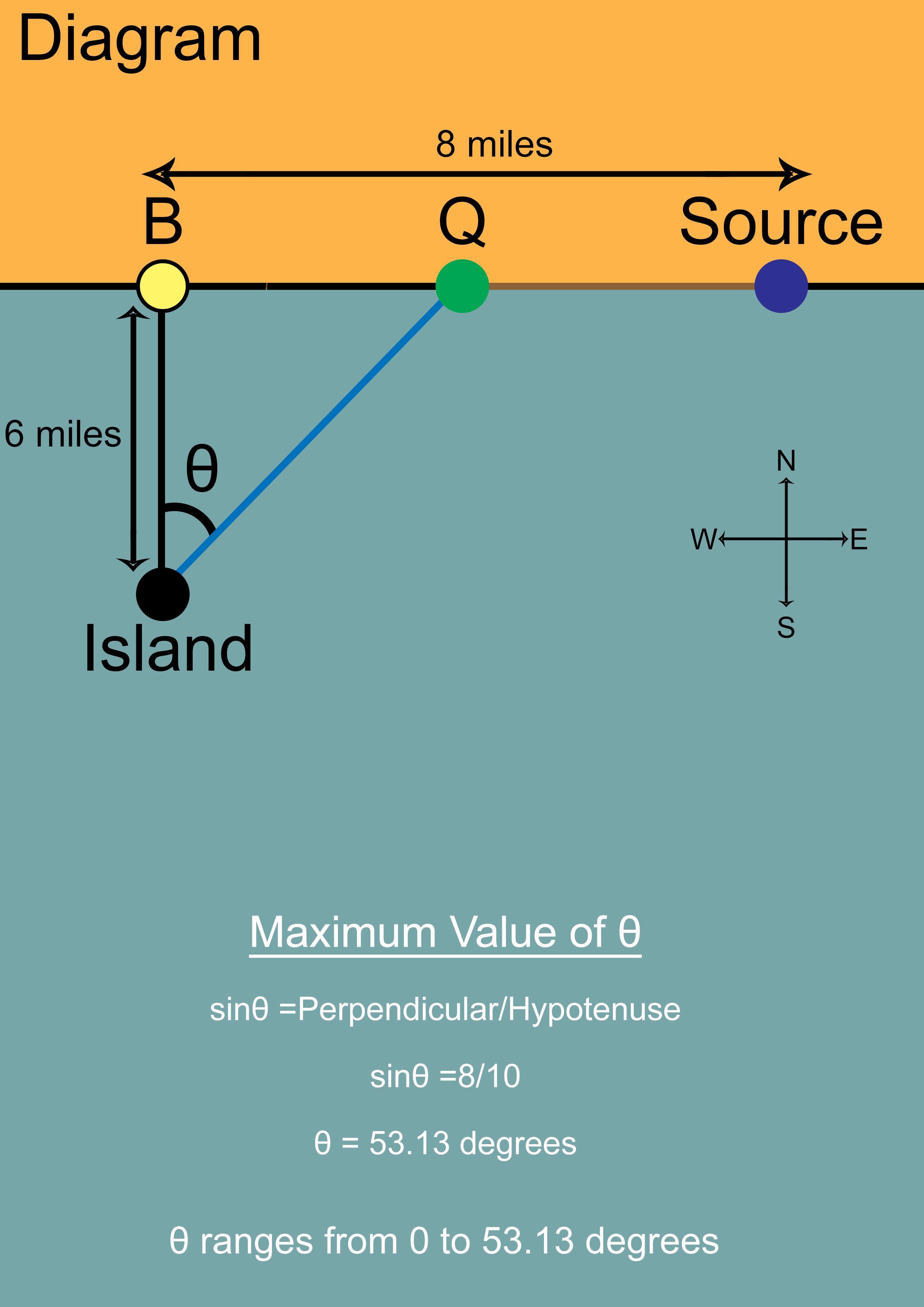
A small house was built on an island off a perfectly straight shoreline. The point B on the shoreline that is closest to the isl
abruzzese [7]

Answer:

Q should be 4.8 miles east of B.

Explanation:

As the diagram shows, we can simply express the construction cost as a function of angle θ (represented in the diagram).  

The length of the pipe in water (represented with blue) = 6/cos θ

The length of the pipe on land (represented with brown) = (8-6*tan θ)

Construction Cost = (6/cos θ) (6000) + (8-6*tan θ)(3750)

The above function represents the construction cost and is in terms of θ

The value of θ varies from 0 degrees to 53.13 degrees as per the diagram.

We can take the derivative of Construction Cost function with respect to θ and equate it to zero to find the angle θ at which the construction cost is minimum.

d(Construction Cost)/d θ = -4500(5*sec θ – 8*tan θ)(sec θ)

-4500(5*sec θ – 8*tan θ) (sec θ) = 0

θ = 38.68 degrees

Using the value of θ, we can find the distance of Q from B.

Distance of Q from B = 6*tan θ  

Distance of Q from B = 6*tan (38.68 degrees)

Distance of Q from B = 4.8 miles

7 0
2 years ago
A bodybuilder lifts a 10 N weight a distance of 2.5 m. <br> How much energy has the weight gained?
dolphi86 [110]

Answer:

25 N

Explanation:

2.5 * 10 = 25

3 0
2 years ago
Other questions:
  • Brass is an alloy made from copper and zinc a 0.59 kg brass sample at 98.0 is dropped into 2.80 kg of water at 5.0 c if the equi
    14·2 answers
  • An 80 kg skateboarder moving at 3 m/s pushes off with her back foot to move faster. If her velocity increases to 5 m/s, what is
    14·2 answers
  • Eratosthenes determined the circumference of Earth by conducting an experiment. Put his steps in order as they correlate to the
    9·1 answer
  • What voltage is delivered to a 120-volt/5,000-watt load that is fed with #10 awg wire (1.24 ohms/1,000 feet) and located 750 fee
    8·1 answer
  • The moon’s orbital speed around Earth is 3.680 × 10^3 km/h. Suppose the moon suffers a perfectly elastic collision with a comet
    15·1 answer
  • The standing vertical jump is a good test of an athlete's strength and fitness. The athlete goes into a deep crouch, then extend
    11·1 answer
  • A battery charges a parallel-plate capacitor fully and then is removed. The plates are then slowly pulled apart. What happens to
    5·1 answer
  • The free-electron density in a copper wire is 8.5×1028 electrons/m3. The electric field in the wire is 0.0520 N/C and the temper
    11·1 answer
  • 1-A boy rolls a toy car across a floor with a velocity of 3.21 m/s. How long does it take the car to travel a distance of 4.50 m
    11·1 answer
  • The Type K thermocouple has a sensitivity of about 41 micro-Volts/℃, i.e. for each degree difference in the junction temperature
    6·1 answer
Add answer
Login
Not registered? Fast signup
Signup
Login Signup
Ask question!