answer.
Ask question
Login Signup
Ask question
All categories
  • English
  • Mathematics
  • Social Studies
  • Business
  • History
  • Health
  • Geography
  • Biology
  • Physics
  • Chemistry
  • Computers and Technology
  • Arts
  • World Languages
  • Spanish
  • French
  • German
  • Advanced Placement (AP)
  • SAT
  • Medicine
  • Law
  • Engineering
LiRa [457]
2 years ago
9

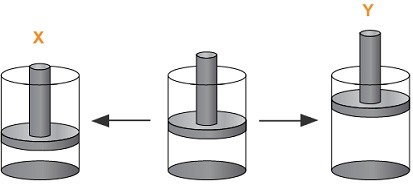
The diagram shows what happens to a system undergoing an adiabatic process.

Physics
2 answers:
Vinvika [58]2 years ago
7 0

Answer:

b)X: Work is done to the system and temperature increases.

Y: Work is done by the system and temperature decreases.

Explanation:

In the first situation, we see that the piston is lowered: this means that the volume of the gas below the piston is decreased (gas is compressed).

In this case, work is done TO the system, because it is the piston that is doing work on the gas, by compressing it. Moreover, since work is done on the system and no heat is lost (during an adiabatic compression, no heat is exchanged), for the first law of thermodynamics it means that the internal energy of the gas is increasing, and so the temperature of the gas is increasing as well.

In the last situation, everything is reversed. We see that the piston is raising: it means that the volume of the gas is increasing, and the gas is expanding, so it is doing work (work is done BY the system). Therefore, the internal energy of the gas is decreasing, and this means that its temperature is decreasing as well.


posledela2 years ago
5 0
The answer is:
B. <span>X: Work is done to the system and temperature increases.
Y: Work is done by the system and temperature decreases.</span>
You might be interested in
An airliner of mass 1.70×10⁵kg1.70×105kg lands at a speed of 75.0 m/sm/s. As it travels along the runway, the combined effects o
Karo-lina-s [1.5K]

Answer:

The airliner travels 1.65 km along the runway before coming to a halt.

Explanation:

Given

Resistive forces = (2.90 × 10⁵) N = 290000 N

Mass of the airliner = (1.70 × 10⁵) kg = 170000 kg

Velocity of airliner = 75 m/s

Let the distance over moved by the airliner be equal to d

According to the work-energy theorem, the work done by the resistive forces in stopping the airliner is equal to the travelling kinetic energy of the airliner.

Work done by the resistive forces = (290000) × d = (290,000d) J

Kinetic energy of the airliner = (1/2)(170000)(75²) = 478,125,000 J

290000d = 478,125,000

d = (478,125,000/290,000)

d = 1648.7 m = 1.65 km

Hope this helps!!!

4 0
2 years ago
3. You have three stars. Star A has an apparent magnitude of 7, Star B has an apparent magnitude of 2, and Star C has an apparen
Mrrafil [7]

"Apparent magnitude" means how bright a star looks to
a person on Earth.

-- The star that appears brightest is the one with the
lowest-number apparent magnitude . . . Star-C, at -4 .

-- All of them are visible from Earth, but may require some 'help'. 
The dimmest stars visible with good human eyes under dark,
non-polluted skies are those with apparent magnitude around 6.
Stars B and C would be visible to the unaided eye, but Star-A
would require binoculars.
Around here, a few miles outside of the Chicago city limits, we're
lucky to see Magnitude-4 without binoculars.

-- It's not possible to determine which star has the highest luminosity.
The apparent magnitude depends on the star's distance from Earth
as well as its luminosity.
A flashlight 3 feet from your face appears much brighter than any
star, although any star is more luminous than the flashlight. 
Distance from you has a lot to do with it.
_____________________________________________

"Absolute magnitude" means how bright each star would appear
to a person on Earth if all stars were at the same distance from us.
(The distance happens to be 32.6 light years.)  It only depends on
the star's real luminosity, not on its distance.

-- It's not possible to determine which star appears brightest.
Star-C (absolute -7) would appear brightest if all stars were
equal distances from us.  But a flashlight ... which has a huge-
number absolute magnitude because we couldn't see at all from
32.6 light years away ... can appear very bright from 3 feet in
front of your face.

-- They're all visible from Earth, but a star with absolute magnitude
greater than 6 would need binoculars (or better) to be visible.

-- Yes, if you know a star's absolute magnitude, then you know its
luminosity.  The lowest-number absolute magnitudes are the ones
that would appear brightest if all stars were the same distance from
us, so they're the stars with the greatest luminosity.  From this group,
that's Star-C.

6 0
2 years ago
In an adiabatic process oxygen gas in a container is compressed along a path that can be described by the following pressure p,
viktelen [127]

Answer:

Explanation:

In case of gas , work done

W = ∫ p dV , p is pressure and dV is small change in volume

the limit of integration is from Vi to Vf .

= ∫ p dV

=  ∫ p₀V^{-\frac{6}{5}  dV

= p₀ V^{-\frac{6}{5} +1} / ( \frac{-6}{5} +1 )

=  - 5p₀ V^{-\frac{1}{5}

Taking limit from Vi  to Vf

W = - 5 p₀ ( V_f^\frac{-1}{5} - V_i^{\frac{-1}{5}  ) ltr- atm.

7 0
2 years ago
If a current of 2.4 a is flowing in a cylindrical wire of diameter 2.0 mm, what is the average current density in this wire?
Gnom [1K]

The average current density in the wire is given by:

J=\frac{I}{A}

where I is the current intensity and A is the cross-sectional area of the wire.


The cross-sectional area of the wire is given by:

A=\pi r^2

where r is the radius of the wire. In this problem, r=\frac{d}{2}=\frac{2.0 mm}{2}=1.0 mm=0.001 m, so the cross-sectional area is

A=\pi (0.001 m)^2=3.14 \cdot 10^{-6} m^2


and the average current density is

J=\frac{I}{A}=\frac{2.4 A}{3.14 \cdot 10^{-6} m^2}=7.64 \cdot 10^5 A/m^2

8 0
2 years ago
Read 2 more answers
A bicyclist of mass 68 kg rides in a circle at a speed of 3.9 m/s. If the radius of the circle is 6.5 m, what is the centripetal
ASHA 777 [7]
Data:
Centripetal Force = ? (Newton)
m (mass) = 68 Kg
s (speed) = 3.9 m/s
R (radius) = 6.5 m

Formula:
F_{centripetal\:force} =  \frac{m*s^2}{R}

Solving:
F_{centripetal\:force} = \frac{m*s^2}{R}
F_{centripetal\:force} = \frac{68*3.9^2}{6.5}
F_{centripetal\:force} = \frac{68*15.21}{6.5}
F_{centripetal\:force} = \frac{1034.28}{6.5}
\boxed{\boxed{F_{centripetal\:force} = 159.12\:N}}
Answer:
<span>B.159 N</span>
3 0
2 years ago
Other questions:
  • This is a cell, which is the basic unit of all life. All organs in human bodies are made of cells and require oxygen to survive.
    5·1 answer
  • It is initiated by the pressure gradient force. b. It blows from regions of high pressure to regions of low pressure. c. The dir
    14·1 answer
  • A student wants to verify a claim that for a given change in momentum, the average applied force decreases as the time interval
    12·1 answer
  • To eight significant figures, Avogadro's constant is 6.0221367×10^(23)mol−1. Which of the following choices demonstrates correct
    11·1 answer
  • A winch is a mechanical device that is used to adjust the tension in a rope or line. A weekend sailor works the manual winch to
    13·1 answer
  • The seeds were sown (change the voice)​
    15·1 answer
  • The total mechanical energy of a simple harmonic oscillating system is
    10·1 answer
  • Which economic idea did Adam Smith promote in The Wealth of Nations?
    9·2 answers
  • Starting at t = 0 a net external force in the +x-direction is applied to an object that has mass 5.00 kg. A graph of the force a
    7·1 answer
  • The equation used to predict the theoretical period Ty of a simple pendulum assumes a small amplitude of oscillation. A student
    14·1 answer
Add answer
Login
Not registered? Fast signup
Signup
Login Signup
Ask question!