answer.
Ask question
Login Signup
Ask question
All categories
  • English
  • Mathematics
  • Social Studies
  • Business
  • History
  • Health
  • Geography
  • Biology
  • Physics
  • Chemistry
  • Computers and Technology
  • Arts
  • World Languages
  • Spanish
  • French
  • German
  • Advanced Placement (AP)
  • SAT
  • Medicine
  • Law
  • Engineering
marysya [2.9K]
2 years ago
6

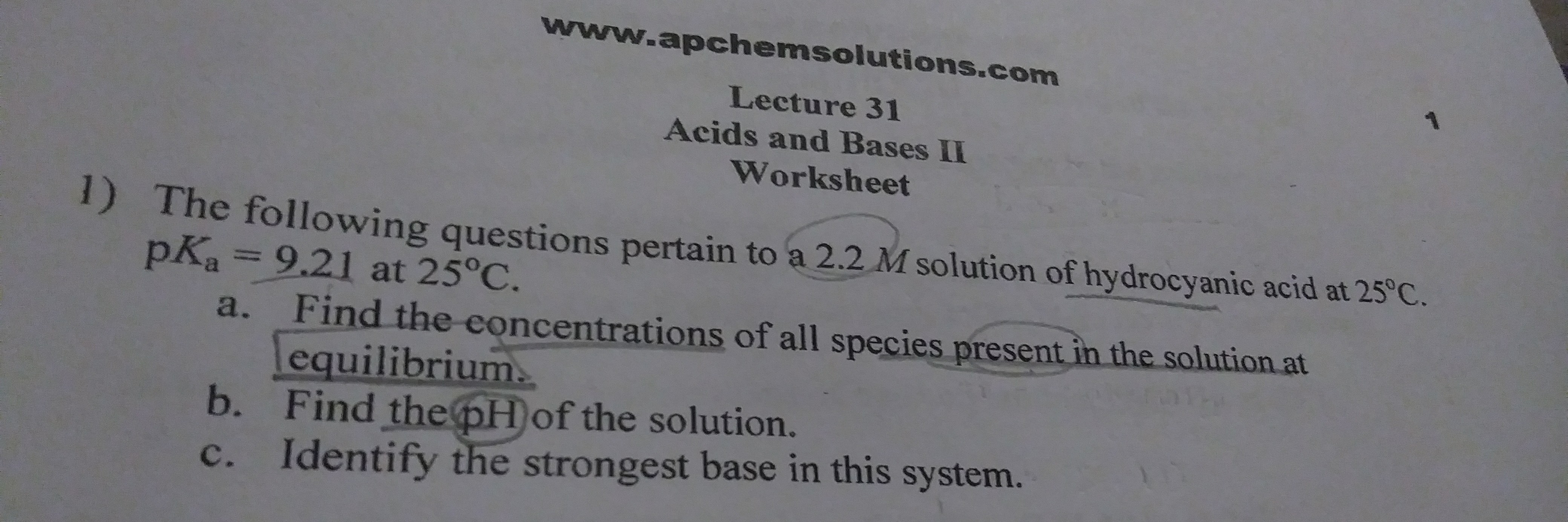
The Following questions pertain to a 2.2M solution of hydrocyanic acid at 25°C. pKa = 9.21 at 25°C. Find the concentrations of a

ll species present in the solution at equilibrium. Find the pH of the solution. Identify the strongest base in this system.

Chemistry
1 answer:
horsena [70]2 years ago
6 0
1) Chemical reaction: HCN + H₂O → CN⁻ + H₃O⁺.
c(HCN) = 2,2 M = 2,2 mol/L.
pKa(HCN) = 9,21.
Ka = 6,16·10⁻¹⁰.
[CN⁻] = [H₃O⁺] = x.
[HCN<span>] = 2,2 M - x.
</span>Ka = [CN⁻] · [H₃O⁺] / [HCN].
6,16·10⁻¹⁰ = x² / 2,2 M -x.
Solve quadratic equation: [CN⁻] = [H₃O⁺] = 0,0000346 M.
[HCN] = 2,2 M - 0,0000346 M = 2,199 M.

2) pH = - log[H₃O⁺].
pH = -log( 0,0000346 M).
pH = 4,46.
Hydrocyanic acid and hydronium ion (H₃O⁺) are acids. Cyanide anion (CN⁻) is the strongest base in the system, cyanide anion accept protons in chemical reaction.
pKb = pKw - pKa.
pKb = 14 - 9,21 = 4,79.

You might be interested in
If you perform the experiment described in investigation #15 by mixing 10 g of glue with 13 g of water and 8 g of sodium borate
Phantasy [73]

10 g of glue with 13 g of water ,

Mass ratio of the material can be calculated as:    

\frac{Mass of glue}{Mass of glue + Mass of water}  

\frac{10 g}{10 g + 13 g }  

\frac{10 g}{23 g }

8 g of sodium borate suspended in 11 g of water, mass ratio can be calculated as:

\frac{Mass of sodium borate}{Mass of sodium borate + Mass of water}  

\frac{ 8 g}{ 8 g + 11 g }  

\frac{8 g}{19 g }

3 0
2 years ago
Give the product for the reaction of 1-butene with methanol in the presence of acid. The mechanism is the same as the mechanism
Nuetrik [128]

Answer:

The final result is <u>2-methoxybutane. </u>

<u />

Explanation:

1-butene has a carbon-carbon double bound between C1 and C2.

When it will react with methanol, in the presence of an acid, the result will be an ether.

C4H8 + CH3OH → C5H12O

An acid-catalyzed ether synthesis from alkenes is limited by carbocation stability.

In the first step, the double bound will disappear. The C2 atom will be a C+ atom, this becaus it has only 3 bounds and not 4.

This C+ -atom will atract the O- atom to form an ether. The CH3 of methanol will bind on the C3 atom, this is the most stable position.

2-methoxybutane will be formed. It has a structural formula of C5H12O

1-methoxybutane will not be formed, because it's less stable.

1-butanol will be formed when water is added to 1-butene. The mechanism has the same principle but not the same product.

1-ethoxybutane and 2-ethoxybutane have a structural formula of C6H14O, this will not be the final result.

The final result is <u>2-methoxybutane. </u>

<u />
8 0
2 years ago
2KOH+H2SO4=k2SO4+2H2O Is a balanced equation, displaying the combination of potassium hydroxide with sulfuric acid increase pota
Lerok [7]

Answer:

The number of moles of potassium hydroxide, KOH required to make 4 moles of K₂SO₄ is 8 moles of KOH

Explanation:

2KOH + H₂SO₄ → K₂SO₄ + 2H₂O

From the above reaction, we have 2 moles of KOH combining with 1 mole of H₂SO₄ to produce 1 mole of K₂SO₄  and 2 moles of H₂O.

Therefore the number of moles of potassium hydroxide that will be needed to make 4 moles of K₂SO₄ is;

8KOH + 4H₂SO₄ → 4K₂SO₄ + 8H₂O

8 moles of KOH is required to make 4 moles of K₂SO₄.

6 0
2 years ago
A sample of ammonia has a mass of 82.9 g. how many molecules are in this sample?
alina1380 [7]
The chemical formula for ammonia is NH3. So first, you need to find the molar mass of ammonia (how many grams in one mole).
N=14g
H3=3g
So one mole of NH3 is 17 grams, you can divide 82.9 grams by 17 grams to find the number of molecules. The answer should be 4.876 moles (molecules) of ammonia. Hope this helps!
8 0
2 years ago
Read 2 more answers
There are three puddles of different sizes on a sidewalk:
nalin [4]

The one property that you can always depend on to change vapor pressure is temperature. So as the water's temperature increases so does the vapor pressure. The warmer the water, the higher the vapor pressure.

Blank one: Hot water

Blank Two: Temperature

7 0
2 years ago
Read 2 more answers
Other questions:
  • Suppose that a certain fortunate person has a net worth of $79.0 billion ($7.90×10¹⁰). If her stock has a good year and gains $3
    9·1 answer
  • Which changes occur when Pt2+ is reduced?
    10·2 answers
  • What is the formal charge on the nitrogen in hydroxylamine, h2noh?
    8·1 answer
  • Calculate the internal energy and enthalpy changes resulting if air changes from an initial |state of 5°C and 10bar, where its m
    11·1 answer
  • A 2 L sample of N2(g) and a 1 L sample of Ar(g), each originally at 1 atm and 0°C, are combined in a 1 L tank. If the temperatu
    10·2 answers
  • Beaker A contains 100.0 g of water initially at 10EC. Beaker B contains 100.0 g of water initially at 20°C. The contents of the
    7·2 answers
  • 50cm3 of sodium hydroxide solution was titrated against a solution of sulfuric acid. The concentration of the sodium hydroxide s
    7·1 answer
  • Identify the true statements regarding alpha-1,6 linkages in glycogen.
    11·1 answer
  • Identify and calculate the number of representative particles in 2.15 moles of gold.<br>​
    13·1 answer
  • A rigid container has 44.5 grams of oxygen gas at room temperature and a pressure of 2.3 atm. How many grams of oxygen should th
    5·1 answer
Add answer
Login
Not registered? Fast signup
Signup
Login Signup
Ask question!
