answer.
Ask question
Login Signup
Ask question
All categories
  • English
  • Mathematics
  • Social Studies
  • Business
  • History
  • Health
  • Geography
  • Biology
  • Physics
  • Chemistry
  • Computers and Technology
  • Arts
  • World Languages
  • Spanish
  • French
  • German
  • Advanced Placement (AP)
  • SAT
  • Medicine
  • Law
  • Engineering
Andrew [12]
2 years ago
4

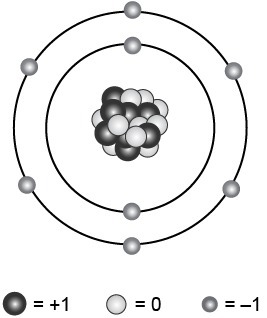
The model below shows an atom of an element.

Chemistry
2 answers:
Dmitry [639]2 years ago
4 0

The  atomic  number of the atom represent by the model is

8 (answer B)

 <u><em>Explanation.</em></u>

 The atomic number  of atom is 8 because the   model below has  a total  number of 8 electrons.

 that  is;  2 electrons in the  inner energy level  and 6 electrons in the outermost energy level which make  a total of 2+6= 8 electrons


Yakvenalex [24]2 years ago
3 0

Answer: The the atomic number of this atom is 8.

Explanation: The particles with zero charge represents neutrons, The particles with negative charge represents electrons and the particles with positive charge represents protons.

The number of particles with negative charge are eight in number, thus there are eight electrons. The number of particles with positive charge are eight in number, thus there are eight protons. Thus it is a neutral atom.

The number of electrons represent the atomic number for a neutral atom. Thus the element has atomic number of 8.


You might be interested in
Describe how to prepare the solution using a 250.0 mL volumetric flask by placing the steps in the correct order. Not all of the
padilas [110]

Answer:

The correct order will be

a. Transfer the measured amount of NaCl to the volumetric flask.

e. Dissolve the NaCl in less than 250 mL of water and mix well.

b. Dilute the solution with water to the 250.0 mL mark.

Explanation:

Preparation of NaCl solution in 250.0 ml volumetric flask:

Add the weighed NaCl directly to volumetric flask and add small amount of water to it and mix it will until all NaCl gets dissolved( if not add small water amount of water more)

After dissolving NaCl add the water upto the mark.

The correct order will be

a. Transfer the measured amount of NaCl to the volumetric flask.

e. Dissolve the NaCl in less than 250 mL of water and mix well.

b. Dilute the solution with water to the 250.0 mL mark.

6 0
2 years ago
What would be the composition and ph of an ideal buffer prepared from lactic acid (ch3chohco2h), where the hydrogen atom highlig
Mashutka [201]

Answer:

P_H =2.86

c=1.4\times 10^{-4}

Explanation:

first write the equilibrium equaion ,

C_3H_6O_3  ⇄ C_3H_5O_3^{-}  +H^{+}

assuming degree of dissociation \alpha =1/10;

and initial concentraion of C_3H_6O_3 =c;

At equlibrium ;

concentration of C_3H_6O_3 = c-c\alpha

[C_3H_5O_3^{-}  ]= c\alpha

[H^{+}] = c\alpha

K_a = \frac{c\alpha \times c\alpha}{c-c\alpha}

\alpha is very small so 1-\alpha can be neglected

and equation is;

K_a = {c\alpha \times \alpha}

[H^{+}] = c\alpha = \frac{K_a}{\alpha}

P_H =- log[H^{+} ]

P_H =-logK_a + log\alpha

K_a =1.38\times10^{-4}

\alpha = \frac{1}{10}

P_H= 3.86-1

P_H =2.86

composiion ;

c=\frac{1}{\alpha} \times [H^{+}]

[H^{+}] =antilog(-P_H)

[H^{+} ] =0.0014

c=0.0014\times \frac{1}{10}

c=1.4\times 10^{-4}

6 0
2 years ago
water’s molar mass is 18.01 g/mol. The molar mass of glycerol is 92.09 g/mol. At 25 celsius, glycerol is more viscous than water
Gemiola [76]

Answer is: glycerol because it is more viscous and has a larger molar mass.

Viscosity depends on intermolecular interactions.

The predominant intermolecular force in water and glycerol is hydrogen bonding.

Hydrogen bond is an electrostatic attraction between two polar groups in which one group has hydrogen atom (H) and another group has highly electronegative atom such as nitrogen (like in this molecule), oxygen (O) or fluorine (F).

4 0
2 years ago
Be sure to answer all parts. Consider the following balanced redox reaction (do not include state of matter in your answers): 2C
timurjin [86]

Answer:

The specie which is oxidized is:- CrO_2^-

The specie which is reduced is:- ClO^-

Explanation:

Oxidation reaction is defined as the chemical reaction in which an atom looses its electrons. The oxidation number of the atom gets increased during this reaction.

X\rightarrow X^{n+}+ne^-

Reduction reaction is defined as the chemical reaction in which an atom gains electrons. The oxidation number of the atom gets reduced during this reaction.

X^{n+}+ne^-\rightarrow X

For the given chemical reaction:

2CrO_2^- + 6ClO^- + 2H_2O\rightarrow 2CrO_4^{2-} + 3Cl_2 + 4OH^-

The half cell reactions for the above reaction follows:

Oxidation half reaction:  CrO_2^- + 2H_2O + 4OH^-\rightarrow CrO_4^{2-} + 4H_2O + 3e^-

Reduction half reaction:  2ClO^- + 4H_2O + 2e^-\rightarrow Cl_2 + 2H_2O + 4OH^-

Thus, the specie which is oxidized is:- CrO_2^-

The specie which is reduced is:- ClO^-

8 0
3 years ago
What properties of metals are explained by its mobile electrons? Strength, malleability, ductility, heat conduction, current con
earnstyle [38]

Due to the presence of mobile or moving electrons in an atom they are good conductor of heat and electricity. Thus, the heat conduction and current conduction properties of metals are explained by its mobile electrons.

The other mentioned properties of metal are strength which can be explained by type of bonding within the metals, malleability explains the tendency of metals to be flattened into thin sheets, ductility explains the tendency to be stretched into wires, luster means the surface of metal is shiny and opacity is measure of impermeability that is to what extent they can pass light through them, metals are opaque, can not pass light through them or they are not transparent . All these properties are not because of mobile electrons in metals.

Therefore, correct properties are heat conduction and current conduction.

8 0
2 years ago
Read 2 more answers
Other questions:
  • jan is holding an ice cube. what causes the ice to melt? thermal energy from the ice is transferred to the air. thermal energy f
    12·2 answers
  • Magnesium has an atomic mass of 24.3. there are two isotopes of magnesium - one contains 12 neutrons and the other contains 13 n
    7·1 answer
  • Ammonia can also be synthesized by this reaction: 3h2(g)+n2(g) → 2nh3(g) what maximum amount of ammonia in grams can be synthesi
    7·2 answers
  • Most NADH molecules generated during cellular respiration are produced during __________. View Available Hint(s) Most NADH molec
    10·1 answer
  • Calculate the molarity of 1.0 mol of KCl in 750 ml of solution
    9·2 answers
  • A gas has a pressure of 3.16 atm at STP. I have decided to transfer it to a container that is 3 times larger than the original v
    11·1 answer
  • For a reaction with ΔH° = −9 kJ/mol, decide if the following statement is true. If it is false, choose the statement that makes
    11·1 answer
  • What is the value of the σ∗1s mo wave function at the nodal plane?
    15·2 answers
  • Calculate the number of kilojoules of energy required to convert 50.0 grams of solid DMSO initially at a temperature of 19.0°C t
    10·1 answer
  • A rigid, 28-L steam cooker is arranged with a pressure relief valve set to release vapor and maintain the pressure once the pres
    15·1 answer
Add answer
Login
Not registered? Fast signup
Signup
Login Signup
Ask question!
