answer.
Ask question
Login Signup
Ask question
All categories
  • English
  • Mathematics
  • Social Studies
  • Business
  • History
  • Health
  • Geography
  • Biology
  • Physics
  • Chemistry
  • Computers and Technology
  • Arts
  • World Languages
  • Spanish
  • French
  • German
  • Advanced Placement (AP)
  • SAT
  • Medicine
  • Law
  • Engineering
Pavel [41]
2 years ago
7

Match the theoretical motions of particles with their associated phases. Solid, Gas, Liquid. 1. oscillation about a fixed point

2. translation, vibration, rotation 3. rotation and vibration

Chemistry
2 answers:
podryga [215]2 years ago
6 0
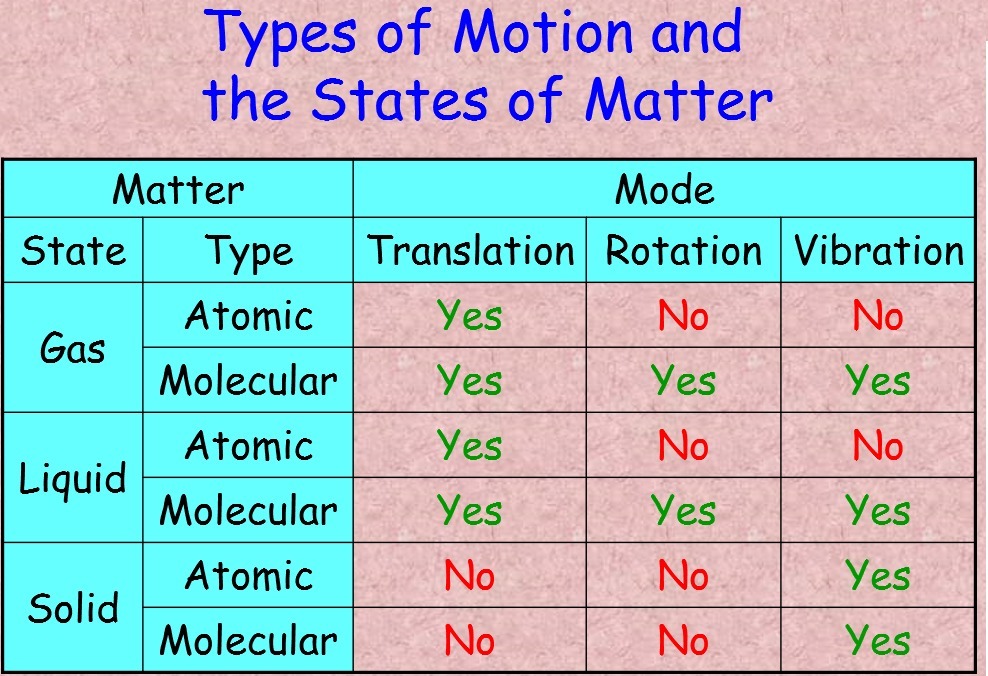
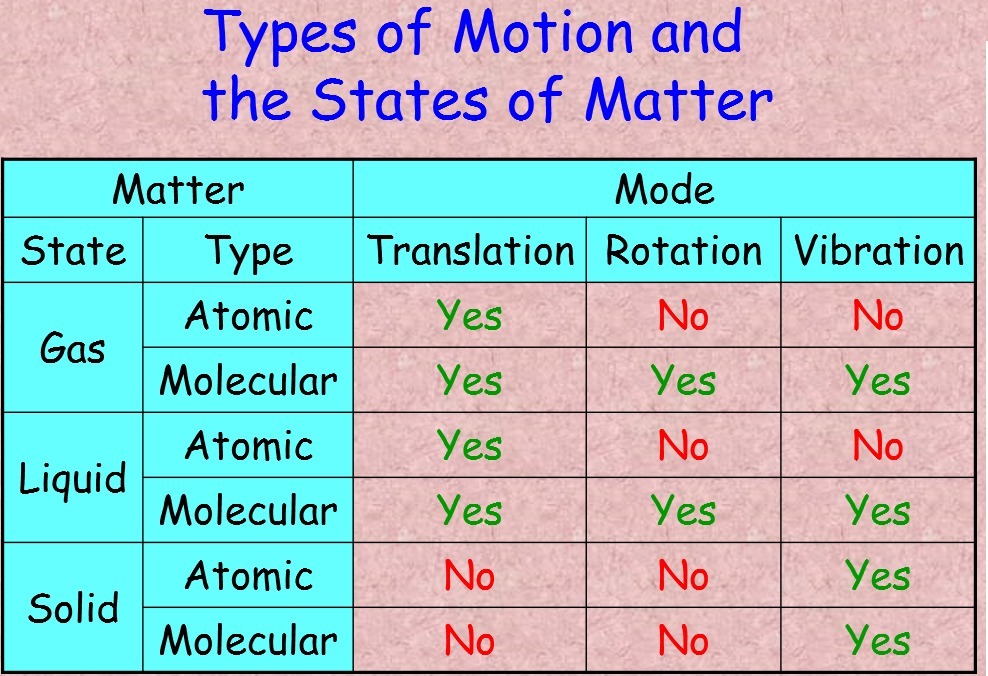
The correct combination of <span>theoretical motions of particles with their associated phases is given below:

1) Solid : </span>oscillation about a fixed point . Because solids do vibrate (atoms/molecules of a solid oscillate around their mean positions)<span>
2) Gas : </span>translation, vibration, rotation. The gas molecules are free to rotate, oscillate & vibrate. <span>
3) Liquid: </span>rotation and vibration. The liquid molecules are free to rotate & vibrate.

A more clear pictures (at atomic & molecular level is shown below):

Viktor [21]2 years ago
3 0

Answer:1) Solid : oscillation about a fixed point .Because solids do vibrate (atoms/molecules of a solid oscillate around their mean positions)

2) Gas : translation, vibration, rotation. The gas molecules are free to rotate, oscillate & vibrate.

3) Liquid: rotation and vibration. The liquid molecules are free to rotate & vibrate.

Explanation:

You might be interested in
Given these reactions, where X represents a generic metal or metalloid 1) H2(g)+12O2(g)⟶H2O(g)ΔH1=−241.8 kJ 1) H2(g)+12O2(g)⟶H2O
Bond [772]

Answer:

ΔH = -793,6 kJ

Explanation:

It is possible to obtain ΔH of this reaction using Hess's law that says you can sum the half-reactions ΔH to obtain the ΔH of the global reaction:

If half-reactions are:

1) H₂(g) + ¹/₂O₂(g) ⟶ H₂O(g) ΔH₁ = −241.8 kJ

2) X(s) + 2Cl₂(g) ⟶ XCl₄(s) ΔH₂ = +356.9 kJ  

3) ¹/₂H₂(g) + ¹/₂Cl₂(g) ⟶ HCl(g) ΔH₃ = −92.3 kJ

4) X(s) + O₂(g) ⟶ XO₂(s) ΔH₄ = −639.1 kJ

5) H₂O(g) ⟶ H₂O(l) ΔH₅ = −44.0 kJ

The sum of (4) + 4×(3) - (2) - 2×(1) - 2×(5) is:

(4) X(s) + O₂(g) ⟶ XO₂(s) ΔH = −639.1 kJ

+4×(3) 2H₂(g) + 2Cl₂(g) ⟶ 4HCl(g) ΔH = −369,2 kJ

-(2) XCl₄(s) ⟶ X(s) + 2Cl₂(g) ΔH = -356,9 kJ

-2×(1) 2H₂O(g) ⟶ 2H₂(g) + O₂(g) ΔH = +483,6 kJ

-2×(5) 2H₂O(l) ⟶ 2H₂O(g) ΔH = +88.0 kJ

= <em>XCl₄(s) + 2H₂O(l) ⟶ XO₂(s) + 4HCl(g)</em>

Where ΔH is:

ΔH = -639,1 kJ -369,2 kJ -356,9 kJ +483,6 kJ +88,0 kJ

<em>ΔH = -793,6 kJ</em>

I hope it helps!
5 0
2 years ago
A graduated cylinder holds 100 mL of water. A lead weight is dropped into the cylinder bringing the new volume up to 450 mL. If
dolphi86 [110]

11.43g/mL

Explanation:

Given parameters:

Volume of water in the graduated cylinder = 100mL

Volume of water + lead weight = 450mL

Mass of lead weight = 4000g

Unknown:

Density of the lead weight = ?

Solution:

Density is the mass per unit volume of a body.

  Density  = \frac{mass}{volume}

Volume of the lead weight = volume of water displaced

 Volume of lead weight = 450 - 100 = 350mL

Density = \frac{4000}{350}  = 11.43g/mL

learn more:

Density brainly.com/question/2690299

#learnwithBrainly

6 0
2 years ago
6. Cross-cuts are best made with which of the following types of knife? A. Utility knife B. Scaler C. Paring knife D. Chef's kni
zaharov [31]

Answer:

A

Explanation:

Utility knife

8 0
2 years ago
Read 2 more answers
an alloy contains 56g of pure silver and 22g of pure copper what is the percentage(%) of silver in the alloy?
Lerok [7]
To get the ans divide 5600by 78 and there is ur answer
6 0
2 years ago
Read 2 more answers
If a penny is made of 3.11 grams of copper, how many atoms of copper are in the penny
Pie

Answer:

2.94x10²² atoms of Cu

Explanation:

We must work with NA to solve this, where NA is the number of Avogadro, number of particles of 1 mol of anything.

Molar mass Cu = 63.55 g/mol

Mass / Molar mass = Mol → 3.11 g / 63.55 g/m = 0.0489 moles

1 mol  of Cu has 6.02x10²³ atoms of Cu

0.0489 moles of Cu, will have (0.0489  .NA)/ 1 = 2.94x10²² atoms of Cu

8 0
2 years ago
Other questions:
  • The Lewis structure for a chlorate ion, ClO3-, should show ____ single bond(s), ____ double bond(s), and ____ lone pair(s).
    15·2 answers
  • In which orbital does an electron in a bromine atom experience the greatest effective nuclear charge?
    9·2 answers
  • if 20.g of a radioactive isotope are present at 1:00 pm and 5.0g remain at 2:00 pm, what is the half life of the isotope?
    9·1 answer
  • How many moles of calcium chloride (CaCl2) are needed to react completely with 6.2 moles of silver nitrate (AgNO3)? 2AgNO3 + CaC
    15·1 answer
  • What is the volume of 1.56 kg of a compound whose molar mass is 81.86 g/mole and whose density is 41.2 g/ml?
    5·1 answer
  • NiO is to be reduced to nickel metal in an industrial process by use of the reaction:NiO(s) + CO(g) &lt;-----&gt; Ni(s) + CO2(g)
    8·1 answer
  • A student adds 10.00 mL of a 2.0 M nitric acid solution to a 100.00 mL volumetric flask. Next, 50.00 mL of a 0.00500 M solution
    15·1 answer
  • 36g of KOH dissolved in 800mL of water. What is the molality of the solution?
    14·1 answer
  • What is the total pressure of air in lungs of an individual with oxygen at 100. mmHg, nitrogen at 573 mmHg, carbon dioxide at 0.
    12·1 answer
  • a sample of mass 6.814grams is added to another sample weighing 0.08753 grams. the subsequent mixture is then divided into exact
    15·1 answer
Add answer
Login
Not registered? Fast signup
Signup
Login Signup
Ask question!