answer.
Ask question
Login Signup
Ask question
All categories
  • English
  • Mathematics
  • Social Studies
  • Business
  • History
  • Health
  • Geography
  • Biology
  • Physics
  • Chemistry
  • Computers and Technology
  • Arts
  • World Languages
  • Spanish
  • French
  • German
  • Advanced Placement (AP)
  • SAT
  • Medicine
  • Law
  • Engineering
Ahat [919]
2 years ago
12

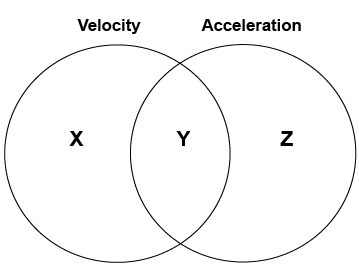
Mateo adds two labels to the Venn diagram shown to explain how velocity and acceleration change during simple harmonic motion.

Physics
2 answers:
Deffense [45]2 years ago
5 0
I think it might be

Label 1: Z
Label 2: Z

Correct me if I'm wrong.
photoshop1234 [79]2 years ago
5 0

Answer:

A) Label 1: Z

Label 2: Z

Explanation:

Let's analyze separately velocity and acceleration in a simple harmonic motion.

1) Velocity:

In a simple harmonic motion, velocity is maximum at the equilibrium position, and it decreases as the system moves away from the equilibrium position. This can be understood by the law of conservation of energy: in fact, the total mechanical energy is the sum of kinetic and potential energy

E=K+U=\frac{1}{2}mv^2+\frac{1}{2}kx^2

where m is the mass, v the velocity, k the spring constant and x the displacement of the system from the equilibrium position. Since E must be remain constant, we can see that:

- when x=0 (equilibrium position), K is maximum, so the velocity v is maximum

- when x increases, the velocity decreases

Therefore, both label 1 and 2 are not valid for velocity.

2) Acceleration:

In a simple harmonic motion, acceleration is maximum when the displacement is maximum, and zero when the system is at equilibrium position. This is due to the fact that acceleration is proportional to the force, and the force is

F=-kx

so, the force F is proportional to the displacement x. Therefore:

- when x=0 (equilibrium position), the acceleration is zero

- when x increases, F increases, and so the acceleration increases as well

Therefore, both label 1 and 2 are valid for the acceleration. So, they should be placed both in Z.
You might be interested in
A basketball with mass of 0.8 kg is moving to the right with velocity 6 m/s and hits a volleyball with mass of 0.6 kg that stays
IceJOKER [234]

Answer:

26.67 m/s

Explanation:

From the law of conservation of linear momentum, the initial sum of momentum equals the final sum.

p=mv where p is momentum, m is the mass of object and v is the speed of the object

Initial momentum

The initial momentum will be that of basketball and volleyball, Since basketball is initially at rest, its initial velocity is zero

p_i= m_bv_b+m_vv_v=8*6+0.6*0=48 Kg.m/s

Final momentum

p_f= m_bv_b+m_vv_v=8*4+0.6*v_v=32+0.6v Kg.m/s\\32+0.6v_v=48\\0.6v=16\\v_v=16/0.6=26.66666667\approx 26.67 m/s

4 0
2 years ago
If a cat falls off a ledge, the Earth pulls the cat to the ground with the force of gravity. According to Newton's Third Law the
elena55 [62]

Answer:

<em><u>The</u></em><em><u> </u></em><em>answer</em><em> </em><em>Is</em><em> </em><em>B.</em><em> </em>

Explanation:

<em><u>The</u></em><em><u> </u></em><em><u>cats</u></em><em><u> </u></em><em><u>acceleration</u></em><em><u> </u></em><em><u>is</u></em><em><u> </u></em><em><u>decreased</u></em>

<em><u>by</u></em><em><u> </u></em><em><u>air</u></em><em><u> </u></em><em><u>resistance</u></em><em><u>.</u></em><em><u> </u></em>

<em><u>hope</u></em><em><u> </u></em><em><u>it</u></em><em><u> </u></em><em><u>helps</u></em><em><u> </u></em><em><u>you</u></em><em><u>!</u></em><em><u> </u></em>

<em><u>follow</u></em><em><u> </u></em><em><u>me</u></em><em><u> </u></em><em><u>for</u></em><em><u> </u></em><em><u>more</u></em>

<em><u>don't</u></em><em><u> </u></em><em><u>worry</u></em><em><u> </u></em><em><u>I'll</u></em><em><u> </u></em><em><u>try</u></em><em><u> </u></em><em><u>my</u></em><em><u> </u></em><em><u>best</u></em>

8 0
2 years ago
Read 2 more answers
A car possesses 20,000 units of momentum. what would be the car's new momentum if ... its velocity was doubled?
pochemuha
10,000 units of momentum.
p=mv
20,000=m(2v)
10,000=mv
7 0
2 years ago
A ship sends out a 1200 Hz sound wave, which has a wavelength of 120 cm in the water. What would happen if that ship sent out a
OlgaM077 [116]

Answer:

the wave length becomes doubled or becomes two times the initial wavelength = 240 cm

Explanation:

From wave,

v = λf................ Equation 1

Where v = velocity of the wave, λ = wavelength of the wave, f = frequency of the wave.

Given: f = 1200 Hz, λ = 120 cm = 1.2 m

Substitute into equation 1

v = 1200(1.2)

v = 1440 m/s.

When the ship sent out a 600 Hz sound wave,

make λ the subject of formula in equation 1

λ = v/f............. Equation 2

Given: f = 600 Hz, v = 1440 m/s

Substitute into equation 2

λ = 1440/600

λ = 2.4 m or 240 cm.

When the ship sent out a 600 Hz sound wave instead, the wave length becomes doubled or becomes two times the initial wavelength = 240 cm

3 0
2 years ago
A river flows with a uniform velocity vr. A person in a motorboat travels 1.22 km upstream, at which time she passes a log float
storchak [24]

Answer:

 t ’= \frac{1450}{0.6499 + 2 v_r},  v_r = 1 m/s       t ’= 547.19 s

Explanation:

This is a relative velocity exercise in a dimesion, since the river and the boat are going in the same direction.

By the time the boat goes up the river

        v_b - v_r = d / t

By the time the boat goes down the river

        v_b + v_r = d '/ t'

let's subtract the equations

       2 v_r = d ’/ t’ - d / t

       d ’/ t’ = 2v_r + d / t

       t' = \frac{d'}{ \frac{d}{t}+ 2 v_r }

In the exercise they tell us

         d = 1.22 +1.45 = 2.67 km= 2.67 10³ m

         d ’= 1.45 km= 1.45 1.³ m

at time t = 69.1 min (60 s / 1min) = 4146 s

the speed of river is v_r

      t ’= \frac{1.45 \ 10^3}{ \frac{ 2670}{4146} \  + 2 \ v_r}

      t ’= \frac{1450}{0.6499 + 2 v_r}

In order to complete the calculation, we must assume a river speed

          v_r = 1 m / s


let's calculate

      t ’= \frac{ 1450}{ 0.6499 + 2 \ 1}

      t ’= 547.19 s

8 0
2 years ago
Other questions:
  • A space shuttle orbits Earth at a speed of 21,000 km/hr. How far does it go in 3.5 hrs?
    14·1 answer
  • A Turtle and a Snail are 360 meters apart, and they start to move towards each other at 3 p.m. If the Turtle is 11 times as fast
    12·2 answers
  • Ancient Greek philosophers spent lots of time thinking about science and imaging explanations for the natural world. What part o
    15·1 answer
  • A particular material has an index of refraction of 1.25. What percent of the speed of light in a vacuum is the speed of light i
    15·2 answers
  • A child pushes a 75 N toy car across the floor. What is the mass of the car?
    6·1 answer
  • A simple pendulum of length 2.5 m makes 5.0 complete swings in 16 s. What is the acceleration of gravity at the location?
    12·1 answer
  • Combine Newton's 2nd law and Hooke's law for a spring to find the acceleration of the block a(t) as a function of time. Express
    15·1 answer
  • A hockey puck of mass m1=165 g slides from left to right with an initial velocity of 15.5 m/s. It collides head on with a second
    14·1 answer
  • A student placed an ice cube on a table and observed it for five minutes. He noticed that the ice cube seemed to get smaller and
    14·1 answer
  • This is a problem about a child pushing a stack of two blocks along a horizontal floor. The masses of the blocks, and the coeffi
    13·1 answer
Add answer
Login
Not registered? Fast signup
Signup
Login Signup
Ask question!
