answer.
Ask question
Login Signup
Ask question
All categories
  • English
  • Mathematics
  • Social Studies
  • Business
  • History
  • Health
  • Geography
  • Biology
  • Physics
  • Chemistry
  • Computers and Technology
  • Arts
  • World Languages
  • Spanish
  • French
  • German
  • Advanced Placement (AP)
  • SAT
  • Medicine
  • Law
  • Engineering
Sauron [17]
2 years ago
9

How many mL of a 0.63 M solution would contain 12g of Al(NO3)3

Chemistry
2 answers:
otez555 [7]2 years ago
5 0
3 is your answer!!! :D
lbvjy [14]2 years ago
4 0

Answer : 89 mL of solution would contain the given amount of Al(NO₃)₃.

Explanation :

Step 1 : Find moles of Al(NO₃)₃.

The molar mass of Al(NO₃)₃ is 213 g/mol

The formula to calculate mole is given below.

Mole = \frac{Mass (grams)}{MolarMass}

We have 12 g of Al(NO₃)₃. Let us plug in this value to find mol.

mole = \frac{12g}{213 g/mol}

Mole = 0.056 mol.

We have 0.056 mols of Al(NO₃)₃

Step 2 : Use molarity formula to find the volume.

The molarity of a solution is defined as moles of solute per liter of solution.

This can be represented in terms of formula as follows.

Molarity (M)= \frac{mol}{L}

We have 0.63 M solution.

0.63 M = \frac{0.056mol}{L}

On rearranging we get,

L = \frac{0.056}{0.63} = 0.089

We have 0.089 L of solution. Let us convert this to mL.

0.089 L \times \frac{1000mL}{1L} = 89 mL

89 mL of solution would contain the given amount of Al(NO₃)₃.

You might be interested in
consideras util conocer las propiedades extensivas e intensivas de los insumos utilizados para la elaboración de producto ¿por q
Brums [2.3K]

Answer:

Explanation:

No.

Las propiedades físicas de los materiales y sistemas a menudo se pueden clasificar como intensivas o extensivas, según cómo cambia la propiedad cuando cambia el tamaño (o extensión) del sistema. Según la IUPAC, una cantidad intensiva es aquella cuya magnitud es independiente del tamaño del sistema, mientras que una cantidad extensiva es aquella cuya magnitud es aditiva para los subsistemas. Esto refleja las ideas matemáticas correspondientes de media y medida, respectivamente.

Una propiedad intensiva es una propiedad a granel, lo que significa que es una propiedad física local de un sistema que no depende del tamaño del sistema o de la cantidad de material en el sistema. Los ejemplos de propiedades intensivas incluyen temperatura, T; índice de refracción, n; densidad, ρ; y dureza de un objeto.

Por el contrario, propiedades extensivas como la masa, el volumen y la entropía de los sistemas son aditivas para los subsistemas porque aumentan y disminuyen a medida que crecen y se reducen, respectivamente.  

Estas dos categorías no son exhaustivas, ya que algunas propiedades, físicas no son exclusivamente intensivas ni extensivas. Por ejemplo, la impedancia eléctrica de dos subsistemas es aditiva cuando, y solo cuando, se combinan en serie; mientras que si se combinan en paralelo, la impedancia resultante es menor que la de cualquiera de los subsistemas.

¡Espero haberte ayudado!  :)

7 0
2 years ago
A piece of wire contains 1.52x10^22 atoms of copper. Calculate the miles of copper in the wire
melamori03 [73]

Moles of Copper =

1.52×10^{22}atoms×\frac{1 mol }{6.022 * 10^{23}atoms}

= 0.0252 mol Cu

6 0
2 years ago
What is most likely the author’s motive for writing this article?
s2008m [1.1K]
You need to attach the article or tell us the title of it
5 0
2 years ago
Read 2 more answers
Starting with 1.5052g of BaCl2•2H2O and excessH2SO4, how many grams of BaSO4 can be formed?
muminat
1.5052g BaCl2.2H2O => 1.5052g / 274.25 g/mol = 0.0054884 mol
=> 0.0054884 mol Ba 
<span>This means that at most 0.0054884 mol BaSO4 can form since Ba is the limiting reagent. </span>
<span>0.0054884 mol BaSO4 => 0.0054884 mol * 233.39 g/mol = 1.2809 g BaSO4</span>
6 0
2 years ago
Read 2 more answers
Enter the net ionic equation representing solid chromium (iii) hydroxide reacting with nitrous acid. express your answer as a ba
Colt1911 [192]

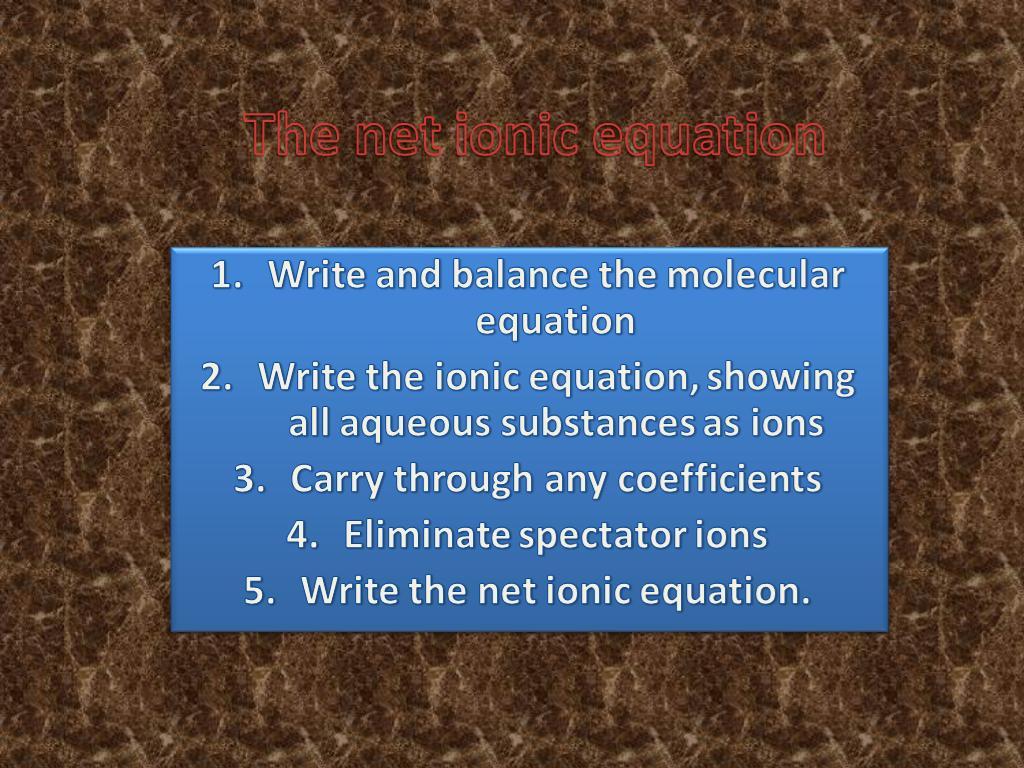
The net ionic equation of chromium (iii) hydroxide reacting with nitrous acid:

Cr(OH)₃ (s) + 3H⁺ (aq) ⇒ Cr³⁺ (aq) + 3H₂O (l)

<h3>Further explanation</h3>

The electrolyte in the solution produces ions.

The equation of a chemical reaction can be expressed in the equation of the ions

For strong electrolytes (the ionization rate = 1) is written in the form of separate ions, while the weak electrolyte (degree of ionization <1) is still written as an un-ionized molecule

In the ion equation, there is a spectator ion that is the ion which does not change (does not react) because it is present before and after the reaction

When these ions are removed, the ionic equation is called the net ionic equation

For gases and solids including water (H₂O) can be written as an ionized molecule

So only the dissolved compound is ionized ((expressed in symbol aq)

From the problem, it is stated that chromium (iii) hydroxide reacting with nitrous acid.

Reactions that occur:

Cr(OH)₃ (s) + 3HNO₂ (aq) ⇒ Cr(NO₂)₃ (aq) + 3H₂O (l)

Cr (OH)₃ solid form that does not decompose in the form of ions, as well as water (H₂O)

So the ionic equation becomes:

Cr(OH)₃ (s) + 3H⁺ (aq) + 3NO₂⁻ (aq) ⇒ Cr³⁺ (aq) + 3NO₂⁻ (aq) + 3H₂O (l)

There is an ion spectator that is 3NO₂⁻, so that if it is removed a net ionic equation will be formed:

Cr(OH)₃ (s) + 3H⁺ (aq) ⇒ Cr³⁺ (aq) + 3H₂O (l)

<h3>Learn more</h3>

the net ionic equation

brainly.com/question/11854070

brainly.com/question/10280219

brainly.com/question/9830467

Keywords: the net ionic equation, an ion spectator

5 0
2 years ago
Read 2 more answers
Other questions:
  • Looking at the same nonmetal group on the periodic table, how does the reactivity of an element in period 2 compare to the react
    12·2 answers
  • If 89.6 joules of heat are needed to heat 20.0 grams of iron from 30.0°c to 40.0°c, what is the specific heat of the iron in jg?
    13·1 answer
  • Matt did an experiment to study the solubility of two substances. He poured 100 mL of water at 20 °C into each of two beakers la
    14·2 answers
  • In this scenario a battery is used to supply chemical potential energy. The potential energy is transformed and produces kinetic
    7·2 answers
  • The ksp of zinc carbonate (znco3 is 1.0 × 10⁻¹⁰. what is the solubility concentration of carbonate ions in a saturated solution
    11·2 answers
  • Avogadro’s number is a constant that helps scientists count atoms and molecules. It is approximately equal to 602,200,000,000,00
    11·2 answers
  • Complete the following sentence: The cathode in a voltaic cell is the electrode _____________.
    5·1 answer
  • A compound with the molecular formula C10H10O4 produces a 1H NMR spectrum that exhibits only two signals, both singlets. One sig
    15·1 answer
  • If two gases react, pumping more gas into the reaction container will _____ the rate of the reaction.
    12·2 answers
  • Prisms separate ________ light, such as that from the Sun, by wavelength. Which best completes the statement? ultraviolet white
    10·1 answer
Add answer
Login
Not registered? Fast signup
Signup
Login Signup
Ask question!