answer.
Ask question
Login Signup
Ask question
All categories
  • English
  • Mathematics
  • Social Studies
  • Business
  • History
  • Health
  • Geography
  • Biology
  • Physics
  • Chemistry
  • Computers and Technology
  • Arts
  • World Languages
  • Spanish
  • French
  • German
  • Advanced Placement (AP)
  • SAT
  • Medicine
  • Law
  • Engineering
julsineya [31]
2 years ago
14

Enter the net ionic equation representing solid chromium (iii) hydroxide reacting with nitrous acid. express your answer as a ba

lanced net ionic equation. identify all of the phases in your answer.

Chemistry
2 answers:
Colt1911 [192]2 years ago
5 0

The net ionic equation of chromium (iii) hydroxide reacting with nitrous acid:

Cr(OH)₃ (s) + 3H⁺ (aq) ⇒ Cr³⁺ (aq) + 3H₂O (l)

<h3>Further explanation</h3>

The electrolyte in the solution produces ions.

The equation of a chemical reaction can be expressed in the equation of the ions

For strong electrolytes (the ionization rate = 1) is written in the form of separate ions, while the weak electrolyte (degree of ionization <1) is still written as an un-ionized molecule

In the ion equation, there is a spectator ion that is the ion which does not change (does not react) because it is present before and after the reaction

When these ions are removed, the ionic equation is called the net ionic equation

For gases and solids including water (H₂O) can be written as an ionized molecule

So only the dissolved compound is ionized ((expressed in symbol aq)

From the problem, it is stated that chromium (iii) hydroxide reacting with nitrous acid.

Reactions that occur:

Cr(OH)₃ (s) + 3HNO₂ (aq) ⇒ Cr(NO₂)₃ (aq) + 3H₂O (l)

Cr (OH)₃ solid form that does not decompose in the form of ions, as well as water (H₂O)

So the ionic equation becomes:

Cr(OH)₃ (s) + 3H⁺ (aq) + 3NO₂⁻ (aq) ⇒ Cr³⁺ (aq) + 3NO₂⁻ (aq) + 3H₂O (l)

There is an ion spectator that is 3NO₂⁻, so that if it is removed a net ionic equation will be formed:

Cr(OH)₃ (s) + 3H⁺ (aq) ⇒ Cr³⁺ (aq) + 3H₂O (l)

<h3>Learn more</h3>

the net ionic equation

brainly.com/question/11854070

brainly.com/question/10280219

brainly.com/question/9830467

Keywords: the net ionic equation, an ion spectator

mart [117]2 years ago
3 0

The net ionic equation is \boxed{{\text{Cr}}{{\left( {{\text{OH}}} \right)}_3}\left( s \right)+3{{\text{H}}^+}\left( {aq} \right)\to{\text{C}}{{\text{r}}^{3+}}\left( {aq}\right)+3{{\text{H}}_{\text{2}}}{\text{O}}\left(l\right)}.

The phase of {\mathbf{Cr}}{\left( {{\mathbf{OH}}} \right)_{\mathbf{3}}} is the solid phase, that of {{\mathbf{H}}_{\mathbf{2}}}{\mathbf{O}} is liquid while that of {{\mathbf{H}}^{\mathbf{ + }}} and {\mathbf{C}}{{\mathbf{r}}^{{\mathbf{3 + }}}} is aqueous.

Further Explanation:

The three types of equations that are used to represent the chemical reaction are as follows:

1. Molecular equation

2. Total ionic equation

3. Net ionic equation

The reactants and products remain in undissociated form in molecular equation. In the case of total ionic equation, all the ions that are dissociated and present in the reaction mixture are represented while in the case of overall or net ionic equation only the useful ions that participate in the reaction are represented.

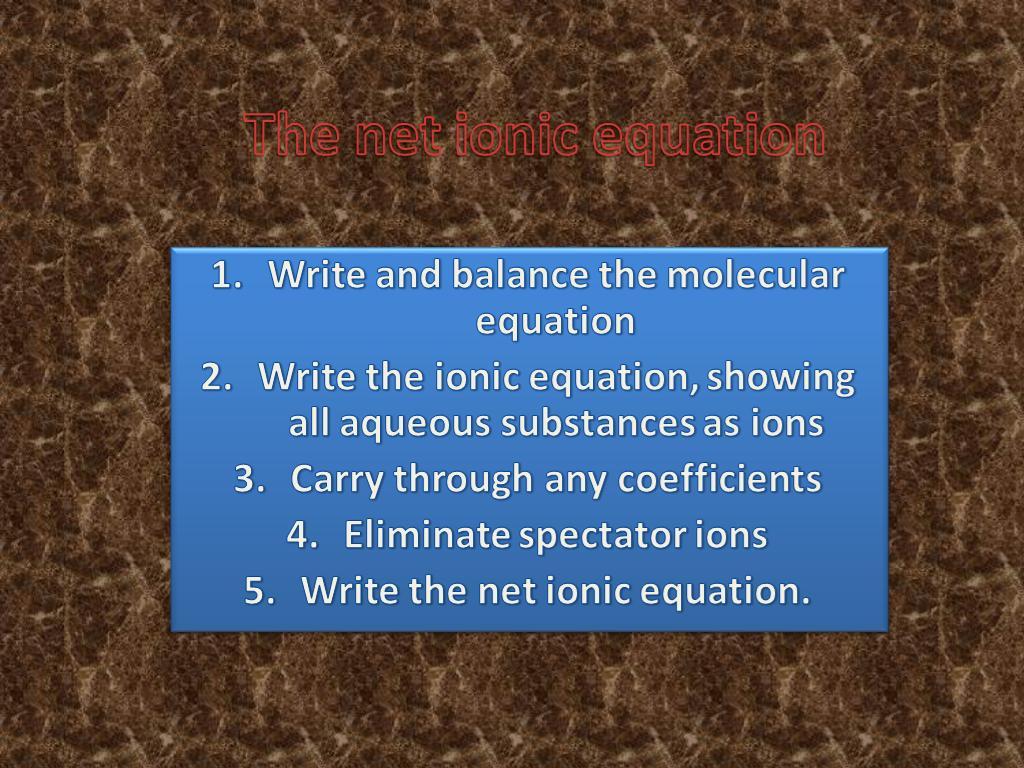
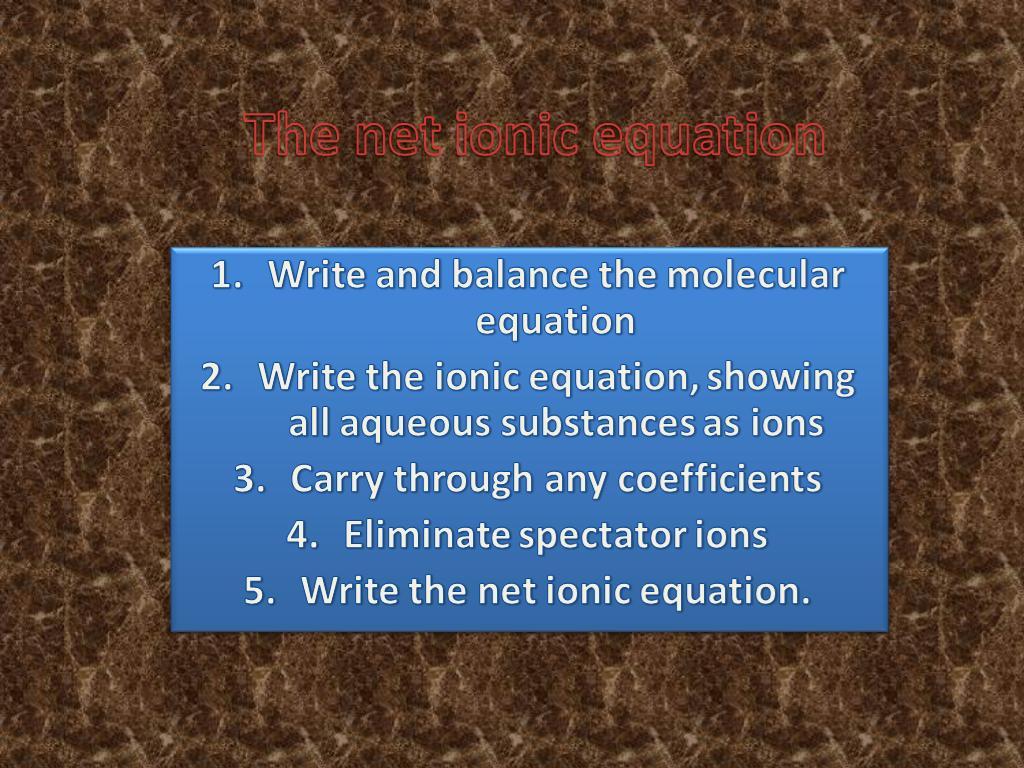
The steps to write the net ionic reaction are as follows:

Step 1: Write the molecular equation for the reaction with the phases in the bracket.

In the reaction, {\text{Cr}}{\left( {{\text{OH}}} \right)_3} reacts with {\text{HN}}{{\text{O}}_2} to form {\text{Cr}}{\left( {{\text{N}}{{\text{O}}_{\text{2}}}} \right)_3} and {{\text{H}}_2}{\text{O}}. The balanced molecular equation of the reaction is as follows:

{\text{Cr}}{\left( {{\text{OH}}} \right)_3}\left( s \right) + {\text{3HN}}{{\text{O}}_2}\left( {aq} \right) \to {\text{Cr}}{\left( {{\text{N}}{{\text{O}}_2}} \right)_3}\left( {aq} \right) + {\text{3}}{{\text{H}}_2}{\text{O}}\left( l \right)

Step 2: Dissociate all the compounds with the aqueous phase to write the total ionic equation. The compounds with liquid and solid phase remain the same. The total ionic equation is as follows:

{\text{Cr}}{\left( {{\text{OH}}} \right)_3}\left( s \right) + {\text{3}}{{\text{H}}^ + }\left( {aq} \right) + {\text{3NO}}_2^ - \left( {aq} \right) \to 3{\text{C}}{{\text{r}}^{3 + }}\left( {aq} \right) + {\text{3NO}}_2^ - \left( {aq} \right) + {\text{3}}{{\text{H}}_2}{\text{O}}\left( l \right)

Step 3: The common ions on both the sides of the reaction get cancelled out to get the overall ionic equation.

{\text{Cr}}{\left( {{\text{OH}}} \right)_3}\left( s \right) + {\text{3}}{{\text{H}}^ + }\left( {aq} \right) + \boxed{{\text{3NO}}_2^ - \left( {aq} \right)} \to 3{\text{C}}{{\text{r}}^{3 + }}\left( {aq} \right) + \boxed{{\text{3NO}}_2^ - \left( {aq} \right)} + {\text{3}}{{\text{H}}_2}{\text{O}}\left( l \right)

Therefore, the overall ionic equation obtained is as follows:

{\text{Cr}}{\left( {{\text{OH}}} \right)_3}\left( s \right) + {\text{3}}{{\text{H}}^ + }\left( {aq} \right) \to 3{\text{C}}{{\text{r}}^{3 + }}\left( {aq} \right) + {\text{3}}{{\text{H}}_2}{\text{O}}\left( l \right)

{\mathbf{Cr}}{\left( {{\mathbf{OH}}} \right)_{\mathbf{3}}} is present in the solid phase, {{\mathbf{H}}_{\mathbf{2}}}{\mathbf{O}} is in the liquid phase while {{\mathbf{H}}^{\mathbf{ + }}} and {\mathbf{C}}{{\mathbf{r}}^{{\mathbf{3 + }}}} are present in the aqueous phase.

Learn more:

1. Balanced chemical equation: brainly.com/question/1405182

2. The net ionic equation for the reaction of {\text{MgS}}{{\text{O}}_{\text{4}}} with {\text{Sr}}{\left( {{\text{N}}{{\text{O}}_3}} \right)_2}: brainly.com/question/4357519

Answer details:

Grade: High School

Subject: Chemistry

Chapter: Chemical reaction and equation

Keywords: net ionic equation, H2O, Cr(OH)3, H+, Cr3+, NO2-, Cr(NO2)3, aqueous phase, dissociate, molecular equation, water, cancelled, common ions, equation.
You might be interested in
The highest energy occupied molecular orbital in the f-f bond of the f2 molecule is _____
Morgarella [4.7K]
The basis of finding the answer to this problem is to know the electronic configuration of Fluorine. That would be: <span>[He] 2s</span>²<span> 2p</span>⁵. The valence electrons, which are the outermost electrons of the atom, are the ones that participate in bonding. <em>Since the highest orbital for F is 2p, that means the highest energy occupied would be 2.</em>
3 0
2 years ago
When monomers combine to form a condensation polymer, another product is also formed. typically, this product is _____. methanol
shtirl [24]
Water is the answer!
4 0
2 years ago
Read 2 more answers
Why couldn't you substitute 3m H2SO4 for concentrated HNO3 when oxidizing copper?
schepotkina [342]

This question seems to be an essay question from experiment. Different solution of oxidizing agent will have different strength.  Sulfuric acid or H2SO4 is weaker oxidizing agent when compared to nitric acid (HNO3). In this case, if you subtitute the H2SO4 you wouldn't be able to get the same result for the experiment.


5 0
2 years ago
Read 2 more answers
Which of the following shows a Bronsted-Lowry acid reacting?
7nadin3 [17]
<h3>Answer:</h3>

         Option-C:  HCl + H₂O  →   H₃O⁺ + Cl⁻

Explanation:

       Bronsted-Lowery concept of Acid and Base defines Acid as that specie which tends to donate H⁺ (Hydrogen Ion) and bases are those species which accepts H⁺ from Acids.

In selected option, HCl is reacting as Acid as it donates H⁺ to water (lowery bronsted base).

Also, the correspong acid is converted into conjugate base (i.e. Cl⁻) and base is converted into conjugate acid (i.e. H₃O⁺)

8 0
2 years ago
Read 2 more answers
Suppose you are studying the K sp of K C l O 3 , which has a molar mass of 122.5 g/mol, at multiple temperatures. You dissolve 4
Ghella [55]

Answer:

The K sp Value is  K_{sp}=7.40

Explanation:

From the question we are told that

   The of KClO_3 is = 122.5 g/ mol

    The mass of KClO_3 dissolved is m_s = 4.0g

    The volume of solution is  V_s = 12mL = 12*10^{-3}L

The number of moles of KClO_3 is mathematically evaluated as

           No \ of  \ moles  \ = \frac{mass }{Molar \ mass}

Substituting values

                                  = \frac{4}{122.5}

                                  =0.0327\ moles

Generally concentration is mathematically represented as

         concentration = \frac{No \ of \ moles}{volume }

For KClO_3        

               Z= \frac{0.0327}{12*10^{-3}}

                              =2.72 \ mol/L

The dissociation reaction of KClO_3  is

         KClO_3 \ ----> K^{+}_{(aq)} + ClO_3^-_{(aq)}

The solubility product constant is mathematically represented as

                   K_{sp} = \frac{concentration of ionic product }{concentration of ionic reactant }

Since there is no ionic reactant we have

                  K_{sp} = [k^+] [ClO_3^-]

                          = Z^2

                          = 2.72^2

                          K_{sp}=7.40


5 0
2 years ago
Read 2 more answers
Other questions:
  • How many Mg atoms are present in 170g of Mg
    15·1 answer
  • A 0.5 mol sample of he(g) of ne(g) are placed separately in two 10.0 l rigid containers at 25°c. each container has a pinhole op
    6·1 answer
  • How many equivalents are in 0.60 mole of Mg2+
    7·1 answer
  • A student prepared an unknown sample by making a dilute solution of the unknown sample. The dilute sample was prepared by adding
    12·1 answer
  • A sample of a solid labeled as NaCl may be impure. a student analyzes the sample and determines that it contains 75 percent chlo
    6·1 answer
  • A 25 gram(m) metal ball is heated to 200C(delta T) with 2330 Joules(q) of energy. What is the specific heat of the metal?
    7·2 answers
  • Before the fire, the forest consists of large trees. After the fire, there is only ash. Explain what the law of conservation of
    8·1 answer
  • Pluto's average distance from the Sun is about 3,666,000,000 miles. What is this in inches?​
    15·1 answer
  • Choose two different particles found in the air. Explain how they are different and how they are the same
    5·1 answer
  • A rigid container has 44.5 grams of oxygen gas at room temperature and a pressure of 2.3 atm. How many grams of oxygen should th
    5·1 answer
Add answer
Login
Not registered? Fast signup
Signup
Login Signup
Ask question!
