answer.
Ask question
Login Signup
Ask question
All categories
  • English
  • Mathematics
  • Social Studies
  • Business
  • History
  • Health
  • Geography
  • Biology
  • Physics
  • Chemistry
  • Computers and Technology
  • Arts
  • World Languages
  • Spanish
  • French
  • German
  • Advanced Placement (AP)
  • SAT
  • Medicine
  • Law
  • Engineering
mafiozo [28]
2 years ago
12

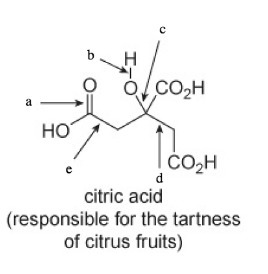
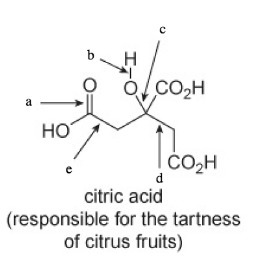
Citric acid is a naturally occurring compound. what orbitals are used to form each indicated bond? be sure to answer all parts.

Chemistry
2 answers:
Tema [17]2 years ago
6 0

Answer : The orbitals that are used to form each indicated bond in citric acid is given below as per the attachment.

Answer 1) σ Bond a: C sp^{2}  O sp^{2} .

Explanation : The sigma bonds in the 'a' position involves carbon atom which undergoes sp^{2} hybridisation and has sp^{2} orbitals of carbon and as well as oxygen atoms involved in the bonding.

Answer 2) π Bond a: C has π orbitals and  O also has π  orbitals.

Explanation : The pi-bond at the 'a'position has carbon and oxygen atoms which undergoes pi-bond formation. And has pi orbitals of oxygen and carbon involved in the bonding process.

Answer 3) Bond b: O sp^{3}  H has only S orbital involved in bonding.

Explanation : The bonding at 'b' position involves oxygen and hydrogen atoms in it. It has sp^{3} hybridized orbitals and S orbital of hydrogen involved in the bonding.

Answer 4) Bond c:   C sp^{3} O sp^{3}

Explanation : The bonding involved at 'c' position has carbon and oxygen atoms involved in it. Both the atoms involves the orbitals of sp^{3} hybridized bonds.

Answer 5) Bond d:   C sp^{3}  C sp^{3}

Explanation : The bonding involved at the position of 'd' involves two carbon atoms. Therefore, they undergo sp^{3} hybridization. The orbitals involved in this hybridization are also sp^{3}.

Answer 6) Bond e:  C1 containing O sp^{2}    C2 sp^{3}

Explanation : The bonding at the 'e' position involves two carbon atoms on is containing oxygen with double bonds and the C2 carbon atom. The carbon containing oxygen has sp^{2} hybridized orbitals involved in the bonding; whereas C2 carbon ha sp^{3} orbitals.

KonstantinChe [14]2 years ago
5 0

Different orbitals are used to form each indicated bond.

Further explanation

Citric acid:

Citrus fruits (oranges, Lemon and guava, etc.) have weak organic acid which is known as citric acid. It is used as a natural preservative and also used to give acidic flavor to soft drinks and food.  

Orbitals

Atomic orbitals are regions of space around the nucleus of an atom where is the most probability of founding an electron. The atomic orbitals are involved in the formation of a covalent bond. The orbitals which are commonly filled are s, p, d and f orbitals.

Orbitals used to form bond

Following are the orbitals used to form each bond in citric acid.

  1. Ϭ Bond between a carbon and oxygen is C sp2 and O sp2 .
  2. Π Bond between carbon and oxygen is C Π and O Π .
  3. Bond between an oxygen and hydrogen of hydroxyl group O sp3 H s.
  4. Bond between carbon and oxygen of hydroxyl group C sp3 and O sp3.
  5. Bond between carbon and carbon C sp3 and C sp3.
  6. Bond between carbon and carbon of carboxyl group C1 sp2 C2 sp3.

Answer details

Subject: Chemistry

Level: College

Keywords

  • Citric acid
  • Orbitals
  • Orbitals used to form bond

Learn more to evaluate

brainly.com/question/11073849

brainly.com/question/10885719

You might be interested in
2. If 2.50g of sodium hydroxide is being reacted with 4.30g of magnesium chloride, how many grams of magnesium hydroxide would b
Virty [35]

Answer:

1.822 g of magnesium hydroxide would be produced.

Explanation:

Balanced reaction: 2NaOH+MgCl_{2}\rightarrow Mg(OH)_{2}+2NaCl

     Compound                                 Molar mass (g/mol)

         NaOH                                           39.997

         MgCl_{2}                                           95.211

        Mg(OH)_{2}                                        58.3197

So, 2.50 g of NaOH = \frac{2.50}{39.997} mol of NaOH = 0.0625 mol of NaOH

      4.30 g of MgCl_{2}  = \frac{4.30}{95.211} mol of MgCl_{2} = 0.0452 mol of MgCl_{2}

According to balanced equation-

2 mol of NaOH produce 1 mol of Mg(OH)_{2}    

So, 0.0625 mol of NaOH produce (\frac{0.0625}{2}) mol of NaOH or 0.03125 mol of NaOH

1 mol of MgCl_{2} produces 1 mol of Mg(OH)_{2}

So, 0.0452 mol of MgCl_{2} produce 0.0452 mol of Mg(OH)_{2}

As least number of moles of Mg(OH)_{2} are produced from NaOH therefore NaOH is the limiting reagent.

So, amount of Mg(OH)_{2} would be produced = 0.03125 mol

                                                                           = (0.03125\times 58.3197) g

                                                                           = 1.822 g

6 0
2 years ago
Aqueous hydrochloric acid reacts with aqueous sodium sulfite to produce aqueous sodium chloride and aqueous sulfurous acid. Writ
ohaa [14]

Answer:

2HCl(aq) + Na2SO3(aq) —> 2NaCl(aq) + H2SO3(aq)

Explanation:

HCl(aq) + Na2SO3(aq) —> NaCl(aq) + H2SO3(aq)

Let us balance the equation. This is illustrated below:

There are 2 atoms of Na on the left side of the equation and 1atom on the right side. It can be balance by putting 2 in front of NaCl as shown below:

HCl(aq) + Na2SO3(aq) —> 2NaCl(aq) + H2SO3(aq)

Now, we have 2 atoms of Cl on the right side and 1 atom on the left side. Thus, it can be balance by putting 2 in front of HCl as shown below:

2HCl(aq) + Na2SO3(aq) —> 2NaCl(aq) + H2SO3(aq)

A careful look at the equation proved that the equation is balanced as the numbers of the different atoms of the element on both side of the equation are the same.

4 0
2 years ago
Read 2 more answers
When the solutes are evenly distributed throughout a solution, we say the solution has reached _______. when the solutes are eve
german
If the solutes are dispersed evenly in their particular solvent we say that the solution has reached diffusion I believe.
5 0
2 years ago
how do i get the bond dissociation energy to break 7 C-H bond(s) in 1 mole of propane (CH₃CH₂CH₃) molecules is
stiv31 [10]

Answer:

2877kJ/mol

Explanation:

Hello.

In this case, since the bond energy per C-H bond is 411 kJ/mol and we of course avoid the C-C bond since we are asked to compute the energy to break 7 C-H bonds, the 411 kJ/mol are multiplied by 7 as shown below:

7*411kJ/mol\\\\=2877kJ/mol

Thus, we obtain the required bond dissociation energy. Note that propane CH₃-CH₂-CH₃ has seven C-H bonds; 3 from the first CH₃, two from the CH₂ and 3 from the last CH₃.

Best regards.

6 0
2 years ago
A piece of aluminum foil 1.00cm square and 0.590mm thick is allowed to react with bromine to form aluminum bromide. Part A How m
nalin [4]

Answer:

Part A: 5.899x10^-3 moles of Al

Part B: 1.573 g of AlBr3

Explanation:

Part A: We have to obtain the volume of the piece of aluminium; all sides of the square must be in cm. Then, use the density to obtain the mass.

0.590 mm  (\frac{1 cm}{10 mm}) = 0.059 cm

V= lxlxl= (1cm)(1cm)(0.059 cm)= 0.059 cm^3.

0.059 is the volume of the Al udes for the reaction. Now, to oabtain the moles:

0.059 cm^3 Al(\frac{2.699 g Al}{1 cm^3 Al})(\frac{1 mol Al}{27 g Al})= 5.899x10^-3 moles

Part B: To obatin the mass of AlBr3, we need the balanced chemical equation:

                                               2Al + 3Br2 → 2AlBr3

We assume bromine (Br2) is in excess, therefore, we calculate the aluminum bromide formed from the Al:

5.898 x 10^-3 moles Al (\frac{2 moles AlBr3}{2 moles Al}) (\frac{266.7 g AlBr3}{1 mol AlBr3}) = 1.573 g of Al

5 0
2 years ago
Other questions:
  • How to correctly solve this problem : 4.05Kg+567.95g+100.1g correct and best way
    10·1 answer
  • How many cycles of the synthesis pathway are needed to produce myristic acid, c13h27cooh?
    7·1 answer
  • Which of these statements describes a limitation of the Treaty on Plant Genetic Resources?
    14·2 answers
  • How can we increase the rate of collisions between the reactants in this reaction?
    10·2 answers
  • avogadro's number of representative particles is equal to one___. A) kilogram B)gram C)kelvin D)mole
    6·2 answers
  • What is the driving force in the wittig reaction?
    5·1 answer
  • El amoniaco y el fluor reaccionan para formar tetrafluoruro de dinitrogeno y fluoruro de hidrogeno. segun la reaccion: NH3 + F2
    12·1 answer
  • Many enzymes are inhibited irreversibly by heavy metal ions such as Hg2+ , Cu2+ , or Ag+ , which can react with essential sulfhy
    11·1 answer
  • The reaction between sulfur dioxide and oxygen is reversible.
    8·1 answer
  • The energy difference between the 5d and 6s sublevels in gold accounts for its color. Assuming this energy difference is about 2
    14·1 answer
Add answer
Login
Not registered? Fast signup
Signup
Login Signup
Ask question!