answer.
Ask question
Login Signup
Ask question
All categories
  • English
  • Mathematics
  • Social Studies
  • Business
  • History
  • Health
  • Geography
  • Biology
  • Physics
  • Chemistry
  • Computers and Technology
  • Arts
  • World Languages
  • Spanish
  • French
  • German
  • Advanced Placement (AP)
  • SAT
  • Medicine
  • Law
  • Engineering
nikitadnepr [17]
2 years ago
3

The Lengths of the shorter altitude and the shorter side of parallelogram are 9cm and root 82 cm, respectively. The Length of a

longer diagonal is 15 cm. What is the area of this parallelogram

Mathematics
1 answer:
levacccp [35]2 years ago
7 0

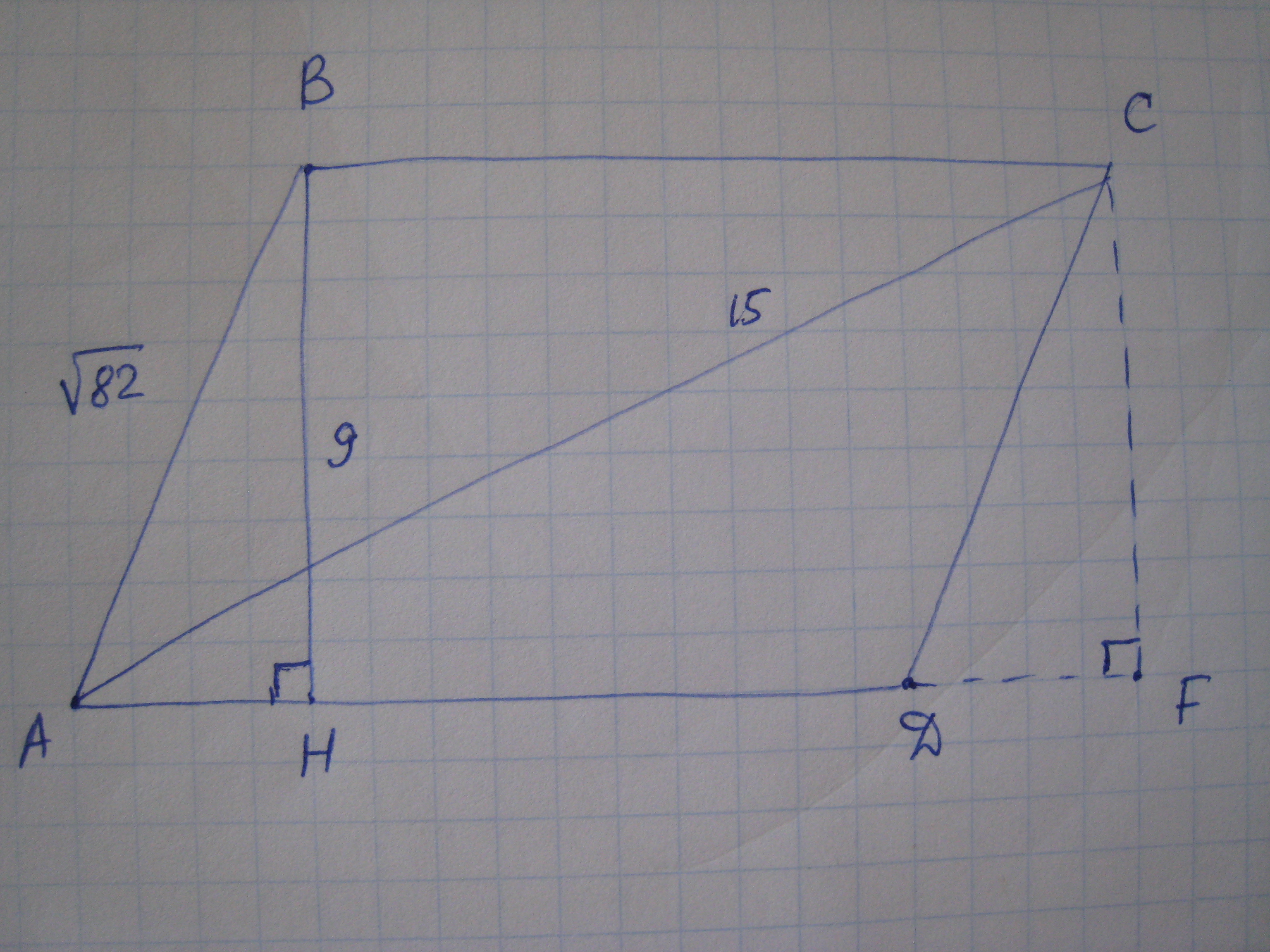
Consider parallelogram ABCD. The shorter sides are AB and CD, so AB=CD=\sqrt{82} cm.

The shorter altitudes are BH=CF=9 cm.

1. Consider right triangle FCD:

CD^2=DF^2+CF^2,

\sqrt{82}^2=9^2+FD^2,\\ \\FD^2=82-81=1,\\ \\FD=1 cm.

2. Consider right triangle FCA:

CA^2=DF^2+FA^2,

15^2=9^2+FA^2,\\ \\FA^2=225-81=144,\\ \\FA=12 cm.

3.

FA=AD+FD,\\ \\AD=12-1=11 cm.

4. Therefore, the area of parallelogram ABCD is

A_{ABCD}=AD\cdot BH=11\cdot 9=99 sq. cm.

Answer: 99 sq. cm.


You might be interested in
Solve for q. 22q+73 > 52q + 63
sammy [17]
Hey!

Let's write the problem.
22q+73\ \textgreater \ 52q+63
Subtract 73 from both sides.
22q+73-73\ \textgreater \ 52q+63-73
22q\ \textgreater \ 52q-10
Subtract 52q from both sides.
22q-52q\ \textgreater \ 52q-10-52q
-30q\ \textgreater \ -10
Since we don't want negative, we will multiply both sides by -1.
\left(-30q\right)\left(-1\right)\ \textless \ \left(-10\right)\left(-1\right)
30q\ \textless \ 10
Divide both sides by 30.
\frac{30q}{30}\ \textless \ \frac{10}{30}

Our final answer would be,
q\ \textless \ \frac{1}{3}

Thanks!
-TetraFish 
3 0
2 years ago
A common assumption in modeling drug assimilation is that the blood volume in a person is a single compartment that behaves like
mixas84 [53]

Answer:

a) \mathbf{\dfrac{dx}{dt} = 30 - 0.015 x}

b) \mathbf{x = 2000 - 2000e^{-0.015t}}

c)  the  steady state mass of the drug is 2000 mg

d) t ≅ 153.51  minutes

Step-by-step explanation:

From the given information;

At time t= 0

an intravenous line is inserted into a vein (into the tank) that carries a drug solution with a concentration of 500

The inflow rate is 0.06 L/min.

Assume the drug is quickly mixed thoroughly in the blood and that the volume of blood remains constant.

The objective of the question is to calculate the following :

a) Write an initial value problem that models the mass of the drug in the blood for t ≥ 0.

From above information given :

Rate _{(in)}= 500 \ mg/L  \times 0.06 \  L/min = 30 mg/min

Rate _{(out)}=\dfrac{x}{4} \ mg/L  \times 0.06 \  L/min = 0.015x \  mg/min

Therefore;

\dfrac{dx}{dt} = Rate_{(in)} - Rate_{(out)}

with respect to  x(0) = 0

\mathbf{\dfrac{dx}{dt} = 30 - 0.015 x}

b) Solve the initial value problem and graph both the mass of the drug and the concentration of the drug.

\dfrac{dx}{dt} = -0.015(x - 2000)

\dfrac{dx}{(x - 2000)} = -0.015 \times dt

By Using Integration Method:

ln(x - 2000) = -0.015t + C

x -2000 = Ce^{(-0.015t)

x = 2000 + Ce^{(-0.015t)}

However; if x(0) = 0 ;

Then

C = -2000

Therefore

\mathbf{x = 2000 - 2000e^{-0.015t}}

c) What is the steady-state mass of the drug in the blood?

the steady-state mass of the drug in the blood when t = infinity

\mathbf{x = 2000 - 2000e^{-0.015 \times \infty }}

x = 2000 - 0

x = 2000

Thus; the  steady state mass of the drug is 2000 mg

d) After how many minutes does the drug mass reach 90% of its stead-state level?

After 90% of its steady state level; the mas of the drug is 90% × 2000

= 0.9 × 2000

= 1800

Hence;

\mathbf{1800 = 2000 - 2000e^{(-0.015t)}}

0.1 = e^{(-0.015t)

ln(0.1) = -0.015t

t = -\dfrac{In(0.1)}{0.015}

t = 153.5056729

t ≅ 153.51  minutes

4 0
2 years ago
In 1900, there was an Olympic underwater swimming event. The score was calculated by giving one point for each second the swimme
mash [69]
68.4*1= 68.4   60.2*2= 120.4   68.4+120.4=    188.8
4 0
2 years ago
Read 2 more answers
A student claims that the expression “9 times the sum of a number and 13” is translated to the algebraic expression 9n + 13. Is
Alex73 [517]
9*13+n 
I think that is correct, try and split up the question. 
9* 
A sum of a number AND 13
So that means that 9 is multiplying by the SUM (adding) of 13 and a number (n)
8 0
2 years ago
Read 2 more answers
In the diagram, the circle will be dilated by a scale factor of 3 about the origin. The points C, A and B map to C, A and B'afte
bagirrra123 [75]
The answer is A 8.15
8 0
2 years ago
Other questions:
  • Tim is designing a logo. The logo is a polygon. Whose shape is a square attached to an equilateral triangle. The square and the
    13·1 answer
  • Bernita and Derek each plot a number on a number line. The numbers are unique but have the same absolute value. The sum of the a
    11·2 answers
  • Strawberries cost $2 per pound. Kate buys 5 pounds and gets 20% discount on the total cost. How much does Kate pay for the straw
    10·1 answer
  • Which equation results from adding the equations in this system?
    9·2 answers
  • According to the Journal of the American Medical Association (JAMA), hospitals that routinely staff with 1:8 nurse-to-patient ra
    11·2 answers
  • A population of 200 animals is decreasing by 4% per year. At this rate, in how many years will the population be less than 170?
    15·2 answers
  • Which values represent solutions to Cosine (StartFraction pi Over 4 EndFraction minus x) = StartFraction StartRoot 2 EndRoot Ove
    14·1 answer
  • The most important component of a physical structure is a solid foundation on which the rest of the structure sits. A strong fou
    13·1 answer
  • PLEASE HELP ME!!!!!!!!!!!
    11·1 answer
  • Josh travels frequently. For a particular airline, it takes 20 minutes for the first bag to arrive in baggage claim after a flig
    9·1 answer
Add answer
Login
Not registered? Fast signup
Signup
Login Signup
Ask question!