answer.
Ask question
Login Signup
Ask question
All categories
  • English
  • Mathematics
  • Social Studies
  • Business
  • History
  • Health
  • Geography
  • Biology
  • Physics
  • Chemistry
  • Computers and Technology
  • Arts
  • World Languages
  • Spanish
  • French
  • German
  • Advanced Placement (AP)
  • SAT
  • Medicine
  • Law
  • Engineering
bazaltina [42]
2 years ago
4

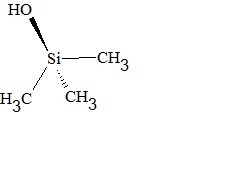
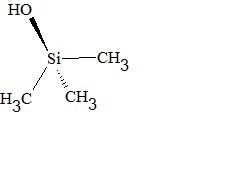
When sand is coated with a layer of trimethylhydroxysilane, (ch3)3sioh, it repels water and can no longer get wet. Hydrophobic s

and (aka, magic sand) is fun to play with, but it can also have useful applications in agriculture to reduce water consumption.8 predict the geometry for the silicon atom in trimethylhydroxysilane?

Chemistry
1 answer:
jek_recluse [69]2 years ago
4 0

The central atom in trimethylhydroxysilane is silicon

The number of valence electrons in silicon = 4

The hybridization can be calculated using the formula

number of total electrons = 0.5 X (number of valence electrons -(charge) + number of single bonded atoms to the central atom)

Number of total electrosn = 0.5 (4+4) = 4

hence hybridization of Si = sp3

There is no lone pair on Si

So the shape / geometry of trimethylhydroxysilane = Tetrahedral


You might be interested in
Question 6 of 15
Georgia [21]

Answer:

c

Explanation:

hypothesis is a scientific guess made be scientist in order to give account for the natural phenomenon

4 0
2 years ago
A student sets up the following equation to convert a measurement. (The stands for a number the student is going to calculate.)
Aliun [14]

The question is incomplete, here is the complete question:

A student sets up the following equation to convert a measurement. (The stands for a number the student is going to calculate.) Fill in the missing part of this equation.

23.Pa.cm^3=?kPa.m^3

<u>Answer:</u> The measurement after converting is 23\times 10^{-9}kPa.m^3

<u>Explanation:</u>

We are given:

A quantity having value 23.Pa.cm^3

To convert this into kPa.m^3, we need to use the conversion factors:

1 kPa = 1000 Pa

1m^3=10^6cm^3

Converting the quantity into kPa.m^3, we get:

\Rightarrow 23.Pa.cm^3\times (\frac{1kPa}{1000Pa})\times (\frac{1m^3}{10^6cm^3})\\\\\Rightarrow 23\times 10^{-9}kPa.m^3

Hence, the measurement after converting is 23\times 10^{-9}kPa.m^3

6 0
2 years ago
The balanced equation shows how sodium chloride reacts with silver nitrate to form sodium nitrate and silver chloride. NaCl + Ag
Verdich [7]
<span>NaCl First calculate the molar mass of NaCl and AgNO3 by looking up the atomic weights of each element used in either compound Sodium = 22.989769 Chlorine = 35.453 Silver = 107.8682 Nitrogen = 14.0067 Oxygen = 15.999 Now multiply the atomic weight of each element by the number of times that element is in each compound and sum the results For NaCl 22.989769 + 35.453 = 58.44277 For AgNO3 107.8682 + 14.0067 + 3 * 15.999 = 169.8719 Now calculate how many moles of each substance by dividing the total mass by the molar mass For NaCl 4.00 g / 58.44277 g/mol = 0.068443 mol For AgNO3 10.00 g / 169.8719 g/mol = 0.058868 Looking at the balanced equation for the reaction, there is a 1 to 1 ratio in molecules for the reaction. Since there is a smaller number of moles of AgNO3 than there is of NaCl, that means that there will be some NaCl unreacted, so the excess reactant is NaCl</span>
8 0
2 years ago
For no2−, write an equation that shows how the anion acts as a base. express your answer as a chemical equation. identify all of
katrin [286]
Hello!

Bases are defined by Arrhenius as substances which release OH⁻ ions when dissolved in water. NO₂⁻ complies with this definition by the chemical reaction that is shown below:

 NO₂⁻(aq) + H₂O (l) HNO₂ (aq) + OH⁻(aq)

Have a nice day!
5 0
2 years ago
Read 2 more answers
How many molecules are in 79g of fe2o3
horrorfan [7]
Convert grams —> mols and then mols —> atoms

We know that there are 6.02 x 10^23 atoms/mol

And we know that there are about 160 grams of fe2o3 per mol

So (79g fe2o3)/(160 g/mol) = .49 mol fe2o3

Now we use avogadro’s number to do

(.49 mol fe2o3)/(6.02 x 10^23 atoms/mol) = the answer.

I’ll leave the easy math to you.

7 0
2 years ago
Other questions:
  • According to reference table J, which of these metals would react most readily with 1.0 M HCl to produce H2(g)
    10·1 answer
  • How many kilowatt-hours of electricity are used to produce 4.50 kg of magnesium in the electrolysis of molten mgcl2 with an appl
    7·1 answer
  • Determine the number of atoms in 1.85 ml of mercury. (the density of mercury is 13.5 g/ml.)
    15·1 answer
  • When you open a bottle of a soft drink and leave it open, the drink eventually goes flat. this happens because the equilibrium b
    6·1 answer
  • What is the oh- in a solution with a poh of 5.71
    12·1 answer
  • Which statements correctly describe the process of nuclear fusion?
    13·2 answers
  • Which statement is true about molarity and percent by mass?
    12·2 answers
  • Elements whose names end with âium are usually metals; sodium is one example. Identify a nonmetal whose name also ends with âium
    14·1 answer
  • A magnesium ion, Mg2+, with a charge of 3.2×10⁻¹⁹C and an oxide ion, O2−, with a charge of −3.2×10⁻¹⁹C, are separated by a dista
    6·1 answer
  • How many molecules of sulfur trioxide would react with 68.9 L of water at STP to produce sulfuric acid? SO3 + H2O H2(SO4)
    11·1 answer
Add answer
Login
Not registered? Fast signup
Signup
Login Signup
Ask question!