answer.
Ask question
Login Signup
Ask question
All categories
  • English
  • Mathematics
  • Social Studies
  • Business
  • History
  • Health
  • Geography
  • Biology
  • Physics
  • Chemistry
  • Computers and Technology
  • Arts
  • World Languages
  • Spanish
  • French
  • German
  • Advanced Placement (AP)
  • SAT
  • Medicine
  • Law
  • Engineering
ioda
2 years ago
7

How many kilowatt-hours of electricity are used to produce 4.50 kg of magnesium in the electrolysis of molten mgcl2 with an appl

ied emf of 5.00 v?
Chemistry
1 answer:
ratelena [41]2 years ago
3 0
First, we need to determine the half reaction of magnesium. It would be expressed as:

Mg2+ + 2e- = Mg

Given the mass of magnesium metal that is produced, we calculate the total charge of the electrolysis by the relations we can get from the half reaction. We do as follows:

4.50 kg Mg ( 1000 g / 1 kg ) ( 1 mol / 24.305 g ) ( 2 mol e- / 1 mol Mg ) ( 96500 C / 1 mol e- ) = 35733388.2 C

We are given the applied EMF in units of V. This value is equal to J/C. So, 5 V is equal to 5 J/C.

35733388.2 C (5 J/C) = 178666941 J
178666941 J ( 1 kW-h / 3.6x10^6 J ) = 49.63 kW-h
You might be interested in
The weight percent of concentrated HClO4(aq) is 70.5% and its density is 1.67 g/mL. What is the molarity of concentrated HClO4
ollegr [7]

Answer:

[HClO₄] = 11.7M

Explanation:

First of all we need to know, that a weight percent represents, the mass of solute in 100 g of solution.

Let's convert the mass to moles → 70.5 g . 1mol/100.45 g = 0.702 moles

Now we can apply the density to calculate the volume.

Density always refers to solution → Solution density = Solution mass / Solution volume

1.67 g/mL = 100 g / Solution volume

Solution volume = 100 g / 1.67 g/mL → 59.8 mL

To determine molarity (mol/L) we must convert the mL to L

59.8 mL . 1L/1000mL = 0.0598 L

Molarity → Moles of solute in 1L of solution → 0.702 mol / 0.0598 L = 11.7M

8 0
2 years ago
Compare properties of covalent compounds and ionic compounds. Which of the following properties differ because of differences in
____ [38]

Answer:

The answer to your question is below

Explanation:

                                ionic compounds                  covalent compounds

1.- Mass                          it does not depend on the type of compound

2.- Conductivity      -conduct electricity               - do not conduct electricity

                                  in solution.

3.- Color                  - Shiny                                     - opaque

4.- Melting point     - high                                       - lower than ionic compounds

5.- Boiling point     - high                                        - lower than ionic compounds

6.- flammability      - not flammable                       - flammable

6 0
2 years ago
Read 2 more answers
According to reference table adv-10, which reaction will take place spontaneously?
olga_2 [115]
Missing table!! write the elements with the first letter of the symbol with Upper Caps letters!!!

http://www.chemeddl.org/services/moodle/media/QBank/GenChem/Tables/EStandardTable.htm

<span>Ni2+ +Pb(s) → Ni(s) + Pb2+
</span>The potential of the oxidation of Pb(s) --> Pb2+(aq) is 0.126 V 
The potential of the reduction go Ni2+(aq) --> Ni(s) is -0.25 V 

<span>Add the two together and the potential for the reaction is -0.124 V (NO SPONTANEOUS THE SIGN IS NEGATIVE)

</span><span>au3+ + al(s) → au(s) + al3+Au3+(aq) ->   Au(s)  +1.5 VAl -> Al3+  +1.66VV= 3.16 (SPONTANEOUS THE SIGN OF THE PONTENTIAL IS POSITIVE)</span><span>Sr2+ + Sn(s) → Sr(s) + Sn2+
</span>
Sr2+(aq) + 2 e–  <span>  Sr(s)  V= -2.89V
</span>Sn -> Sn2+ V= 0.14 V
V= -2.75 V (no spontaneous)

<span>Fe2+ + Cu(s) → Fe(s) + Cu2+
</span>Fe2+(aq) + 2 e–<span>  </span><span>  Fe(s)  V= -0.44 V
</span>Cu -> C2+  V = - 0.337V

V= - 0.777V (no spontaneous)
5 0
2 years ago
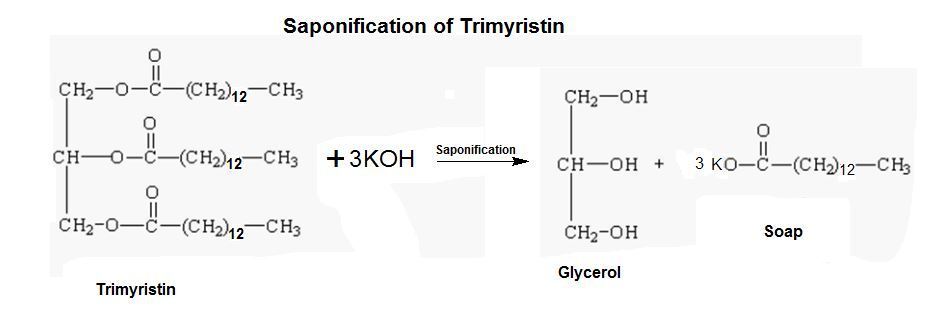
Draw the condensed structural formula in the equation for the saponification of trimyristin with koh
Ludmilka [50]

Explanation: Saponification reaction is a reaction in which hydrolysis of fats takes place under basic conditions giving glycerol and a salt of corresponding fatty acid.

We are given a Fatty acid called as Trimyristin.

Its reaction with KOH leads to the formation of soap and is given by the equation:

Trimyristin+3 KOH\rightarrow Glycerol+Soap

C_{45}H_{86}O_6+3KOH\rightarrow C_3H_5(OH)_3+3CH_3(CH_2)_{12}CO_2K

The condensed structural formula for the equation is given in the image attached.

4 0
2 years ago
Read 2 more answers
14) The central iodine atom in the ICl4- ion has __________ nonbonded electron pairs and __________ bonded electron pairs in its
masha68 [24]

Answer:

Two non bonded electron pairs and four bonded electron pairs

Explanation:

An image of the compound as obtained from chemlibretext is attached to this answer.

The ion ICl4- ion, is an AX4E2 ion. This implies that there are four bond pairs and two lone pairs of electrons. As expected, the shape of the ion is square planar since the lone pairs are found above and below the plane of the square. This is clear from the image attached.


7 0
2 years ago
Other questions:
  • How many molecules are in 13.5g of sulfur dioxide, SO2?
    6·2 answers
  • What did the Romans build as a step toward environmental management? The Romans built to carry water from abundant water areas t
    13·2 answers
  • Each of the following substances is a liquid at –50°C. Place these liquids in order of increasing vapor pressure: dimethyl ether
    9·1 answer
  • If, as a pioneer, you wished to warm your room by taking an object heated on top of a pot-bellied stove to it, which of the foll
    9·1 answer
  • If matter is uniform throughout and cannot be separated into other substances by physical processes, but can be decomposed into
    7·1 answer
  • Draw the major organic product for the reaction of 1-phenylpropan-1-one with the provided phosphonium ylide in part 1. In part 2
    9·2 answers
  • when switch s is closed positive ions will undergo 1) oxidation at electrode B 2) oxidation at electrode A 3) reduction at elect
    9·1 answer
  • Addition of an excess of lead (II) nitrate to a 50.0mL solution of magnesium chloride caused a formation of 7.35g of lead (II) c
    10·1 answer
  • The enthalpy of Sodium is 235 calories. The enthalpy Chlorine is 435 calories. The enthalpy of Sodium chloride 670 joules, what
    6·1 answer
  • In 2021, you were given a 100. g wine sample to verify its age. Using tritium dating you observe that the sample has 0.688 decay
    14·1 answer
Add answer
Login
Not registered? Fast signup
Signup
Login Signup
Ask question!