answer.
Ask question
Login Signup
Ask question
All categories
  • English
  • Mathematics
  • Social Studies
  • Business
  • History
  • Health
  • Geography
  • Biology
  • Physics
  • Chemistry
  • Computers and Technology
  • Arts
  • World Languages
  • Spanish
  • French
  • German
  • Advanced Placement (AP)
  • SAT
  • Medicine
  • Law
  • Engineering
lara31 [8.8K]
2 years ago
9

Each of the following substances is a liquid at –50°C. Place these liquids in order of increasing vapor pressure: dimethyl ether

(CH3OCH3), propane (C3H8), and ethanol (CH3CH2OH).a) propane < ethanol < dimethyl etherb)ethanol < propane < dimethyl etherc)propane < dimethyl ether < ethanold)ethanol < dimethyl ether < propanee)dimethyl ether < ethanol < propane
Chemistry
1 answer:
Phoenix [80]2 years ago
6 0

Answer:

Increasing vapor pressure order -

propane > dimethyl ether > ethanol

Explanation:

Vapor pressure - the pressure exerted the gaseous molecules , on the walls of the container is called the vapor pressure.

Boiling point - the temperature at which the the vapor pressure of the liquid equals the external atmospheric pressure.

Both boiling point and vapor pressure are linked by the inter molecular forces between the atoms.

The compound with stronger inter molecular forces are tightly held , hence more amount of energy is required to vaporize. Therefore, higher boiling point , and in turn the vapor pressure will be lower .

And the compound with weaker inter molecular forces are loosely held , hence less amount of energy is required to vaporize. Therefore, lower boiling point , and in turn the vapor pressure will be higher .

Therefore,

Ethanol has lowest vapor pressure , because at lower temperature , it has H - bonding , hence, its boiling point is more, therefore, less vapor pressure.

Dimethyl ether has vapor pressure more than ethanol as it has weaker dipole - dipole interactions as compared to strong H - bonding .

Propane has maximum vapor pressure among all , because of lower molecular mass than others , it can easily vaporize into vapors.

Hence,

Increasing vapor pressure order -

propane > dimethyl ether > ethanol

You might be interested in
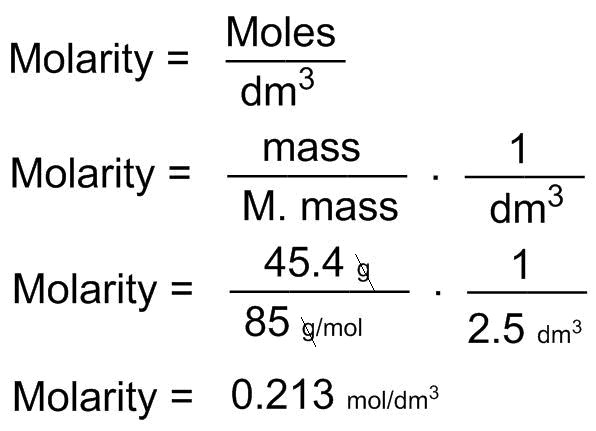
Calculate the molarity of a solution made by adding 45.4 g of nano3 to a flask and dissolving it with water to create a total vo
aleksandr82 [10.1K]
Solutions are made up of two non reacting species called solute and solvent. The amount of solute in solvent is known as concentration of that solute. Concentration is often measured in Molarity. Molarity is the amount of solute dissolved in 1 dm3 of solution. Answer to your question is as follow;

3 0
2 years ago
Read 2 more answers
The chemical formula for cesium oxide is Cs2O. What is the charge of cesium? +1 +2 –1 –2
aalyn [17]
The Charge Of Cesium Is +1
5 0
2 years ago
Read 2 more answers
Hydrogen sulfide (H2S) is a common and troublesome pollutant in industrial wastewaters. One way to remove H2S is to treat the wa
Kryger [21]

Explanation:

As the given reaction is as follows.

     H_{2}S(aq) + Cl_{2}(aq) \rightarrow S(s) + 2H^{+}(aq) + 2Cl^{-}(aq)

So, according to the balanced equation, it can be seen that rate of formation of Cl^{-} will be twice the rate of disappearance of H_{2}S .

And, it is known that rate of disappearance of reactant will be negative and rate of formation of products will be positive value.

This means that,

Rate of the reaction = -Rate of disappearance of H_{2}S

                 = k[H_{2}S][Cl_{2}]

                 = (3.5 \times 10^{-2}) \times (2 \times 10^{-4}) \times (2.8 x 10^{-2})

                 = 1.96 \times 10^{-7} M/s

Therefore, calculate the rate of formation of Cl^{-} as follows.

Rate of formation of Cl^{-} = 2 \times 1.96 \times 10^{-7}

                                        = 3.92 \times 10^{-7} M/s

Thus, we can conclude that the rate of formation of Cl^{-} is 3.92 \times 10^{-7} M/s.

5 0
2 years ago
When HCl(g) reacts with NH3(g) to form NH4Cl(s) , 176 kJ of energy are evolved for each mole of HCl(g) that reacts. Write a bala
Orlov [11]

Answer:

q = -176kJ

Explanation:

HCl and NH3 reacts as following to NH4Cl

HCl(g) + NH3(g)=========>NH4Cl(s)   : ΔH = -176 KJ

Clearly,

ENERGY IS EVOLVED MEANING IT IS A EXOTHERMIC REACTION .

therefore, the value of heat evolved as q = -176kJ

8 0
2 years ago
10.000g of boron (B) combines with hydrogento form 11.554g of a pure compound. What is the empirical formula of this compound?
Citrus2011 [14]

Answer:

B3H5

Explanation:

The law of conservation of mass states that matter in an closed system is neither created nor destroyed by physical transformations or chemical reactions but changes from one form to the other.

That is, the sum of masses of the reactants = The sum of masses of the product

10.00g of Boron + x grams of Hydrogen = 11.55g of the product

Mass of hydrogen = 11.55 - 10.00 = 1.55g

Molar mass of Boron = 10.811g

Molar mass of Hydrogen = 1.00784g

Number of moles of Boron = (mass of Boron)/(molar mass of Boron) = 10/10.811 = 0.9249 mols

Number of moles of Hydrogen = (mass of Hydrogen)/(molar mass of Hydrogen) = 1.55/1.00784 =1.5379mols

0.9249 mols of Boron combines with 1.5379mols of Hydrogen

Dividing both sides mols by 0.9249 gives

1 mole of Boron combines with 1.66266 mols of Hydrogen

Converting 1.66266 to fractions we have 1.66266 approximately 5/3

or 1 mole of Boron combines with 5/3 moles of Hydrogen

Multiplying both sides by 3 we have

3 moles of Boron combines with 5 moles of Hydrogen

Molecular formula of the compound is

B3H5

4 0
2 years ago
Other questions:
  • Table salt, NaCl, is an example of an amorphous solid.<br> TRUE<br> FALSE
    15·2 answers
  • An archeologist finds a 1.62 kg goblet that she believes to be made of pure gold. She determines that the volume of the goblet i
    13·1 answer
  • Magnesium has an atomic mass of 24.3. there are two isotopes of magnesium - one contains 12 neutrons and the other contains 13 n
    7·1 answer
  • Leaded gasoline contains an additive to prevent engine knocking. On analysis, the additive compound is found to contain carbon,
    13·1 answer
  • If 4.9 kg of CO2 are produced during a combustion reaction, how many molecules of CO2 would be produced?
    13·1 answer
  • Consider the following voltaic cell. Identify the anode and cathode, and indicate the direction of Na ion and NO3- ion flow from
    6·1 answer
  • A gas that has a volume of 28 liters, a temperature of 45C, And an unknown pressure has its volume increased to 34 liters and it
    8·1 answer
  • Determinación de pH Expresa las siguientes concentraciones de [H+ ] en función del pH • [H+] = 0.001 M • [H+] = 0.002 M • [H+] =
    11·1 answer
  • Quantization of energy lab Hypothesis: Make a prediction that describes the relationship between the composition of an unknown s
    13·2 answers
  • Is Plutonium an element, compound, solution* or heterogeneous mixture.
    7·1 answer
Add answer
Login
Not registered? Fast signup
Signup
Login Signup
Ask question!