answer.
Ask question
Login Signup
Ask question
All categories
  • English
  • Mathematics
  • Social Studies
  • Business
  • History
  • Health
  • Geography
  • Biology
  • Physics
  • Chemistry
  • Computers and Technology
  • Arts
  • World Languages
  • Spanish
  • French
  • German
  • Advanced Placement (AP)
  • SAT
  • Medicine
  • Law
  • Engineering
Simora [160]
2 years ago
12

Describe how transpiration and respiration show interactions among Earth's system

Chemistry
2 answers:
stepladder [879]2 years ago
7 0

Earth has 4 systems/ spheres which are known as Lithosphere(land), Biosphere(living things), Hydrosphere(water) and Atmosphere(air).

Transpiration is the process that interact with the Hydrosphere and Respiration is the process that interacts with the Atmosphere.

Transpiration is the process happening in plants which absorb and distribute water through their roots and release water in the form of vapors through their leaves. As this process involves Water, therefore this process interacts with the Hydrosphere.  

Respiration is the process in which plants convert carbon dioxide to oxygen as a part of photosynthesis which was then inhaled by the animals. As this process involves Air, therefore this process interacts with the Atmosphere.

melamori03 [73]2 years ago
5 0
Transpiration is when a plant and soil absorbs water while respiration is when plants convert carbon dioxide into oxygen.This shows interactions with Earth by talking about plants and rocks also part of soil which are part of Earth (unless you think they aren't)

i know this is not really helpful but i tried
You might be interested in
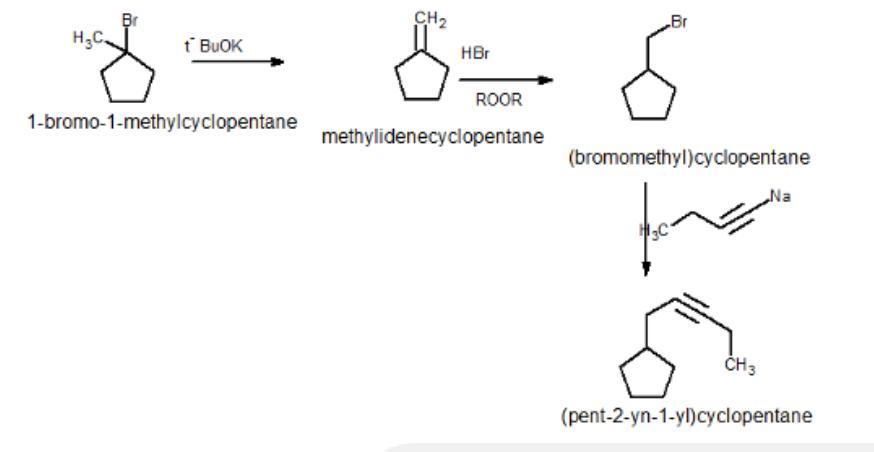
Question 096 Propose a three-step synthetic sequence to accomplish the transformation below. 1) HBr, ROOR; 2) t-BuOK; 3) CH3CH2C
salantis [7]

Complete Question

Question 096 Propose a three-step synthetic sequence to accomplish the transformation below.

Option 1 =>  1) HBr, ROOR; 2) t-BuOK; 3) CH3CH2CCNa

Option 2 => 1) NaOEt; 2) HBr, ROOR; 3) CH3CH2CCNa

Option 3 => 1) t-BuOK; 2) NaNH2; 3) CH3CH2CCNa

Option 4 => 1) CH3CH2CH2CH2Br; 2) NaOEt; 3) HBr, ROOR

Option 5 => 1) t-BuOK; 2) HBr, ROOR; 3) CH3CH2CCNa

Option 6 => 1) NaOEt; 2) NBS, hν; 3) NaSBu

Answer:

The correct option is option 5

Explanation:

   The mechanism of the reaction is shown on the first uploaded image

8 0
2 years ago
A student checks the air in her bicycle tires early in the morning when it is cool outside. If she measures it again later in th
Dmitry_Shevchenko [17]

Answer:

She will observe that the pressure on the tire is higher.

Explanation:

By the ideal gas law, the pressure and the temperature are directly proportional, so, if the temperature increases the pressure increases too:

PV = nRT (P is the pressure, V is the volume, n is the number of moles, R is the ideal gas constant, and T is the temperature).

The temperature is a measure of the average kinetic energy of the gas molecules, so when the temperature increases, the energy also increases, and the gas molecules will move more quickly, so they will collide more often between themselves and in the wall. Those collisions will be with more force because the velocity is higher.

So, the pressure will be higher, because it is the result of collisions of the gas molecules with the walls of the tire.

6 0
2 years ago
2. A compound with the following composition by mass: 24.0% C, 7.0% H, 38.0% F, and 31.0% P. what is the empirical formula
Svetach [21]

Answer:

C₂H₇F₂P

Explanation:

Given parameters:

Composition by mass:

                C = 24%

                H = 7%

                 F  = 38%

                 P  = 31%

Unknown:

Empirical formula of compound;

Solution :

The empirical formula is the simplest formula of a compound. To solve for this, follow the process below;

                                   C                          H                         F                   P

% composition

by mass                     24                          7                        38                  31

Molar mass                 12                           1                         19                  31

Number of

moles                       24/12                          7/1                    38/19           31/31

                                     2                               7                       2                   1

Dividing

by the

smallest                      2/1                             7/1                       2/1                1/1

                                     2                                7                        2                   1

           Empirical formula        C₂H₇F₂P

5 0
2 years ago
Explain why groups 14 and 15 are better representatives of mixed groups than groups 13 and 16
Brrunno [24]
<h3><u>Answer</u>;</h3>

Groups 14 and 15 each contain metals, nonmetals, and metalloids while Group 13 contains metals and a metalloid, and Group 16 contains metalloids and nonmetals.

<h3><u>Explanation;</u></h3>
  • Groups 13–16 of the periodic table contain one or more metalloids, in addition to metals, nonmetals, or both.
  • Unlike other groups of the periodic table, which contain elements in one class, groups 13–16 referred to as mixed groups contain elements in at least two different classes. In addition to metalloids, they also contain metals, nonmetals, or both.
  • <em><u>Group 14 also known as the carbon group contains carbon which is a non metal, silicon and germanium which are metalloids and tin and lead which are metals.</u></em>
  • <em><u>Group 15 also known as the Nitrogen group contains non metals such as oxygen, metalloid tellurium and a metal polonium.</u></em>
3 0
2 years ago
Keiko needs 100mL of a 5% acid solution for a science experiment. She has available a 1% solution and a 6% solution. How many mi
4vir4ik [10]

Answer:

Keiko should mix 20 mL 1% solution and 80 mL 6% solution for to make 100 mL 5% solution

Explanation:

There are 2 unknown values X= mL 6% solution and Y=1% solution. So, we need 2 equations:

1. Equation acid concentration. X mL 6% + Y mL 1% = 100 mL 5%

2. Equation solvent concentration X mL 94% + Y mL 99% = 100 mL 95%

When clearing X and Y :

(X mL 6%    +   Y mL 1%      =    100 mL 5%) (-15,7)

X mL 94%  +   Y mL 99%   =   100 mL 95%

_______________________________

 -                      Y  0.83       =   16.5

                        Y                =   19.9 mL 1% solution

Replace Y in anyone equation and X = 80 mL 6% solution

I hope to see been helpful

7 0
2 years ago
Read 2 more answers
Other questions:
  • A hydrogen atom has a diameter of about 10 nm. Express this diameter in micrometers, meters, and millimeters.
    5·2 answers
  • Write a complete step-by-step plan for dealing with broken glassware on the floor or lab table. Write your plan in list form in
    14·2 answers
  • To begin the experiment, 1.11g of methane CH4 is burned in a bomb calorimeter containing 1000 grams of water. The initial temper
    7·1 answer
  • Concentration of 10.00 mL of HBr if it takes 5 mL of a 0.253 M LiOH solution to<br> neutralize it?
    6·1 answer
  • What is the empirical formula? A compound is used to treat iron deficiency in people. It contains 36.76% iron, 21.11% sulfur, an
    9·2 answers
  • A ground state hydrogen atom absorbs a photon of light having a wavelength of 93.73 nm. It then gives off a photon having a wave
    10·1 answer
  • A solution is prepared by adding 100 mL of 1.0 M HC2H3O2 (aq) to 100 mL of 1.0 M NaC2H3O2 (aq). The solution is stirred and its
    8·1 answer
  • 7. If you fill a balloon with 5.2 moles of gas and it creates a balloon with a volume of 23.5 liters, how many moles are in a ba
    12·1 answer
  • Sugar is easily soluble in water and has a molar mass of 342.30 g/mol. What is the molar concentration of a 259.8 mL aqueous sol
    15·1 answer
  • How many moles of copper are in 6,000,000 atoms of copper?
    9·1 answer
Add answer
Login
Not registered? Fast signup
Signup
Login Signup
Ask question!