answer.
Ask question
Login Signup
Ask question
All categories
  • English
  • Mathematics
  • Social Studies
  • Business
  • History
  • Health
  • Geography
  • Biology
  • Physics
  • Chemistry
  • Computers and Technology
  • Arts
  • World Languages
  • Spanish
  • French
  • German
  • Advanced Placement (AP)
  • SAT
  • Medicine
  • Law
  • Engineering
Archy [21]
2 years ago
4

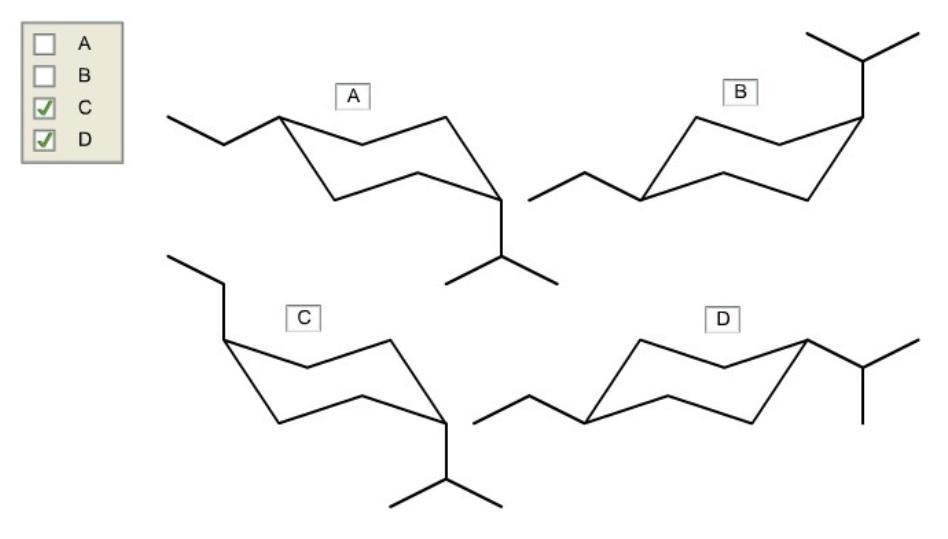
For trans-1-ethyl-4-isopropylcyclohexane, which structures represent the possible boat conformations?

Chemistry
2 answers:
noname [10]2 years ago
5 0

Answer:

C and D on the attached picture.

Explanation:

Hello,

At first, it is important to remember that a cyclohexane beat conformation is a possible shape adopted by this molecule.

In this case, boat conformations are said to be in equilibrium, it means a condition at which the opposing force or influence is balanced with the conformation force. In such way, no changes are noticed as a function of time due to their stability. Thus, the two structure attaining the equilibrium are C and D (attached picture) as result of the distancing between the included radicals.

Best regards.

Rainbow [258]2 years ago
3 0

The structure of boat confirmation for any cyclohexane be like as shown in figure (1)

The two substituents are

ethyl : at 1st position

isopropyl: at fourth position

So possible combinations for structures are shown in figure (2)

So the correct answer is

figure (3)


You might be interested in
An experiment requires that each student use an 8.5 cm length of magnesium ribbon. How many students can do the experiment if th
melisa1 [442]
570/8.5=67.0 58... you only have to take the natural part, si the answer is 67 students
7 0
2 years ago
Read 2 more answers
a radiator is filled with a mixture of 3.25kg ethylene glycol (C2H6O2) in 7.75kg of water. calculate the molality of this questi
Vladimir [108]
3.25 kg in g = 3.25 * 1000 = 3250 g

Molar mass C₂H₆O₂ =  62.0 g/mol

Mass solvent = 7.75 kg

Number of moles:

n = mass solute / molar mass

n = 3250  / 62.0 

n = 52.419 moles

Molality = moles of solute / kilograms of solvent

M = 52.419 / 7.75

M = 6.7637 mol/kg

hope this helps!
5 0
2 years ago
Robyn has been working on developing a new task to test the reaction time of athletes. As she begins to test athletes using her
umka2103 [35]

Answer:

Ceiling effect

Explanation:

A ceiling effect takes place when the test items are not challenging enough for a group of individuals. Thus, the test score will not increase for a subsample of people who may have improved because they have already attained the highest score that can be achieved on that test.

6 0
2 years ago
What is the emf produced in a 1.5 meter wire moving at a speed of 6.2 meters/second perpendicular to a magnetic field of strengt
valentinak56 [21]

Answer:

0.037 volts

Explanation:

5 0
2 years ago
Consider a saturated solution formed when 17.5 g of a solute dissolve in 28.3 g of a solvent, giving a total solution volume of
STALIN [3.7K]

Answer:

a) 38.2 % mass

b) 61.8 g solute/100 g solvent

c) 1.65 g/mL

Explanation:

Given the data:

mass of solute = 17.5 g

mass of solvent= 28.3 g

total solution volume= 27.8 mL

a)- mass percent= mass of solute/mass of solution x 100

mass of solution = mass solute + mass solvent = 17.5 g + 28.3 g = 45.8 g

mass % = 17.5 g/45.8 g x 100 = 38.2 % mass

b)- solubility = grams of solute/ 100 g solvent

                    = 17.5 g x (100 g /28.3 g solvent) = 61.8 g solute/100 g solvent  

c)- density = massof solution/total volumesolution  = 45.8 g/27.8 mL = 1.65 g/mL

7 0
2 years ago
Other questions:
  • How many kilojoules are required to melt 15g of ice at 0c and raise the temperature of the liquid that forms to 85c?
    12·2 answers
  • Looking at the same nonmetal group on the periodic table, how does the reactivity of an element in period 2 compare to the react
    12·2 answers
  • The reaction below has an equilibrium constant kp=2.2×10⁶ at 298 k. 2cof2(g)⇌co2(g)+cf4(g) calculate kp for the reaction below.
    15·2 answers
  • A 30.0 g sample of a metal was heated in a hot water bath to 80°c. it was then quickly transferred to a coffee-cup calorimeter.
    15·2 answers
  • Read the following passage.
    10·2 answers
  • A reaction A(aq)+B(aq)↽−−⇀C(aq) has a standard free‑energy change of −4.20 kJ/mol at 25 °C. What are the concentrations of A, B,
    8·1 answer
  • Choose ALL TRUE statements about calorimetry from the choices below:
    10·1 answer
  • Can one atom in this type of reaction win the "tug of war"? What might happen if it did?
    10·2 answers
  • Two stones resembling diamonds are suspected of being fakes. To determine if the stones might be real, the mass and volume of ea
    15·1 answer
  • What else is produced during the combustion of butane, C4H10?
    15·2 answers
Add answer
Login
Not registered? Fast signup
Signup
Login Signup
Ask question!