answer.
Ask question
Login Signup
Ask question
All categories
  • English
  • Mathematics
  • Social Studies
  • Business
  • History
  • Health
  • Geography
  • Biology
  • Physics
  • Chemistry
  • Computers and Technology
  • Arts
  • World Languages
  • Spanish
  • French
  • German
  • Advanced Placement (AP)
  • SAT
  • Medicine
  • Law
  • Engineering
attashe74 [19]
2 years ago
15

Emergency room health care tends to have a demand curve that is very steeply sloped, while elective surgery does not. Why? Also,

health care insurance and vacation spending tend to have a negative cross price elasticity of demand for many people. Why?
Business
1 answer:
RoseWind [281]2 years ago
3 0

<span>Emergency room health care demand is expensive because it tends to be more of a necessity in its time of use. On the other hand, elective surgery is the contrast because compared to ER; it is less of a necessity. People have more money to spend on vacations when healthcare insurance prices go down.</span>

You might be interested in
ADVANCED ANALYSIS Assume the following values for Figures 4.4a and 4.4b: Q1 = 20 bags. Q2 = 15 bags. Q3 = 27 bags. The market eq
Amiraneli [1.4K]

Answer:

Explanation:

a. Total surplus is the area bounded by points a, b, and c. To calculate total surplus, we use the following formula for the area of a triangle: Area = ½ × Base × Height. The area between the demand curve and the supply curve for the quantity ranging from 0 to 20 is the total economic surplus. This is a triangle with a base (best read off the price axis) of $80, which is the price difference at Q = 0, or between points a and c, and a height of 20 (the number of units purchased in equilibrium). Using these values, we have a total surplus of (1/2) × $80 × 20 = $800.

The consumer surplus is the area between the demand curve and the equilibrium price line. Here we have a base of $40 (the price difference between the demand schedule price at Q = 0, which is $85, and the equilibrium price of $45). The height of the triangle is once again 20 (the number of units purchased in equilibrium). Using these values, we have a consumer surplus of (1/2) × 40 × 20 = $400.

b. Deadweight loss is the difference in total surplus between an efficient level of output Q1 and a reduced level of output at Q2. We can calculate this as the area of a triangle bounded by points bde. The base of this triangle is the difference in prices at points d and e, or $55 – $35 = $20. The height of this triangle is given by the difference in the restricted level of output of Q2 = 15 and the efficient level of output Q1 = 20, or 5 units. Thus, the area of this triangle (the deadweight loss) is equal to (1/2) × $20 × 5 = $50. The remaining total surplus can be found by subtracting the deadweight loss from the original (efficient) total surplus. This is $800 (maximum total surplus) – $50 (deadweight loss) = $750.

c. The deadweight loss from overproduction is the difference in total surplus between an efficient level of output Q1 and an additional level of output at Q3. We can calculate this as the area of a triangle bounded by points bfg. The base of this triangle is the difference in prices at points f and g, or $59 – $31 = $28. The height of this triangle is given by the difference in the additional level of output Q3 = 27 and the efficient level of output Q1 = 20, or 7 units. Thus, the area of this triangle (the deadweight loss) is equal to (1/2) × $28 × 7 = $98. The remaining total surplus can be found by subtracting the deadweight loss from the original total surplus. This is $800 (maximum total surplus) – $98 (deadweight loss) = $702. Note here that we maximize total (producer + consumer) surplus by producing the equilibrium quantity, but we lose surplus from overproduction (inefficient use of resources).

3 0
2 years ago
You must estimate the intrinsic value of Noe Technologies’ stock. The end-of-year free cash flow (FCF1) is expected to be $27.50
emmasim [6.3K]

Answer:

= $52.78 per share

Explanation:

<em>The value of a business can be determined using the free cash flow model. According to this model, the value of a firm is is the present value of its free cash flow discounted at the weigthed average cost of capital (WACC.)</em>

<em>The value of equity is the value of firm less value of other instruments (e.g debt and preferred stocks)</em>

<em>Value of equity = Value of the entire firm - Value of debt </em>

We can work out the the value per share using the steps below:

<em>Step 1</em>

<em>Calculate the total value of the firm</em>

Value of firm =  27.50/(0.1-0.07)

 = $916.66 million

<em>Step 2</em>

<em>Calculate the value of equity</em>

<em>Value of equity = Value of the entire firm - Value of debt</em>

= $916.66 million - $125.0 million

=791.666 million

<em>Step 3</em>

<em>Calculate the value per share</em>

Value per share = Value of equity/ units of common stock

=$791.666 million/15 million units

= $52.78 per share

3 0
2 years ago
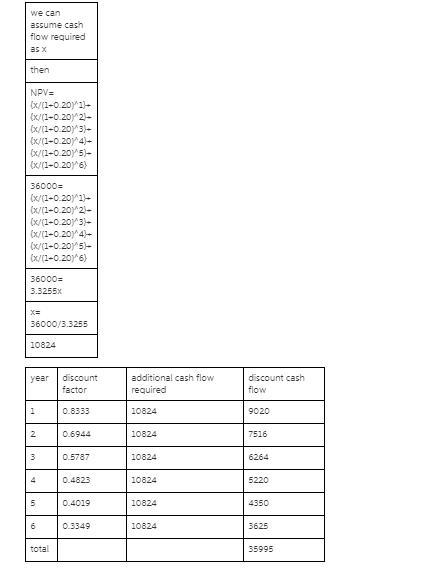
(Ignore income taxes in this problem.) Naomi Corporation has a capital budgeting project that has a negative net present value o
olga2289 [7]

Answer:

$10,824 or more

Explanation:

Please see attachment .

6 0
2 years ago
Minden Company introduced a new product last year for which it is trying to find an optimal selling price. Marketing studies sug
Ivahew [28]

Answer:

1. Net operating loss is $63,300.

2. break even point in unit is 27,710 units while break even point in dollar sales is $2,632,450.

3. Profit is maximum at $180,700 at 50,600 units and selling price of $85 per unit.

4. Break even point in unit is 41,565 units while break even point in dollar sales is $3,533,025.

Explanation:

1. What is the present yearly net operating income or loss?

Total revenue = 25,600 × $95 = $2,432,000  

Total variable expenses =  25,600 × $65 = $1,664,000

Fixed expenses = $831,300

Total expenses = Total variable expenses + Fixed expenses

                          = $1,664,000 + $831,300

Total expenses = $2,495,300

Net operating loss = Total revenue -  Total expenses

                               = $2,432,000  - $2,495,300

Net operating loss = - $63,300

Therefore, net operating loss is $63,300.

2. What is the present break-even point in unit sales and in dollar sales?

Break even point in unit = Fixed costs ÷ (Unit selling price - Unit variable cost)

Note that (Unit price - Unit variable cost) refers to contribution per unit. Therefore, we have:

Break even point in unit = $831,300 ÷ ($95 - $65)  = 27,710 units

Break even point in dollar = Break even point in unit × Unit selling price

Break even point in dollar = 27,710 × $95 = $2,632,450.

Therefore, break even point in unit is 27,710 units while break even point in dollar sales is $2,632,450.

3. Assuming that the marketing studies are correct, what is the maximum annual profit that the company can earn? At how many units and at what selling price per unit would the company generate this profit?

Units = 25,600 + (5,000 × n)

Where n denotes number of years.        

Tota revenue = Units × [$95 - (n × $2)]

Total cost = (Units × $65) + $831,300

When n = 3,

Units = 25,600 + (5,000 × 3) = 40,600 units

Total revenue = 40,600 × [$95 - (3 × $2)] = $3,613,400  

Total cost = (40,600 × $65) + $831,300 = $3,470,300

Net profit =  $3,470,300  - $3,470,300 =$143,100

When n = 4,

Units = 25,600 + (5,000 × 4) = 45,600 units

Total revenue = 45,600 × [$95 - (4 × $2)] = $3,967,200  

Total cost = (45,600 × $65) + $831,300 = $3,795,300

Net profit =  $3,967,200  - $3,795,300 =$171,900

When n = 5,

Units = 25,600 + (5,000 × 5) = 50,600 units

Total revenue = 50,600 × [$95 - (5 × $2)] = $4,301,000  

Total cost = (50,600 × $65) + $831,300 = $4,120,300

Net profit =  $4,301,000  - $4,120,300 =$180,700

When n = 6,

Units = 25,600 + (5,000 × 6) = 55,600 units

Total revenue = 55,600 × [$95 - (6 × $2)] = $4,614,800  

Total cost = (55,600 × $65) + $831,300 = $4,445,300

Net profit =  $4,301,000  - $4,120,300 =$169,500

Therefore, profit is maximum at $180,700 at 50,600 units and selling price of $85 per unit.

4. What would be the break-even point in unit sales and in dollar sales using the selling price you determined in (3) above (e.g., the selling price at the level of maximum profits)?

Break even point in unit = $831,300 ÷ ($85 - $65)  = 41,565 units

Break even point in dollar sales = 41,565 × $85 = $3,533,025.

Therefore, break even point in unit is 41,565 units while break even point in dollar sales is $3,533,025.


3 0
2 years ago
Travis Industries plans to issue perpetual preferred stock with an $11.00 dividend. The stock is currently selling for $108.00,
Ulleksa [173]

Answer:

The cost of the preferred stock, including flotation is 11.31%

Explanation:

In order to calculate the cost of the preferred stock, including flotation we would have to use the following formula:

cost of the preferred stock= <u>Annual Dividend</u>

                                                Price×(1-Flotation Cost)

cost of the preferred stock=<u>     $11        </u>

                                              $108×(1-10%)

cost of the preferred stock=<u>    $11         </u>

                                               $97.20

cost of the preferred stock=11.31%

The cost of the preferred stock, including flotation is 11.31%

8 0
2 years ago
Other questions:
  • Special consideration should be paid to your tutor’s___________when selecting a tutor.
    8·2 answers
  • Jacob lost his wallet but did not report his credit card lost until 3 days later. When he checked his balance, he saw 5 unauthor
    13·2 answers
  • Suzanne, a single taxpayer, operates a printing business as a sole proprietor. The business has two employees who are paid a tot
    5·1 answer
  • Josefina is the only seller of sopapillas in town. Last week, she sold 200 sopapillas, and the marginal revenue of the 200th sop
    6·1 answer
  • Discuss the effects that an impending labor shortage might have on the following three sub-functions of human resource managemen
    9·1 answer
  • When banks try to make their positioning strategies tangible through the ________ dimension, they make sure the exterior and int
    5·1 answer
  • Caitlin, Chris, and Molly are partners and share income and losses in a 3:4:3 ratio. The partnership’s capital balances are Cait
    14·1 answer
  • Amortization Expense For each of the following unrelated situations, calculate the annual amortization expense and prepare a jou
    8·1 answer
  • Easy question.........
    9·2 answers
  • This problem Set is based on materials covered in modules 1 and 2. It is designed for you to demonstrate your understanding of b
    12·1 answer
Add answer
Login
Not registered? Fast signup
Signup
Login Signup
Ask question!