answer.
Ask question
Login Signup
Ask question
All categories
  • English
  • Mathematics
  • Social Studies
  • Business
  • History
  • Health
  • Geography
  • Biology
  • Physics
  • Chemistry
  • Computers and Technology
  • Arts
  • World Languages
  • Spanish
  • French
  • German
  • Advanced Placement (AP)
  • SAT
  • Medicine
  • Law
  • Engineering
const2013 [10]
2 years ago
3

Draw the reactants for the best way to prepare ch3och(ch3)2 by an sn2 reaction.

Chemistry
1 answer:
V125BC [204]2 years ago
6 0

Here we have to get the reactant to produce CH₃C(OH)(CH₃)₂ via SN₂ reaction pathway.

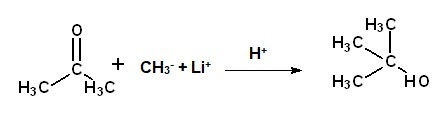
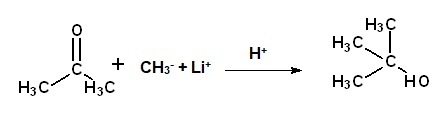
The compound CH₃C(OH)(CH₃)₂ can be prepared from the reaction between acetone [(CH₃)₂CO] and methyl lithium (CH₃Li) in acidic medium the reaction is shown in the figure.

The SN₂ reactions are those in which the reaction happened in a single step i.e. neucleophilic attack and product formation. Here the necluophile is methyl ion (CH₃⁻) which readily attacks the -C=O carbon atom and produces the compound.

You might be interested in
Assuming ideal solution behavior, what is the freezing point of a solution of 9.04 g of I2 in 75.5 g of benzene?
cluponka [151]

Answer:

3.1°C

Explanation:

Using freezing point depression expression:

ΔT = Kf×m×i

<em>Where ΔT is change in freezing point, Kf is freezing point depression constant (5.12°c×m⁻¹), m is molality of the solution and i is Van't Hoff factor constant (1 For I₂ because doesn't dissociate in benzene).</em>

Molality of 9.04g I₂ (Molar mass: 253.8g/mol) in 75.5g of benzene (0.0755kg) is:

9.04g ₓ (1mol / 253.8g) = 0.0356mol I₂ / 0.0755kg = 0.472m

Replacing in freezing point depression formula:

ΔT = 5.12°cm⁻¹×0.472m×1

ΔT = 2.4°C

As freezing point of benzene is 5.5°C, the new freezing point of the solution is:

5.5°C - 2.4°C =

<h3>3.1°C</h3>

<em />

3 0
2 years ago
For the Bradford assay, the instructor will make a Bradford reagent dye by mixing 50 ml of 95% v/v ethanol with 100 mg of Coomas
jolli1 [7]

Answer:

4,25% v/v H3PO4

Explanation:

The concentration of phosphoric acid (H3PO4) is expressed as a volume / volume percentage, which means:

%v/v H3PO4 = (mL of pure H3PO4/mL of solution)*100%

In other words, <u>we are only interested in the final volume of the solution to which the phosphoric acid was diluted, regardless of its composition</u>. Which in this case is 1 L (1000 mL).

We can then apply the following equation, commonly used to calculate the initial or final concentration (or volume) of a substance when it is diluted:

Ci*Vi=Cf*Vf

<u>Where</u>:

Ci, is the initial concentration of the substance.

Vi, the initial volume of the substance

Cf, the final concentration reached after dilution

Vf, the final volume of the solution at which the substance was diluted

In this case, the incognite would be the final concentration of H3PO4 reached after dilution, that is, Cf. Therefore, we proceed to clear Cf from the previous equation and replace our data:

Cf = (Ci*Vi)/Vf = (85% v/v * 50 mL)/1000 mL = 4,25 % v/v

Note that being up and down in the division, the mL unit is canceled to result in% v / v.
7 0
2 years ago
1) How many aluminum atoms are there in 3.50 grams of Al2O3?
drek231 [11]

Answer:

Aluminium atoms =  4.13 *10^22 aluminium atoms

The correct answer is E

Explanation:

Step 1: Data given

Mass of Al2O3 = 3.50 grams

Molar mass of Al2O3 = 101.96 g/mol

Number of Avogadro = 6.022 * 10^23 /mol

Step 2: Calculate moles Al2O3

Moles Al2O3 = mass Al2O3 / molar mass Al2O3

Moles Al2O3 = 3.50 grams / 101.96 g/mol

Moles Al2O3 = 0.0343 moles

Step 3: Calculate moles Aluminium

In 1 mol Al2O3 we have 2 moles Al

in 0.0343 moles Al2O3 we have 2*0.0343 = 0.0686 moles Al

Step 4: Calculate aluminium atoms

Aluminium atoms =  moles aluminium * Number of Avogadro

Aluminium atoms =  0.0686 * 6.022 * 10^23

Aluminium atoms =  4.13 *10^22 aluminium atoms

The correct answer is E

3 0
2 years ago
Complete ionic equation K2CO3(aq)+2CuF(aq) → Cu2CO3(s)+2KF(aq) Examine each of the chemical species involved to determine the io
Fudgin [204]

Answer:

2K+(aq) + CO3²¯(aq) + Ca^2+(aq) + 2F¯(aq) —› Cu2CO3(s) + 2K+(aq) + 2F¯(aq)

Explanation:

K2CO3(aq) + 2CuF(aq) → Cu2CO3(s) + 2KF(aq)

The complete ionic equation for the above equation can be written as follow:

In solution, K2CO3 and CuF will dissociate as follow:

K2CO3(aq) —› 2K+(aq) + CO3²¯(aq)

CuF(aq) —› Ca^2+(aq) + 2F¯(aq)

Thus, we can write the complete ionic equation for the reaction as shown below:

K2CO3(aq) + 2CuF(aq) —›

2K+(aq) + CO3²¯(aq) + Ca^2+(aq) + 2F¯(aq) —› Cu2CO3(s) + 2K+(aq) + 2F¯(aq)

8 0
2 years ago
How many grams are in 2.5 pound sample
julsineya [31]
About 2,500 grams Ans balkfdoaks; 
5 0
2 years ago
Other questions:
  • What is the function of an arrow ( -7) and a plus sign ( ) in a chemical equation?
    12·1 answer
  • Which of these is the lowest subgroup? kingdom, order, genus, or species.
    15·2 answers
  • An article about half-lives describes a daughter isotope. What is a daughter isotope?
    10·1 answer
  • Determine the number of bonding electrons and the number of nonbonding electrons in the structure of cs2.
    14·2 answers
  • Given the equation: ch4 + br2 → ch3br + hbr which type of reaction does this equation represent
    11·2 answers
  • Industrial production of nitric acid, which is used in many products including fertilizers and explosives, approaches 10 billion
    9·1 answer
  • A mixture contains cobalt metal, copper metal, and tin metal. This mixture is mixed with nickel nitrate. Which metals, if any, w
    9·1 answer
  • The infrared spectrum above represents the absorption of certain wavelengths of radiation by molecules of CO2. Which of the foll
    9·1 answer
  • A titration is performed to determine the amount of sulfuric acid, H2SO4, in a 6.5 mL sample taken from car battery. About 50 mL
    10·1 answer
  • A chef takes four pans from different parts of her kitchen and puts them in two stacks. The diagram above shows the pans before
    12·2 answers
Add answer
Login
Not registered? Fast signup
Signup
Login Signup
Ask question!