The electrolysis of molten potassium bromide produces K metal at the cathode and Br gas at the anode
<h3>
Further explanation</h3>
Electrolysis utilizes electrical energy to carry out non-spontaneous redox reactions. The ions in the solution flowed by an electric current will move toward the electrode opposite the charge.
The electrolyzed substance is an electrolyte which can be in the form of a melt or a solution.
In the electrolytic cell the positive pole - the anode is the site of oxidation, whereas the negative pole - the cathode is the site of the reduction.
The results of the reaction at the anode are based on substances around the anode which are easily oxidized while the reaction at the cathode is based on substances that are easily subjected to reduction.
Electrons (electricity) enter the electrolysis cell through the negative pole (cathode)
The negative ions from the solution will move towards the positive electrode, and release electrons around the positive electrode (oxidation occurs) and electrons flow to the negative pole
While around the negative electrode electron binding occurs and a reduction reaction occurs
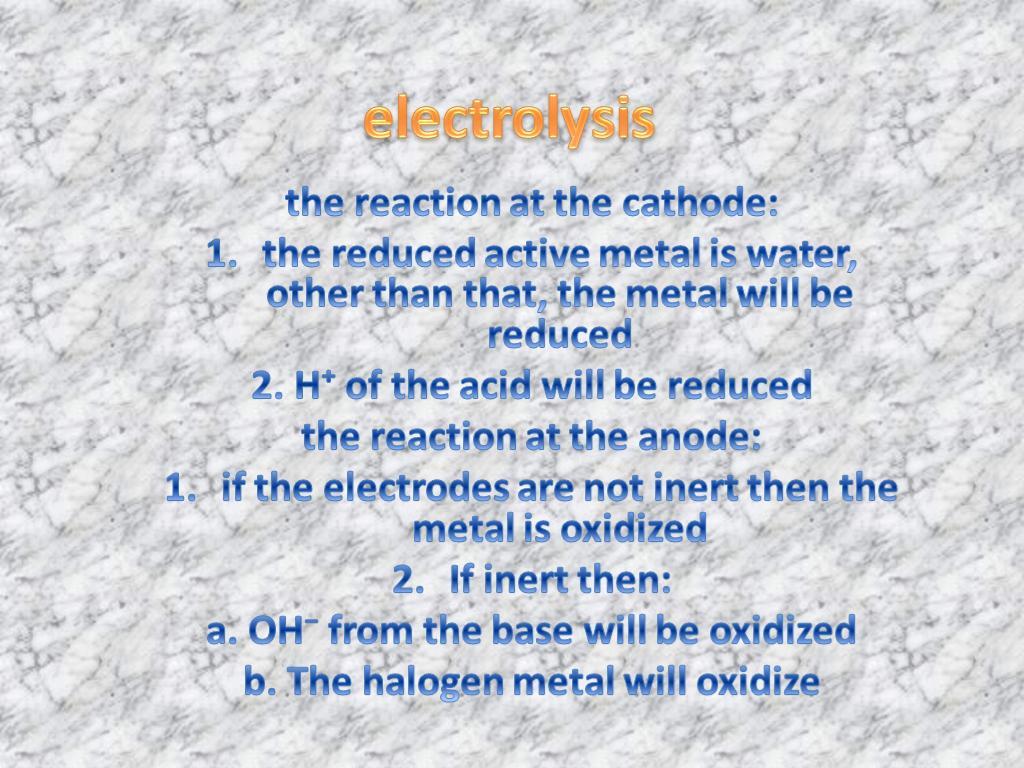
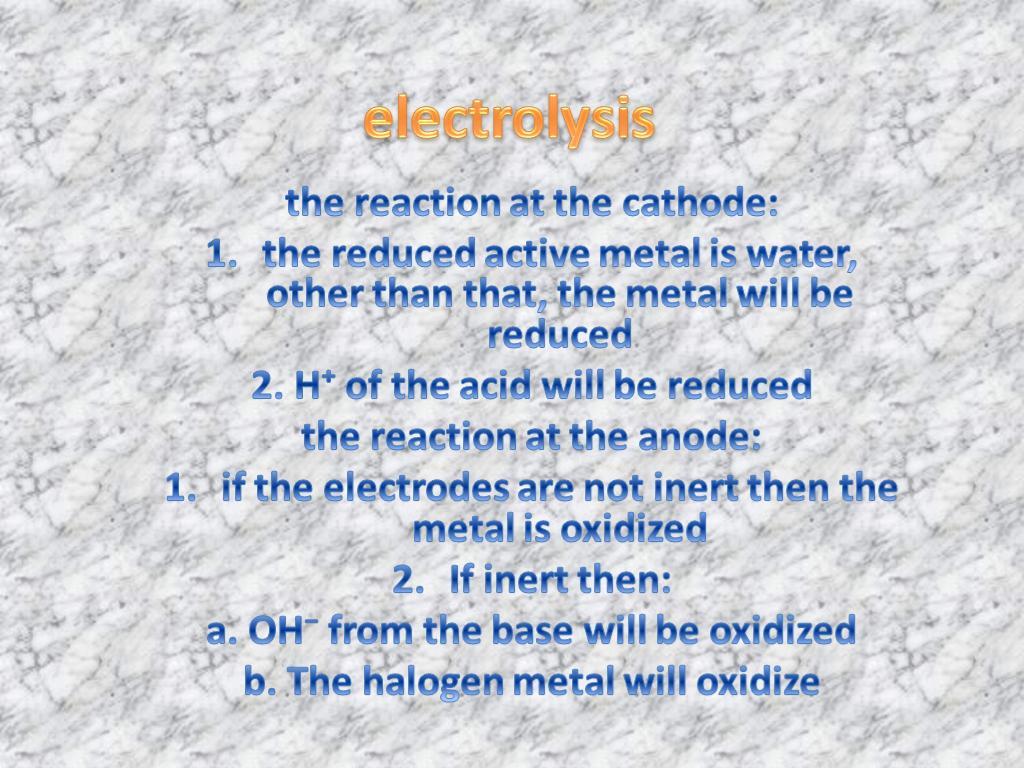
In principle the reaction at the cathode:
- 1. the reduced active metal is water, other than that, the metal will be reduced
- 2. H⁺ of the acid will be reduced
For reactions in anode:
- 1. if the electrodes are not inert then the metal is oxidized
a. OH⁻ from the base will be oxidized
b. The halogen metal will oxidize
In the electrolysis of molten KBr with an inert electrode, the cation will be reduced at the cathode and the anion will be oxidized at the anode
Cathode (-): K⁺ (l) + e⁻ ⇒ K (l) (x 2)
Anode (+): 2Br⁻ (l) ⇒Br₂ (g) + 2e⁻
2K⁺ (l) + 2Br⁻9l) ⇒ 2K (l) + Br₂ (g)
metal K is produced at the cathode and Br gas at the anode
<h3>Learn more</h3>
an electrolytic cell
brainly.com/question/1319774
During electrolysis
brainly.com/question/11868966
the substance is produced at the cathode during the electrolysis
brainly.com/question/6854891
Keywords: the half-reactions, electrolysis, KBr