answer.
Ask question
Login Signup
Ask question
All categories
  • English
  • Mathematics
  • Social Studies
  • Business
  • History
  • Health
  • Geography
  • Biology
  • Physics
  • Chemistry
  • Computers and Technology
  • Arts
  • World Languages
  • Spanish
  • French
  • German
  • Advanced Placement (AP)
  • SAT
  • Medicine
  • Law
  • Engineering
finlep [7]
2 years ago
5

Sample (3.585g) contains 1.388g of C, 0.345g of H, 1.850g of O and its molar mass is 62g. What is the molecular formula of this

substance ? Show your work.

Chemistry
1 answer:
Tanzania [10]2 years ago
6 0

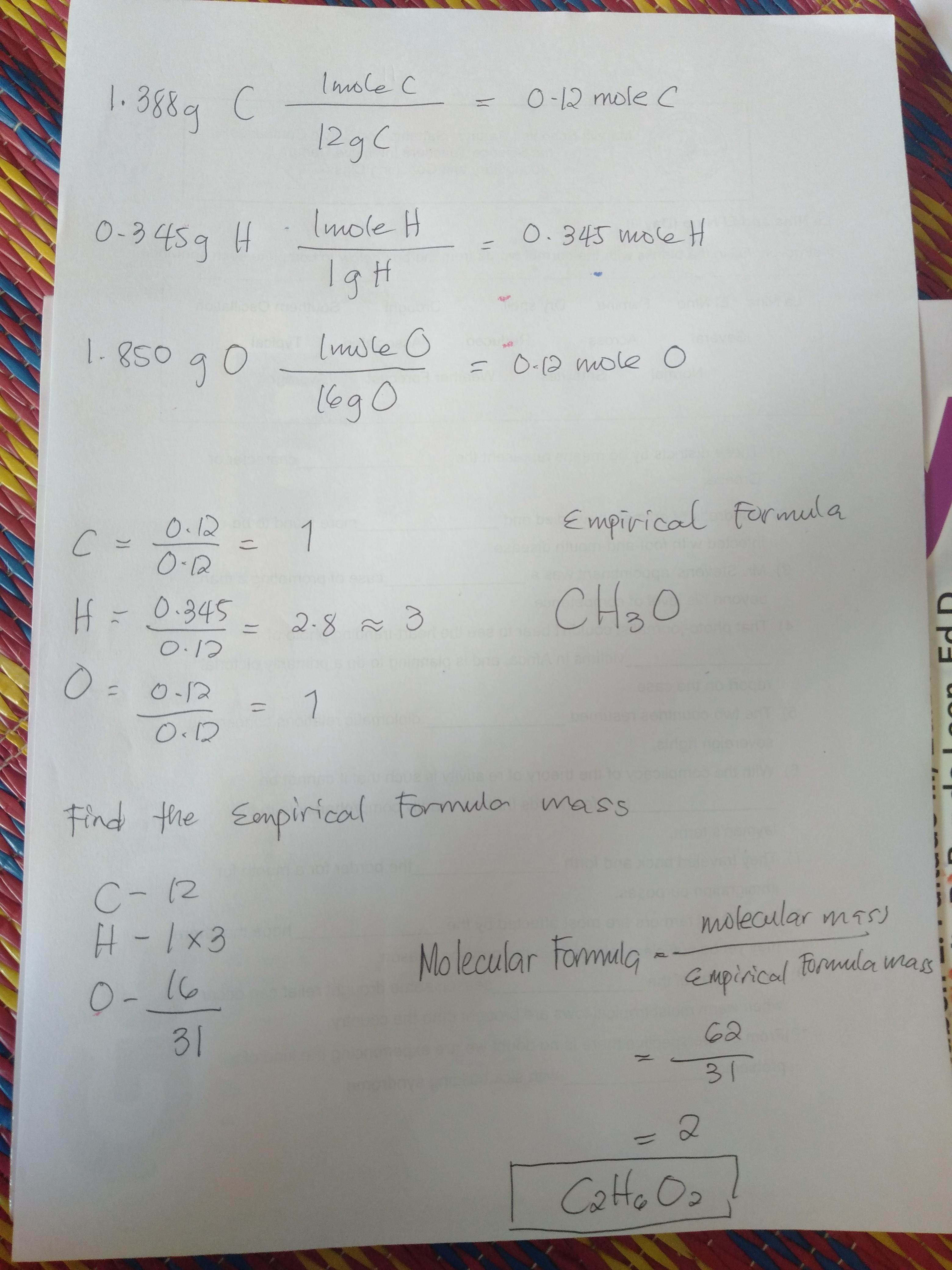
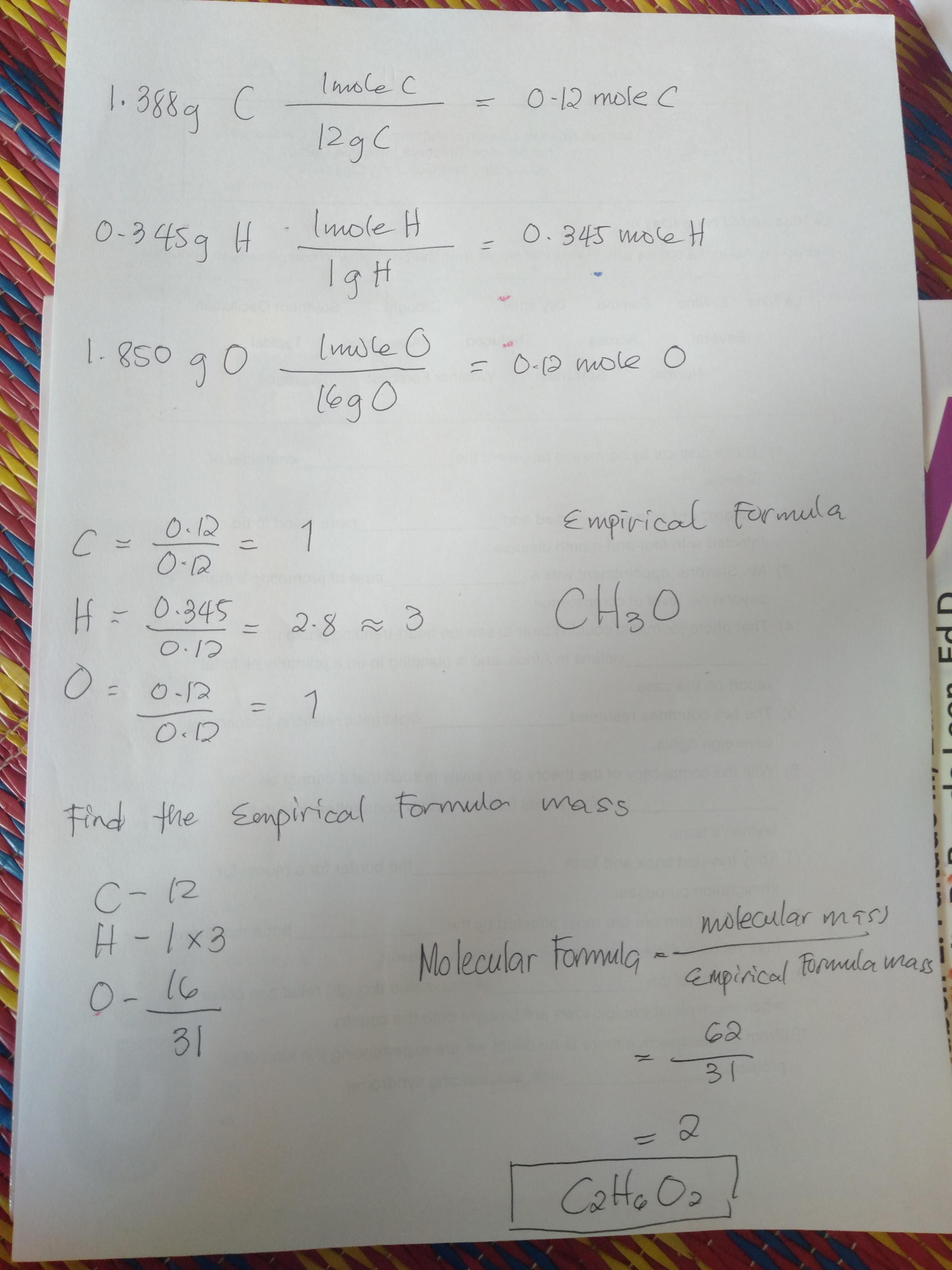
Answer: C2H6O2

Explanation: solution attached:

First convert mass to moles.

Second divide each moles on the lowest amount to find the number of atoms in the empirical formula.

Third calculate the empirical formula mass.

Fourth calculate for the molecular formula by dividing the molar mass over the empirical formula mass.

Fifth multiply the empirical formula by the answer and that is the molecular formula of the compound.

You might be interested in
Two weak acids, A and B, have pKa values of 4 and 6, respectively. Which statement is true?A) Acid A dissociates to a greater ex
zalisa [80]

Answer:

A) Acid A dissociates to a greater extent in water than acid B

Explanation:

A) Acid A dissociates to a greater extent in water than acid B

We are given the pKa for both acids, and we know

pKa = - log Ka

Taking antilog to both sides of the equation we can solve for Ka

⇒ -pKa = log Ka

-antilog pKa = Ka

10 ^-pka = Ka

So ka for acid A = 10⁻⁴

and

ka for acid B = 10⁻⁶

True the equilibrium constant for acid A is greater, so it dissociates more.

B) For solutions of equal concentration, acid B will have a lower pH.

We know the stronger acid is A, and it dissociates more. Since pH is the negative log of H₃O⁺ concentration, it follows that at equal concentrations the acid A will have at equilibrium a greater [H₃O⁺] and hence a lower pH

C) B is the conjugate base of A

False:

If B were the conjugate base of A, its  Kb would have been given by:

Ka x Kb = Kw

Kb = 10⁻¹⁴/10⁻⁶ = 10⁻⁸ for the conjugate base of acid B

Kb = 10⁻¹⁴/10⁻⁴ = 10⁻¹⁰ for the conjugate base of acid A

which are not equal.

D) Acid A is more likely to be a polyprotic acid than acid B.

False

Just having the pkas for both acids one cannot know if any of the acids is polyprotic. We will need the formula for the acids.

E) The equivalence point of acid A is higher than that of acid B

False

The equivalence point depends on the the concentration of the acids  and their volumes.

The equivalence point is reached in the titration when the number of equivalents of base equals the number of equivalents of acid:

# equivalents acid = # equivalents of base  @ end point

and

# equivalents acid = Molarity of acid x Volume of acid
4 0
2 years ago
How many grams of sulfur must be burned to give 100.0 g of So2
andriy [413]

Answer:

50 g of S are needed

Explanation:

To star this, we begin from the reaction:

S(s) + O₂ (g) →  SO₂ (g)

If we burn 1 mol of sulfur with 1 mol of oxygen, we can produce 1 mol of sulfur dioxide. In conclussion, ratio is 1:1.

According to stoichiometry, we can determine the moles of sulfur dioxide produced.

100 g. 1mol / 64.06g = 1.56 moles

This 1.56 moles were orginated by the same amount of S, according to stoichiometry.

Let's convert the moles to mass

1.56 mol . 32.06g / mol = 50 g

4 0
2 years ago
What name is used to describe the H-N-H group?
mamaluj [8]

Answer:

an amine group

Explanation:

Hope that helped :)

5 0
2 years ago
A bottle of concentrated aqueous sulfuric acid, labeled 98.0 wt% h2so4, has a concentration of 18.0 m. (a) how many milliliters
nadya68 [22]
<span>n this order, Ď=1.8gmL, cm=0.5, and mole fraction = 0.9 First, let's start with wt%, which is the symbol for weight percent. 98wt% means that for every 100g of solution, 98g represent sulphuric acid, H2SO4. We know that 1dm3=1L, so H2SO4's molarity is C=nV=18.0moles1.0L=18M In order to determine sulphuric acid solution's density, we need to find its mass; H2SO4's molar mass is 98.0gmol, so 18.0moles1Lâ‹…98.0g1mole=1764g1L Since we've determined that we have 1764g of H2SO4 in 1L, we'll use the wt% to determine the mass of the solution 98.0wt%=98g.H2SO4100.0g.solution=1764gmasssolution→ masssolution=1764gâ‹…100.0g98g=1800g Therefore, 1L of 98wt% H2SO4 solution will have a density of Ď=mV=1800g1.0â‹…103mL=1.8gmL H2SO4's molality, which is defined as the number of moles of solute divided by the mass in kg of the solvent; assuming the solvent is water, this will turn out to be cm=nH2SO4masssolvent=18moles(1800â’1764)â‹…10â’3kg=0.5m Since mole fraction is defined as the number of moles of one substance divided by the total number of moles in the solution, and knowing the water's molar mass is 18gmol, we could determine that 100g.solutionâ‹…98g100gâ‹…1mole98g=1 mole H2SO4 100g.solutionâ‹…(100â’98)g100gâ‹…1mole18g=0.11 moles H2O So, H2SO4's mole fraction is molefractionH2SO4=11+0.11=0.9</span>
5 0
2 years ago
A 0.286-g sample of gas occupies 125 ml at 60. cm of hg and 25°
irga5000 [103]
Using the Equation: PV=nRT
Where P is the pressure 60 cmHg or 600 mmHg or 600/760= 0.789 atm
V is the volume 125 ml or 0.125 L, n is the number of moles, R is a constant 0.082057, and T is temperature 25 °C or 298 K; 
Therefore:
0.789 × 0.125 = n × 0.082057 × 298
 n = 0.0987/24.45 
    = 0.004036 mol
0.004036 mole has a mass of  0.286 g
Hence; 1 mole has a mass of 0.286/0.004036 
  = 70.8 g /mol
Therefore the molar mass of the gas is 71 g/mol (2 sfg)


4 0
2 years ago
Other questions:
  • if the solubility of a gas is 7.5 g/L at 404 pressure, what is the solubility of the gas when the pressure is 202 kPa?
    9·2 answers
  • Rank the size of a change in temperature of one degree Fahrenheit, one degree Celsius, and one kelvin. In other words, if a ther
    6·1 answer
  • Both black and white road surfaces absorb sunlight. the warmer road surface at the end of a sunny day is the
    12·1 answer
  • How many free ions are there on the products side of the total ionic equations that results from the reaction between bismuth 3
    10·1 answer
  • What are the coefficients to balance the following equation?<br><br> ba+br2=babr2
    8·2 answers
  • How will increasing the pressure on the system affect this equilibrium reaction? 2H2(g)+O2(g) -&gt; 2H2O(g)
    6·1 answer
  • The enthalpy change for the explosion of ammonium nitrate with fuel oil is –7198 kJ for every 3 moles of NH4NO3. What is the ent
    13·1 answer
  • Calculate the amount of heat released to convert 150.0 g of to water to ice at 0ºC.
    10·2 answers
  • A chemist forms 16.6 g of potassium iodide by combining 3.9 g of potassium with 12.7 g of iodine. Show that these results are co
    10·1 answer
  • When you are finished with the experiment, complete the following data analysis and record your answers in the Essay box
    7·1 answer
Add answer
Login
Not registered? Fast signup
Signup
Login Signup
Ask question!