answer.
Ask question
Login Signup
Ask question
All categories
  • English
  • Mathematics
  • Social Studies
  • Business
  • History
  • Health
  • Geography
  • Biology
  • Physics
  • Chemistry
  • Computers and Technology
  • Arts
  • World Languages
  • Spanish
  • French
  • German
  • Advanced Placement (AP)
  • SAT
  • Medicine
  • Law
  • Engineering
katen-ka-za [31]
2 years ago
10

The molar mass of two equally sized samples of unknown gaseous compounds is shown in the table.

Chemistry
1 answer:
SpyIntel [72]2 years ago
8 0

Answer:

D.) Gas X has a lower density and effuses faster than Gas Y.

Explanation:

  • Since gas X has a molar mass lower than that of Y, and the density of the gas is directly proportional to its molar mass.

So, it is has a lower density of Y.

<em>Thomas Graham</em> found that, at a constant  temperature and pressure the rates of effusion  of various gases <em>(∨)</em> are inversely proportional to  the square root of their molar masses <em>(M)</em>.

So, the gas with lower molar mass will effuse faster than gas of higher molar mass.

∴ Gas X effuses faster than Gas Y.

  • So, the right choice is:

<em>D.) Gas X has a lower density and effuses faster than Gas Y.</em>

<em />

You might be interested in
A mysterious white powder could be powdered sugar (C12H22O11), cocaine (C17H21NO4), codeine (C18H21NO3), norfenefrine (C8H11NO2)
rodikova [14]

Norfenefrine (C₈H₁₁NO₂).

<h3>Further explanation</h3>

We will solve a case related to one of the colligative properties, namely freezing point depression.

The freezing point of the solution is the temperature at which the solution begins to freeze. The difference between the freezing point of the solvent and the freezing point of the solution is called freezing point depression.

\boxed{ \ \Delta T_f = T_f(solvent) - T_f(solution) \ } \rightarrow \boxed{ \ \Delta T_f = K_f \times molality \ }

<u>Given:</u>

A mysterious white powder could be,

  • powdered sugar (C₁₂H₂₂O₁₁) with a molar mass of 342.30 g/moles,
  • cocaine (C₁₇H₂₁NO₄) with a molar mass of 303.35 g/moles,
  • codeine (C₁₈H₂₁NO₃) with a molar mass of 299.36 g/moles,
  • norfenefrine (C₈H₁₁NO₂) with a molar mass of 153.18 g/moles, or
  • fructose (C₆H₁₂O₆) with a molar mass of 180.16 g/moles.

When 82 mg of the powder is dissolved in 1.50 mL of ethanol (density = 0.789 g/cm³, normal freezing point −114.6°C, Kf = 1.99°C/m), the freezing point is lowered to −115.5°C.

<u>Question: </u>What is the identity of the white powder?

<u>The Process:</u>

Let us identify the solute, the solvent, initial, and final temperatures.

  • The solute = the powder
  • The solvent = ethanol
  • The freezing point of the solvent = −114.6°C
  • The freezing point of the solution = −115.5°C

Prepare masses of solutes and solvents.

  • Mass of solute = 82 mg = 0.082 g
  • Mass of solvent = density x volume, i.e., \boxed{ \ 0.789 \ \frac{g}{cm^3} \times 1.50 \ cm^3 = 1.1835 \ g = 0.00118 \ kg  \ }

We must prepare the solvent mass unit in kg because the unit of molality is the mole of the solute divided by the mass of the solvent in kg.

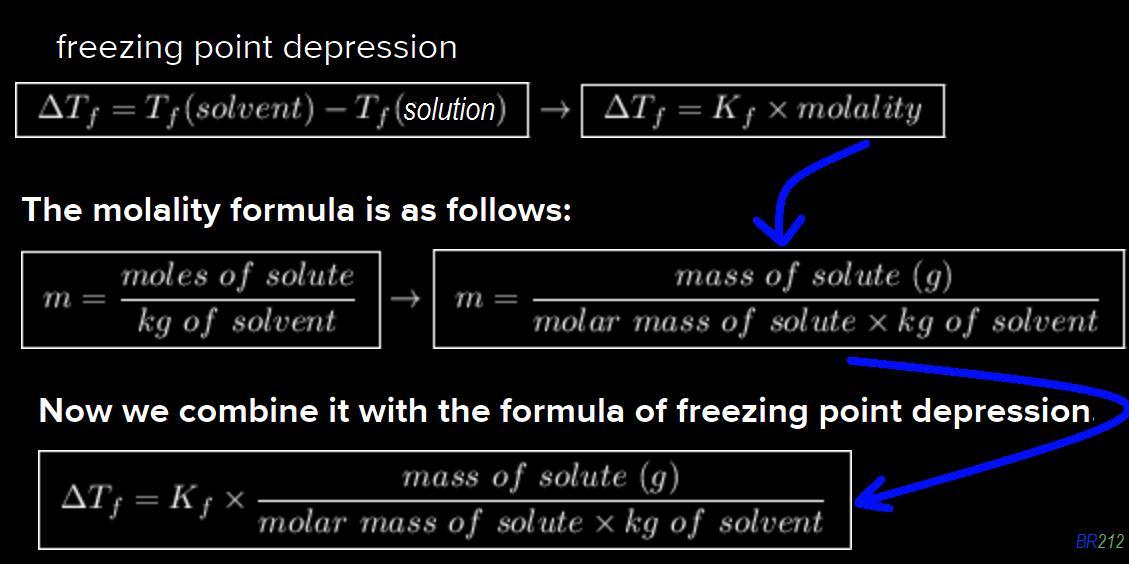
The molality formula is as follows:

\boxed{ \ m = \frac{moles \ of \ solute}{kg \ of \ solvent} \ } \rightarrow \boxed{ \ m = \frac{mass \ of \ solute \ (g)}{molar \ mass \ of \ solute \times kg \ of \ solvent} \ }

Now we combine it with the formula of freezing point depression.

\boxed{ \ \Delta T_f =  K_f \times \frac{mass \ of \ solute \ (g)}{molar \ mass \ of \ solute \times kg \ of \ solvent} \ }

It is clear that we will determine the molar mass of the solute (denoted by Mr).

We enter all data into the formula.

\boxed{ \ -114.6^0C - (-115.5^0C) = 1.99 \frac{^0C}{m} \times \frac{0.082 \ g}{Mr \times 0.00118 \ kg} \ }

\boxed{ \ 0.9 = \frac{1.99 \times 0.082}{Mr \times 0.00118} \ }

\boxed{ \ Mr = \frac{0.16318}{0.9 \times 0.00118} \ }

We get \boxed{ \ Mr = 153.65 \ }

These results are very close to the molar mass of norfenefrine which is 153.18 g/mol. Thus the white powder is norfenefrine.

<h3>Learn more</h3>
  1. The molality and mole fraction of water brainly.com/question/10861444
  2. About the mass and density of ethylene glycol as an  antifreeze brainly.com/question/4053884
  3. About the solution as a homogeneous mixture  brainly.com/question/637791

Keywords: a mysterious white powder, sugar, cocaine, codeine, norfenefrine, fructose, the solute, the solvent, dissolved, ethanol, normal freezing point, the freezing point depression, the identity


7 0
2 years ago
Read 2 more answers
Calculate the freezing point of a 0.08500 m aqueous solution of nano3. the molal freezing-point-depression constant of water is
Citrus2011 [14]
Depression in freezing point (ΔT_{f}) = K_{f}×m×i,
where, K_{f} = cryoscopic constant = 1.86^{0} C/m,
m= molality of solution = 0.0085 m
i = van't Hoff factor = 2 (For NaNO_{3})

Thus, (ΔT_{f}) = 1.86 X 0.0085 X 2 = 0.03162^{0}C

Now, (ΔT_{f}) = T^{0} - T
Here, T = freezing point of solution
T^{0} = freezing point of solvent = 0^{0}C
Thus, T = T^{0} - (ΔT_{f}) = -0.03162^{0}C
8 0
2 years ago
Read 2 more answers
Which statement is TRUE regarding the macroscopic and
damaskus [11]

Answer:

Chemists make observations on the macroscopic a scale that lead to conclusions about microscopic features

Explanation:

Many important chemical observations are made on the macroscopic scale. This is because, many of the scientific equipments available are not presently able to provide direct evidence about microscopic processes. Evidences obtained from macroscopic observations could serve as important insights into the nature of certain microscopic processes.

This is evident in the study of the structure of the atom. Most of the evidences that led to the deduction of the atomic structure were obtained from macroscopic evidence but ultimately provided important information about the microscopic structure of the atom.

7 0
2 years ago
The activation energy for the reaction no2(g)+co(g)⟶no(g)+co2(g) is ea = 75 kj/mol and the change in enthalpy for the reaction i
Nonamiya [84]
Answer: 350 kj/mol


Explanation:

As shown below this expression gives the activation energy of the reverse reaction:

EA reverse reaction = EA forward reaction + | enthalpy change |

1) The activation energy, EA is the difference between the potential energies of the reactants and the transition state:

EA = energy of the transition state - energy of the reactants.

2) The activation energy of the forward reaction given is:

EA = energy of the transition state - energy of  [ NO2(g) + CO(g) ] = 75 kj/mol

3) The negative enthalpy change - 275 kj / mol for the forward reaction means that the products are below in the potential energy diagram, and that the potential energy of the products, [NO(g) + CO2(g) ] is equal to 75 kj / mol - 275 kj / mol = - 200 kj/mol

4) For the reverse reaction the reactants are [NO(g) + CO2(g)], and the transition state is the same than that for the forward reaction.

5) The difference of energy between the transition state and the potential energy of [NO(g) + CO2(g) ] will be the absolute value of the change of enthalpy plus the activation energy for the forward reaction:

EA reverse reaction = EA forward reaction + | enthalpy change |

EA reverse reaction = 75 kj / mol + |-275 kj/mol | = 75 kj/mol + 275 kj/mol = 350 kj/mol.

And that is the answer, 350 kj/mol

3 0
2 years ago
If your lungs were filled with air containing this level of lead, how many lead atoms would be in your lungs? (Assume a total lu
kolbaska11 [484]

Answer:

1.505×10^23 atoms of lead

Explanation:

Volume of lead in the lungs = total volume of lungs = 5.60L

1 mole = 22.4L

5.6L of lead = 5.6/22.4 = 0.25 mole

From Avogadro's law

1 mole of lead contains 6.02×10^23 atoms of lead

0.25 mole of lead = 0.25×6.02×10^23 = 1.505×10^23 atoms of lead

6 0
2 years ago
Other questions:
  • A hydrogen atom has a diameter of about 10 nm. Express this diameter in micrometers, meters, and millimeters.
    5·2 answers
  • What mass of lif is contained in 18.66 g of a 20.0% by mass solution of lif in water?
    10·1 answer
  • If you perform the experiment described in investigation #15 by mixing 10 g of glue with 13 g of water and 8 g of sodium borate
    7·1 answer
  • The identity of an element depends on the number of
    10·2 answers
  • A piston containing 0.120moles of methane gas, CH4, has a volume of 2.12liters. If methane is added until the volume is increase
    6·1 answer
  • a) (1 point) Build anthracene, optimize its geometry and examine its structure. Describe its shape. b) (1 point) Measure the C-C
    13·1 answer
  • Can 750 mL of water dissolve 0.60 mol of gold(III) chloride (AuCl3)?
    15·1 answer
  • A 1000.0 ml sample of lake water in titrated using 0.100 ml of a 0.100 M base solution. What is the molarity (M) of the acid in
    13·1 answer
  • A 2.50 g sample of zinc is heated, and then placed in a calorimeter containing 65.0 g of water. Temperature of water increases f
    6·1 answer
  • The reading on a speedometer represents the average velocity of the car. True False
    15·1 answer
Add answer
Login
Not registered? Fast signup
Signup
Login Signup
Ask question!